



For a year, the compensation investors demand to hold STRC has moved almost in lockstep with the price of Bitcoin. The relationship is strong, it is stable, and it is not a coincidence. It reframes what STRC actually is - and where its recovery has to come from.
In plain terms
STRC's spread - the yield it pays over the duration-matched risk-free rate - is the market's read on how much compensation it demands to hold the instrument. Wide spread, wary market; tight spread, comfortable market.
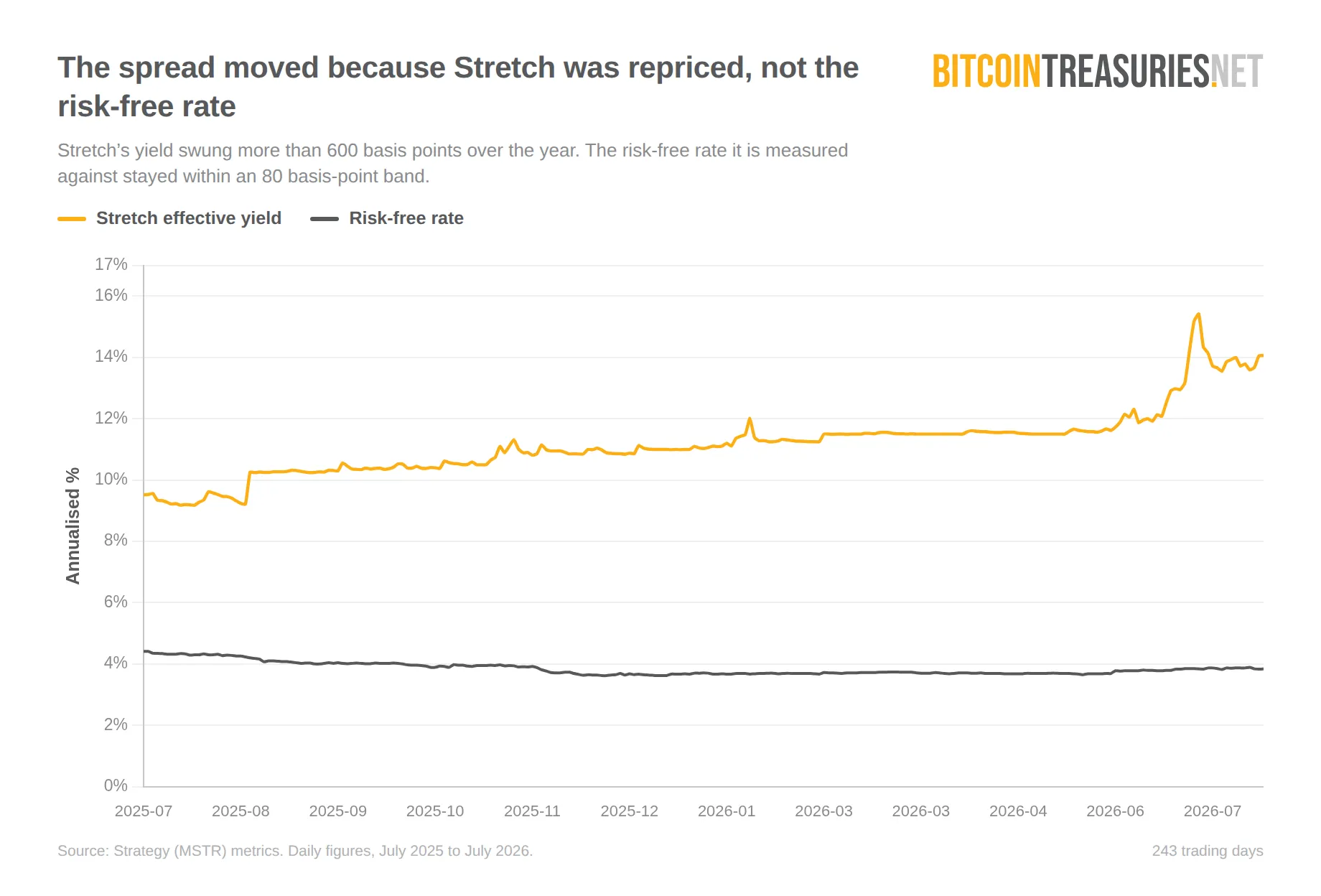
A year of daily data shows that spread is largely a Bitcoin trade. Bitcoin price explains roughly three-quarters of its variation (r ≈ −0.86): Bitcoin down, spread wide; Bitcoin up, spread tight. The remaining quarter is not Bitcoin, and it is where Strategy's own decisions live. And it is STRC being repriced, not the curve - the risk-free rate moved inside an 80 bps band all year while STRC's yield swung more than 600.
The consequence: STRC trades as a coupon-wrapped read on Bitcoin sentiment, not the rate-adjacent stability instrument it was issued as. Spread compression back to its late-2025 tights is gated on Bitcoin, not on anything Strategy announces. The last leg of the price back to par is the separate, weaker channel — a coupon-and-coverage question, not a spot one.
The spread has tracked Bitcoin for a full year
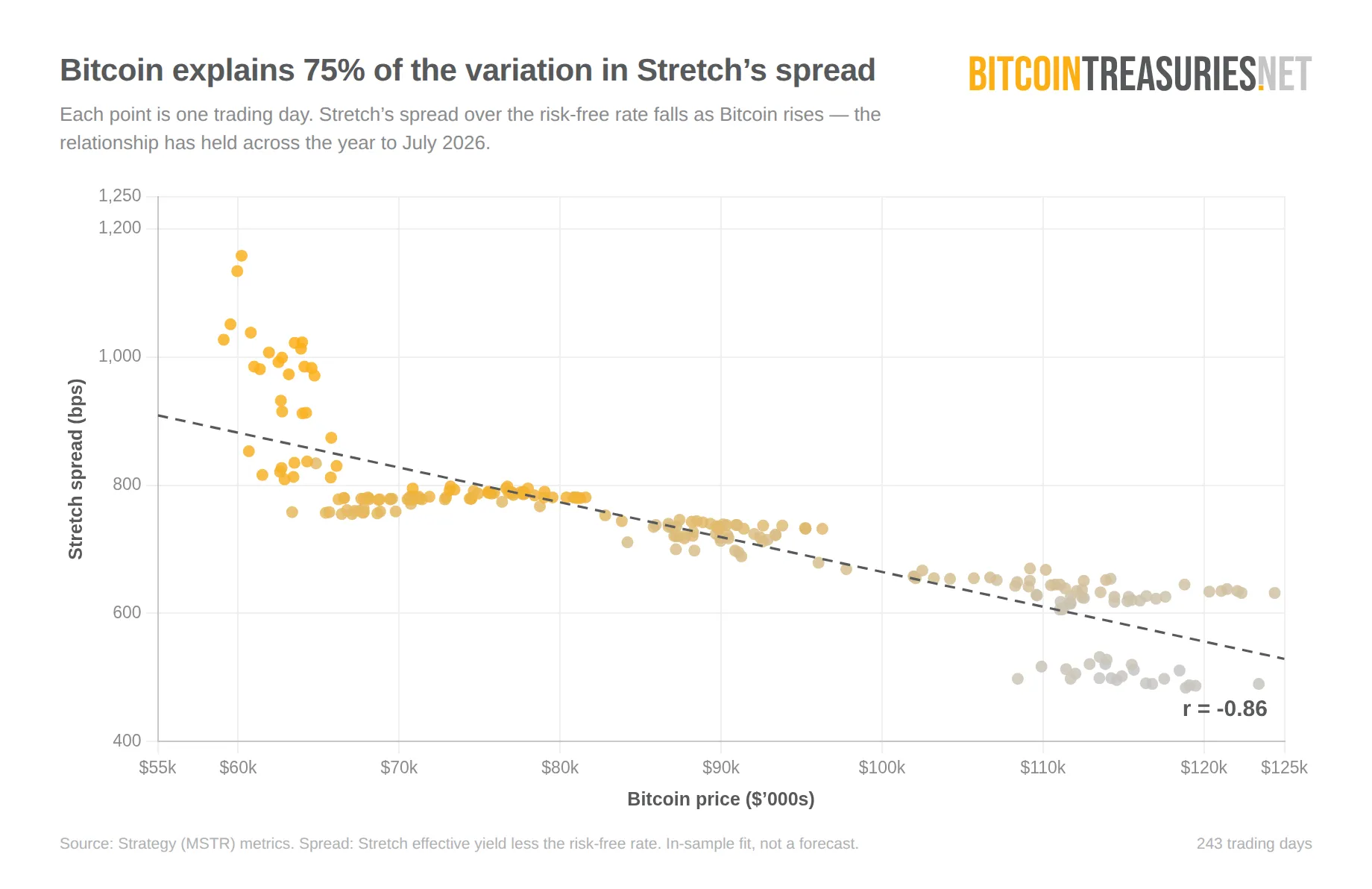
Take the year to 17 July 2026 - Bitcoin from a high above $126,000 down to a June low near $58,000, and back to the low sixties. Across those 243 trading days, the spread STRC pays over the duration-matched risk-free rate has moved against Bitcoin's price with a correlation of −0.86. That is an r-squared of roughly 0.75: about three-quarters of the variation in STRC's spread is accounted for by the price of Bitcoin alone. The figure is calculated on daily closing prices, with the spread taken as STRC's effective yield less the duration-matched Treasury rate, over the 243 trading days to 17 July 2026.
Higher Bitcoin, tighter spread. Lower Bitcoin, wider spread. The fit is strong but not total: a quarter of the spread's variation sits off the Bitcoin line, and that residual matters later. The extremes sit where the fit predicts. When Bitcoin sat above $118,000 last August, the spread compressed to its tightest of the year, around 484 basis points; when Bitcoin bottomed around $60,212 on 26 June, it blew out to its widest, 1,158 basis points. Both are single days on the same regression, illustrating the relationship rather than adding to it.
The compensation is moving, not the coupon
The instinct is to read a widening spread as a funding problem - the coupon climbing to keep the instrument sold. That is not what drove it. STRC's stated dividend rate rose steadily through the year in small steps, from 9 per cent to 11.5 per cent, and then jumped to 12 per cent on 29 June - the most aggressive single adjustment of the year, made in the depths of the drawdown. If the coupon were the lever setting the spread, that move should have pulled it in. It did not: the spread was at its widest, above 1,150 basis points, in the days around the adjustment, and was still above 1,000 basis points weeks later. The mechanism responded; the spread stayed wide because Bitcoin, not the coupon, was setting it.
The wider defence tells the same story. Strategy's dividend coverage - its USD reserve measured against its dividend obligations - had collapsed to barely six months of coverage by late May after the retiring of the 2029 convertible notes. Over June and July the company rebuilt it hard, back above to 22 months as of 20th July, and turned net seller of Bitcoin to do it, booking its first disposals of the year at the lows. Coverage was restored; the coupon was raised; the reserve was topped up. The spread did not compress until Bitcoin did.
Nor did the benchmark move. The risk-free rate STRC is measured against barely travelled: across the whole year the duration-matched rate ranged only about 79 basis points, from roughly 3.62 to 4.41 per cent.
STRC's own effective yield, by contrast, ranged from 9.18 per cent to 15.42 per cent - a swing of more than 600 basis points. Almost all of the spread's movement is coming from STRC's side of the equation, not the Treasury side. The market is not being repriced by the Fed. It is repricing STRC.
And it is repricing STRC in time with Bitcoin. The effective yield and the STRC price are two expressions of the same thing: for a fixed dollar dividend, yield is coupon divided by price, so the −0.97 correlation between them is arithmetic, not an empirical finding - it confirms the identity, nothing more. The mechanism it sits inside is what matters: Bitcoin falls, sentiment toward the whole Strategy structure sours, the market marks STRC down, the price drops, the yield rises by construction, the spread widens. Over the year, Bitcoin has been the dominant pricing factor in that chain - not the only one, but the one that moves it.
What this means: STRC trades as a Bitcoin-sensitivity instrument
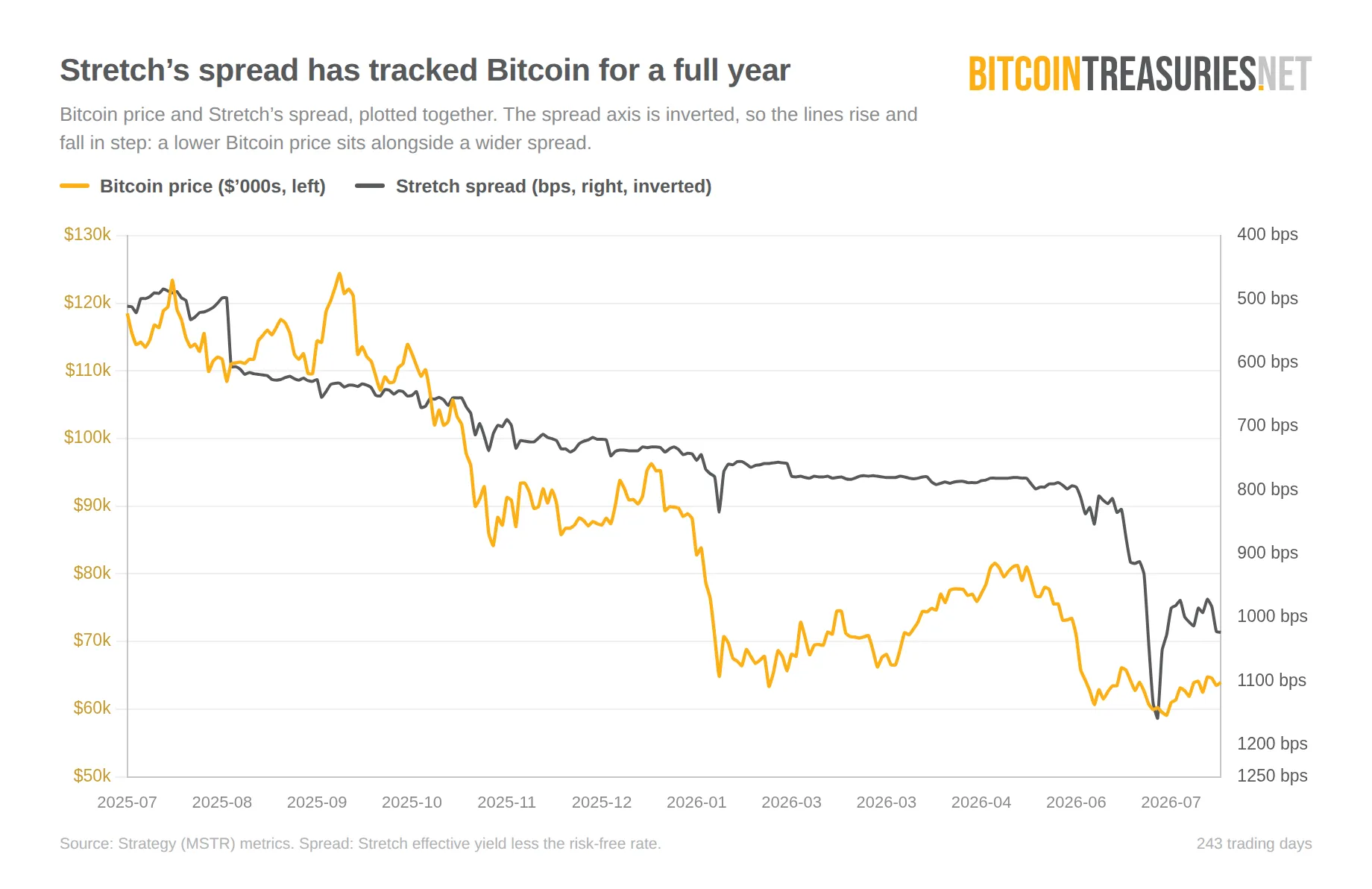
This is the part the market has been slow to name. STRC was issued as the least volatile rung of the Strategy preferred stack - a near-par instrument for investors who wanted the coupon without the equity swing. The year's data says something different. The compensation embedded in STRC is a live read on Bitcoin sentiment. It is not credit-quality noise and it is not rate noise. It is a Bitcoin signal wearing a fixed-income label.
That has two consequences worth stating plainly.
The first is for how STRC should be understood. A spread that is three-quarters explained by Bitcoin is not primarily a function of Strategy's coverage ratios or its dividend obligations in any given month. Those matter at the extremes. But day to day, the instrument is priced off the same sentiment that prices the underlying. An investor buying STRC for its stability is, on this evidence, buying a dampened, coupon-wrapped exposure to Bitcoin.
The second is for the recovery. If the spread is a Bitcoin trade, then spread compression back toward the 700s or below - the levels held through late 2025 - is gated on Bitcoin, not on anything Strategy can announce. The fitted relationship puts Bitcoin at $70,000 against a spread near 828 basis points, and $90,000 against roughly 719 basis points. The spread does not return to its tights without Bitcoin returning toward six figures.
Where the coupon still matters
None of this retires the coupon debate - it relocates it. Bitcoin governs the spread. But the last stretch of the STRC price back toward par is not something a year of data shows Bitcoin delivering on its own: the price-level sensitivity to Bitcoin is far weaker than the spread sensitivity, so whatever moves the price the final distance to $100 is largely not spot.
The candidate is Strategy's dividend coverage - the USD reserve set against the obligations it has to service, not the raw reserve figure, which on its own tracks nothing. And here the channel is no longer purely inferred: coverage moves with the STRC price directly, with a correlation of about +0.47 over the year - better coverage, higher price. That is measurable evidence that Strategy's capacity to service the coupon feeds the price, in a way spot Bitcoin does not. The caveat is that it cannot yet be cleanly separated from the Bitcoin move, since the two ran together all year. Bitcoin demonstrably compresses the spread from the top; coverage is the measurable, if not yet isolated, route by which the price closes from the bottom.
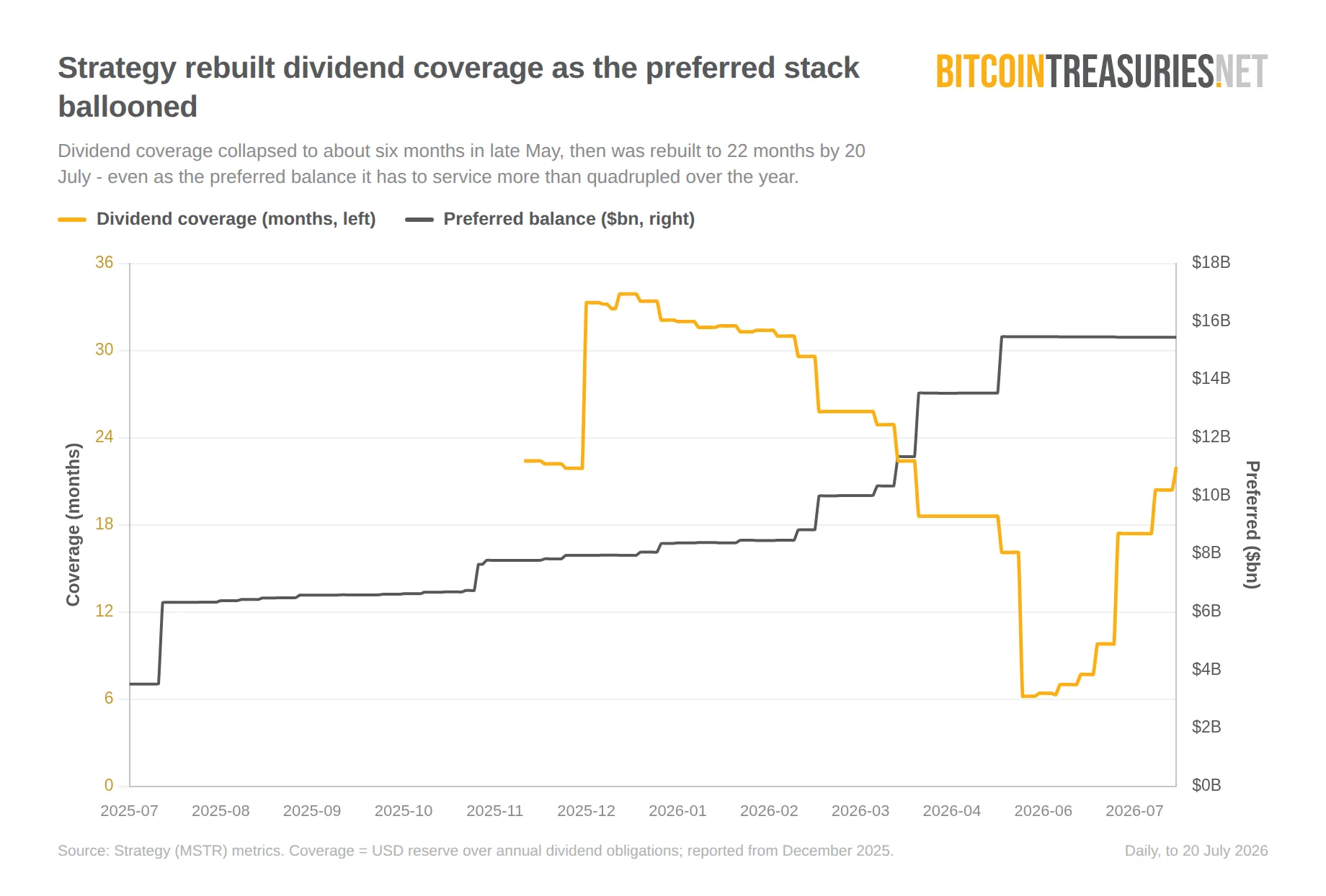
There is a competing explanation that has to be put on the table. Over the year Strategy's preferred balance more than quadrupled, from about $3.5 billion to $15.5 billion, and that balance is the single strongest balance-sheet correlate of the spread - it moves with it more tightly than coverage does. A reasonable reading is that the spread widened not only because Bitcoin fell but because the market was being asked to absorb a rapidly growing stack of preferred supply. The caution is that supply, coverage, mNAV and Bitcoin all moved together through a single drawdown year, so the correlations cannot be separated from one another on this data alone. Preferred issuance is a real pressure on the spread; whether it is an independent one, or simply another face of the same Bitcoin move, is not something a year of collinear series can settle.
The named voices arguing for a rate hike beyond the 12 per cent the coupon has just reached, and for rebuilt coverage, are arguing about the price channel. The year of spread data is a different argument, and it points at Bitcoin. Both can be true at once, because they are not describing the same number.
The close
The tell will be the next Bitcoin move. If Bitcoin climbs back toward $70,000 and the spread compresses toward the low 800s in step, the relationship holds and STRC is confirmed as the sentiment-sensitive instrument the year's data says it is. If Bitcoin rises and the spread does not follow, something has changed in how the market prices the Strategy structure. For now, the compensation on STRC is the clearest fixed-income read on Bitcoin sentiment in the market, and it moves when Bitcoin moves.
Want more bitcoin treasury coverage in your search results? Add Bitcoin Treasuries as a preferred source on Google.