
Strategy Raises STRC Dividend to 12%, And Launches $2B Buyback Programs



Strategy will pay 12.00% on STRC from 1 July - but the rate rise arrives bolted to a $2.55bn USD Reserve floor, two $1bn buyback programmes, and a formal BTC monetisation mandate, and the company now says it will no longer lift the coupon simply because the stock trades below par.
The rate rise is real, but it is no longer the main lever
On 29 June, Strategy set the regular dividend rate on its Variable Rate Series A Perpetual Stretch Preferred Stock at 12.00%, effective for semi-monthly periods with record dates on or after 1 July. The move follows four consecutive months at 11.50%, a streak that ran from March through the 1 June decision and held even as the stock slid through the back half of June. The instrument is eleven months old. It has carried seven rate increases since its July 2025 launch at 9%.
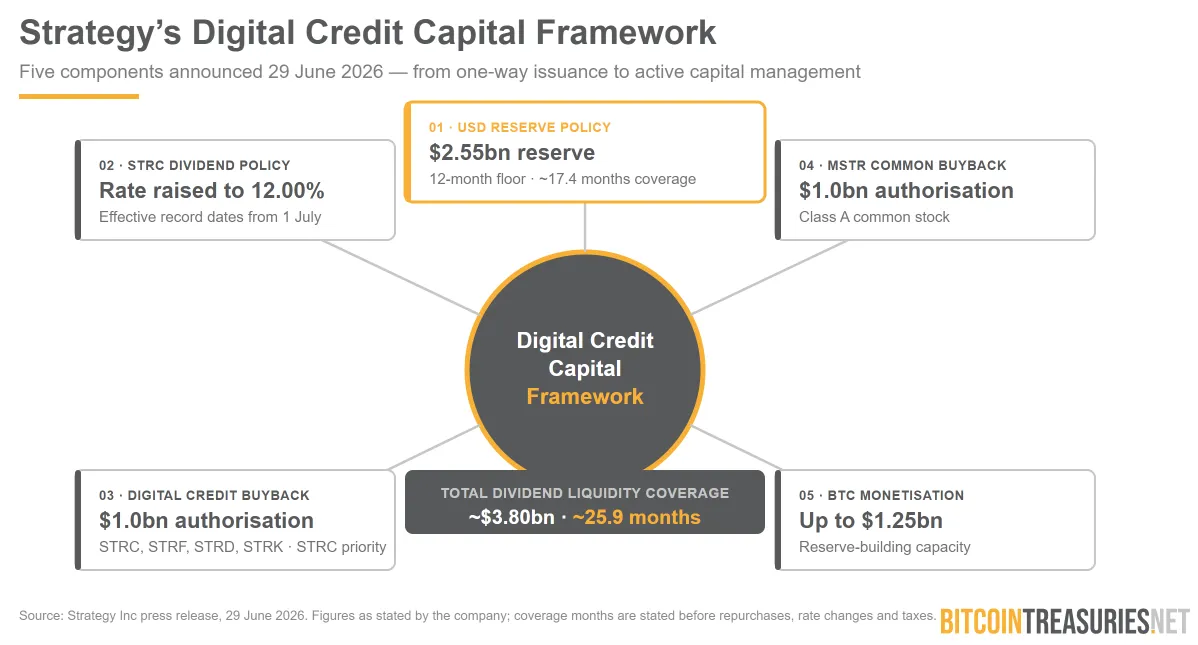
But the headline rate change is the smallest piece of what Strategy announced. The 12% coupon arrived as one component of a five-part Digital Credit Capital Framework: a Board-approved USD Reserve policy, the revised STRC dividend policy, a $1bn Digital Credit Securities repurchase programme, a $1bn class A common stock repurchase programme, and a BTC monetisation programme. The mechanism that set STRC's rate for eleven months has been demoted to one tool among several - and the company said so directly.
The market reaction
The market's first response was to buy. MSTR climbed back above $89 and STRC rose almost 10% to around $82, recovering a meaningful slice of a sell-off that had taken the preferred to a record low near $71.25 days earlier.
The reaction reads, at least in the immediate window, as a restoration of confidence in the Digital Credit instruments: the framework answered the specific fear that had driven the slide - that Strategy had no lever left but to let the coupon chase the price down - by showing it had several. By pairing the 12% rate with a ring-fenced reserve, a buyback bid under the stock, and an explicit mandate to monetise Bitcoin, Saylor demonstrated optionality the market had stopped pricing in, and holders responded accordingly.
The qualifier is that the move is partial. At $82, STRC remains roughly 18% below its $100 stated amount and below the new $99-$100 target band, and a one-session bounce off a deeply oversold low is not yet a return to par. Whether the confidence holds is a question for the sessions after the headline, not the first hour of trading.
The month that ran the price away from par
The 1 June hold rested on a single number. STRC's one-month VWAP read $99.62, near enough to the $100 stated amount that the rate could stay put. Within three weeks that floor was gone. The stock posted an intraday price of $71.25 on 26 June, its weakest level since the IPO, and kept falling from there.
Two structural events sat underneath the slide. The stock fell below par, which paused Strategy's at-the-market programme - the company issues STRC into the market above $100 and stops when the discount makes issuance a loss, so sub-par trading shuts the accumulation channel. And the company had, for the first time since it began accumulating in 2022, sold Bitcoin to fund a preferred distribution - 32 coins for roughly $2.5m in late May, disclosed on 1 June. By the 26 June close STRC sat at $74.57, down 1.48% on the day, with the effective yield at 15.42%.
The framework didn't break - it finally registered
STRC's rate is governed by where the price trades, measured through a one-month VWAP. For four months that average sat at or near par and the rate held. The reason it could hold through a falling tape is mechanical: a 30-day volume-weighted average gives disproportionate weight to the high-volume sessions around each ex-dividend date, when arbitrage activity reliably lifts the price toward par. Read more about this here. That distortion let the reported VWAP sit inside a no-change band while the stock spent most of the month below par. [FLAG: VWAP arbitrage distortion and the no-change band are BTN's own framework characterisation — not Strategy published guidance.]
That cushion has now thinned. The one-month VWAP read $94.09 on 23 June and $90.13 by the 26 June close — roughly $10 below par and below the level at which the framework had previously justified a hold. At $74.57 against an 11.50% coupon, the effective yield ran to 15.42% as of 26 June, some 392 basis points beyond the stated rate. [Derived: 15.42% reported effective yield minus 11.50% stated coupon = 392bps. Effective yield reported on dashboard; the spread is arithmetic.] The 12% rate closes part of that gap. The rest of the framework is built to close the rest.
Strategy now says the coupon will not chase the discount
The revised dividend policy carries a sentence that reframes everything the market thought it knew about STRC. Strategy will evaluate the rate monthly against a range of factors - trading levels, market yields, credit spreads, BTC price and volatility, USD Reserve coverage, and the overall capital structure - and stated plainly that it "will not necessarily increase the STRC dividend rate solely because STRC trades below its stated amount." The company also published an explicit corporate objective for the first time: STRC trading in a range of approximately $99 to $100. The single-lever VWAP mechanism is gone. In its place is a discretionary policy and a published target band.
A $2.55bn reserve, a 12-month floor, and 25.9 months of cover
The USD Reserve is the spine of the new framework. Strategy put it at approximately $2.55bn as of 28 June, including unsettled ATM proceeds, and ring-fenced it: under Board policy the reserve may be used only to pay preferred dividends and interest on debt, with any other use requiring Board authorisation. Against approximately $1.76bn in current annual expected preferred dividends and interest, that $2.55bn represents roughly 17.4 months of coverage. The Board set a floor: a minimum reserve equal to at least 12 months of that expense, breachable only with authorisation. Layer in $1.25bn of Board-authorised reserve-building BTC monetisation capacity and total coverage rises to about $3.80bn, or roughly 25.9 months.
Two buyback programmes turn issuance into two-way capital management
Strategy authorised up to $1.0bn to repurchase its Digital Credit Securities - STRC, STRF, STRD and STRK - and named STRC the initial priority if management judges repurchases accretive. A separate $1.0bn authorisation covers class A common stock. Neither programme will be funded from the USD Reserve; where they are funded through BTC sales, those run under the monetisation programme. The logic is explicit in the company's own words: buying Digital Credit Securities back at a discount to stated amount reduces future dividend obligations and strengthens credit quality. CEO Phong Le framed the shift as moving from one-way capital issuance to active capital management - issuing when capital is attractive, repurchasing when instruments trade at accretive levels.
Bitcoin becomes a funding tool, formally
The BTC Monetization Program converts what was an emergency act in late May - selling 32 coins to fund a distribution - into a standing authorisation. The Board approved BTC sales for three purposes: to generate up to $1.25bn for the USD Reserve, to fund or replenish dividends and interest when more advantageous than issuing common equity, and to fund the repurchase programmes. CFO Andrew Kang put it as "Bitcoin is capital." The framework pairs this with a commitment to disciplined common equity issuance, particularly near 1x mNAV per share.
A move to 12% would once have been the whole story. On 29 June it is the smallest of five moves, and the framework around it is an admission that the coupon alone was never going to do the work. Strategy has stopped relying on a single monthly lever and built a toolkit: a ring-fenced reserve with a floor, the capacity to buy its own discounted paper back, and a mandate to monetise Bitcoin to fund any of it. The stated target is now explicit - $99 to $100 - and the company has told the market it will get there through capital management, not through the coupon chasing the discount.
Want more bitcoin treasury coverage in your search results? Add Bitcoin Treasuries as a preferred source on Google.