



STRC has endured seven consecutive rate increases and its 1M VWAP sits at $94.09 while the stated yield remains 11.50%. The variable-rate guidance mechanism that was supposed to solve this problem has become part of it. There are four things Strategy needs to fix - and the market is watching all of them.
The Product That Was Supposed to Hold
When Strategy launched its Variable Rate Series A Perpetual Stretch Preferred Stock in July 2025, the pitch was elegant. Issue shares at $100. Pay a monthly cash dividend. Adjust the rate each month to keep the price anchored near par. Let the mechanism do the work.
And for most of this year so far, we have watched STRC act as intended. STRC has allowed Strategy to acquire an approximately extra 127,000 Bitcoin. The instrument was the first of its kind and has been heralded as one of the great financial innovations of our time. And it's still under 11 months old.
Eleven months since launch, STRC has absorbed seven consecutive rate increases - from 9% at launch to 11.50% today - and the price is $87.31. That is nearly 13 points below the $100 par it was built to defend. Strategy's own dashboard shows an effective yield of 14.4% against a stated rate of 11.50%. The gap between those two numbers - 290 basis points - is the market's verdict on what the coupon should be. The mechanism has not caught up.
The scale matters. STRC now carries a notional of $10.49 billion - the largest preferred equity issuance in the United States. Annual dividend obligations across all of Strategy's preferred series total $1.711 billion. An instrument this size sustaining a 13-point discount is a structural problem, not a technical one. Every day STRC trades below par, the ATM issuance channel - the machine's primary funding mechanism - sits idle.
This article is not about whether Strategy survives. It will. It is about how STRC recovers - and what that recovery actually requires. There are four issues. Yield. Dividend frequency. Cash reserves. The VWAP guidance framework. None is independently decisive. All four need to move.
Yield: The Gap the Market Has Already Priced
The rate argument does not require editorial opinion. Strategy publishes it on its own dashboard. At a market price of $87.31, a holder buying STRC today receives an effective yield of 14.4% on the 11.50% stated coupon. The market has already moved the return 167 basis points beyond the stated rate. The question is why the mechanism hasn't.
The comparison to SATA - Strive's equivalent preferred instrument - is instructive. SATA reached 13.00% in April 2026. It has spent considerably more time at par than STRC over comparable periods. Multiple market participants have pointed to the yield differential as a primary driver of capital rotation between the two instruments. The market is not confused about which product is better priced.
A move to 12-12.5% as a stated floor is the minimum credible adjustment. Not because 12% is the mathematically correct permanent rate - it isn't. But because a 25 or 50 basis point increase to 11.75% or 12.00% that leaves the price at $87 is not a defence of par. It is the appearance of one. The mechanism has already conceded 290 basis points to market pricing. The stated rate needs to start closing that gap, not chasing it one quarter-point at a time. I want to see Strategy use it's fantastic balance sheet with aggression.
There is a counter-argument worth naming. Some market participants have argued that rapidly raising the rate signals weakness and undermines the predictability the prospectus committed to. The market rewards transparency and stability, not reactive adjustments. This tension is real. The resolution is not choosing between yield and credibility - it is explaining the miscalibration, committing to a revised framework, and then holding to it. With Saylor having keen eyes on S&P inclusion, it is fair to argue that sticking to the guidance is essential to giving continuity and therefore an image of stability.
Frequency: Semi-Monthly Is Progress, Not a Fix
On 8 June 2026, Strategy announced that shareholders had approved the move from monthly to semi-monthly dividend payments. Phong Le, President and CEO, described it as designed to stabilise price, dampen cyclicality, drive liquidity, and give STRC holders faster reinvestment opportunity.
It is progress. It is not a fix.
The dividend frequency debate matters because of how the arbitrage works. Around ex-dividend dates, traders buy STRC in the days before the record date to capture the dividend, then sell after. This creates a spike in both price and volume immediately before each record date - a window when the stock reliably trades close to or above par. That spike is mechanically useful as a signal but dangerous as a basis for rate decisions.
The approval required a shareholder vote because Strategy is incorporated in Delaware. Delaware law requires shareholder approval to change dividend payment frequency. Strive, incorporated in Nevada, implemented daily dividends without a shareholder vote. That is not a management failure - it is jurisdictional architecture. But it matters when trying to understand why Strategy's response has been structurally slower than a competitor that built on different legal ground.
Semi-monthly payments compress the arbitrage window. They do not eliminate the distortion - they create two smaller versions of the same problem per month rather than one larger one. The question of whether twice-monthly dividends meaningfully reduce the ex-dividend volume spike in a 30-day VWAP calculation is, at this point, unanswered. The next two months of data will be the first real test.
Cash Reserves: The Drawdown, the Recovery, and What Saylor Said
The USD Reserve story over the past six weeks is the most important context for understanding why STRC hit its all-time low on 25 June.
Strategy built the reserve to approximately $2.25 billion through at-the-market sales of MSTR stock, framing it as a protective cushion for preferred shareholders - covering around 24 months of dividend obligations. Between 11 and 25 May, Strategy used $1.38 billion of that reserve to repurchase $1.5 billion of its 0% Convertible Senior Notes due 2029, retiring the debt at an 8% discount to face value. The reserve fell 63%, from $2.25 billion to $871 million. Six months of coverage. The instrument had been built as a 24-month buffer.
The logic of the debt repurchase was sound on its own terms - buying back zero-coupon notes at a discount reduces structural liabilities and improves the credit profile. CFO Andrew Kang described it as beneficial for equity and credit status. But preferred shareholders had been told the reserve existed for them. The sudden halving of that buffer, followed by STRC's slide below par and the first Bitcoin sale since 2022 (although incredibly minor), produced a confidence shock that the mechanism was not designed to absorb.
What happened next matters as much as what preceded it. On 22 June, Saylor posted on X that Strategy had increased its USD Reserve by $300 million to $1.4 billion and, critically, that the company plans to continue replenishing it to support the credit quality of its Digital Credit securities. That is a public commitment to ongoing reserve rebuilding, made at a moment when the market was pricing in exactly the opposite concern. Saylor is acknowledging the issue clearly.
The same day, Phong Le posted that he had personally bought $1 million of STRC and intended to hold it until it reached par, likely longer. Two coordinated signals in one session - institutional capital backing the reserve, management capital backing the instrument.
Strategy's current dashboard shows the reserve at $1.4 billion against annual dividend obligations of $1.711 billion - approximately 9.8 months of cash coverage. That is materially better than the six months that followed the convertible note retirement. It is still below the 24-month target the reserve was originally built to provide. The direction has changed. The destination has not been reached.
VWAP: The Framework That Hid the Problem
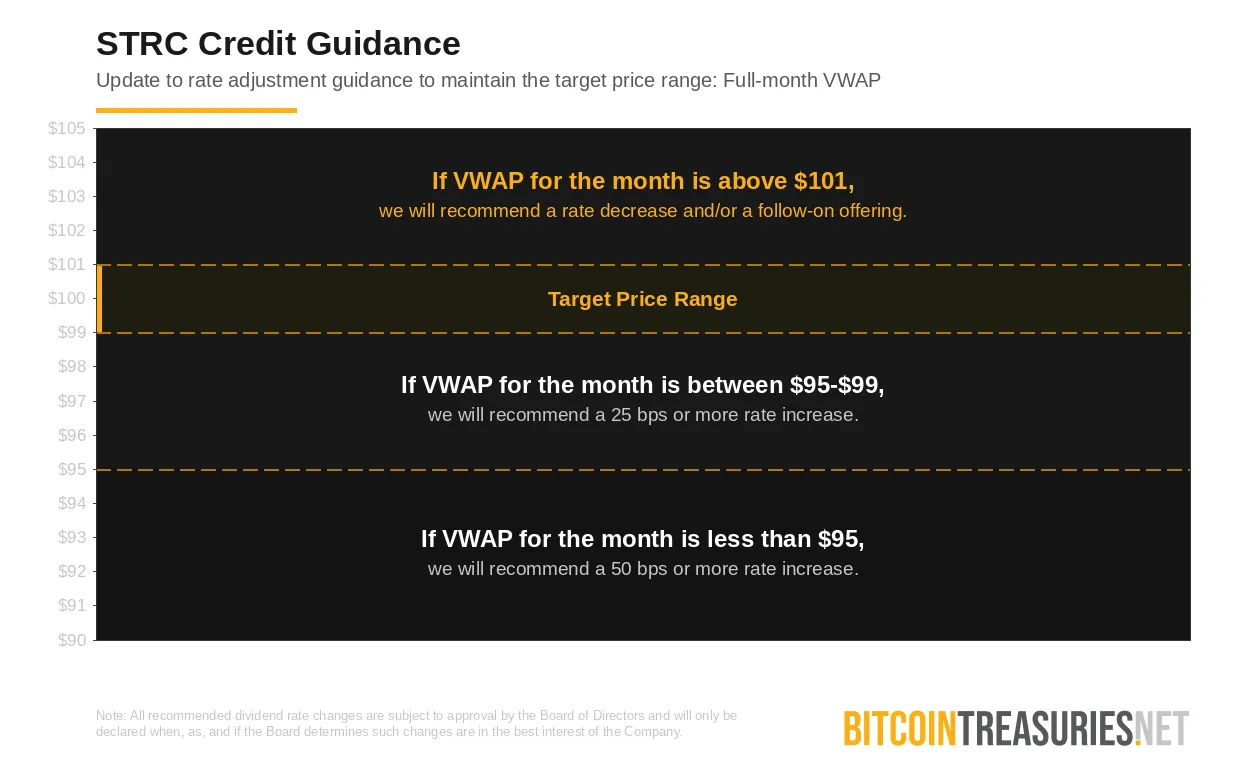
The rate-adjustment mechanism Strategy designed for STRC has a specific structure, documented in the prospectus and communicated publicly by Saylor. The original framework used a five-day end-of-month VWAP as the trigger reference. At some point after launch, the averaging window was extended to 30 days. The logic was reasonable - a longer window reduces noise and prevents the mechanism from overreacting to short-term volatility.
The unintended consequence took months to surface. A 30-day volume-weighted average is systematically distortable by dividend arbitrage activity. Around each ex-dividend date, traders buy STRC ahead of the record date to capture the dividend, then sell after. This creates a high-volume spike near par that carries disproportionate weight in the VWAP calculation - because VWAP is volume-weighted, and those pre-dividend sessions trade dramatically more than typical days. The few sessions around each record date can dominate the entire 30-day average.
The result: the 30-day VWAP can sit comfortably inside the no-change band - between $99 and $101 - even when the product spends the majority of the month well below par. The framework reports a healthy reading. The price chart tells a different story.
Strategy's own dashboard now supplies the clearest evidence. As of 23 June 2026, the 1M VWAP reads $94.09. That sits below $95 - the threshold that should trigger a recommendation for at least 50 basis points of increase. The rate has been held at 11.50% for four consecutive months. The mechanism's own signal has been either ignored or overridden - or the 30-day averaging methodology is producing a reading that does not reflect actual trading conditions for most of the month.
One further figure from Strategy's own dashboard deserves attention. Implied volatility for STRC currently stands at 45.7%, against a 30-day historical volatility of 21.6%. An instrument marketed as a cash-like, low-volatility yield product is being priced by the options market as significantly more volatile than its recent history suggests. The gap between implied and realised volatility is the market pricing in continued stress, not a one-off correction.
One potential fix could be a mid-period trigger: if STRC trades below a defined threshold for a sustained stretch of sessions at any point during the month, convene a rate review immediately. End-of-month VWAP will always lag a product that is trending away from par. The mechanism was designed for a product spending brief periods outside its target band. It was not designed for one that has been below $95 for most of a month while the 30-day VWAP reads above it.
What This Episode Tells the Category
STRC is the first Digital Credit instrument at meaningful scale - $10.49 billion in notional, the largest preferred equity issuance of 2025, one of the largest preferred instruments in the United States. The four problems identified above are not unique to Strategy's product design. They are the first real-world stress test of a rate-adjustment mechanism applied to a preferred equity instrument at this size. Every issuer building in this category is watching.
The reserve drawdown triggered by the convertible note retirement was a decision that made balance sheet sense and dividend-cushion sense simultaneously - until those two objectives came into conflict. Deploying the reserve that had been framed as preferred shareholder protection into a debt repurchase, without a public explanation of how the buffer would be rebuilt, was a communication failure as much as a capital allocation one. Saylor's 22 June announcement - explicit on both the replenishment amount and the ongoing intent - is the correction.
The VWAP framework failure is a calibration problem, not a design flaw. The principle of adjusting the rate monthly to maintain par is sound. A 30-day averaging window that can be dominated by ex-dividend volume spikes is not. The extension from a five-day to a 30-day reference period added smoothing at the cost of responsiveness. Adding a mid-month trigger alongside the monthly review closes the gap without abandoning the framework.
Yield, frequency, cash, and guidance. Each of those four levers has moved in the right direction since mid-June - except one. The yield has not moved. The frequency improves with semi-monthly dividends from July. The cash reserve has been rebuilt to $1.4 billion with a public commitment to continue. The guidance mechanism remains unreformed.
The 1M VWAP on Strategy's own dashboard sits at $94.09. The rate remains 11.50%.
The market is still waiting.
Want more bitcoin treasury coverage in your search results? Add Bitcoin Treasuries as a preferred source on Google.