
Strategy's Stretch Buybacks Are the First Sign of a Bigger Playbook



Strategy's first Stretch repurchase is too small, at 0.28 per cent of the stock outstanding, to move the price on its own. What it previews is bigger: a capital-allocation playbook built this year in public, where common can fund preferred, bitcoin funds the reserve if needed, and the USD Reserve itself has just been rebuilt from $871 million to $3.75 billion in nine weeks.
Strategy's 27 July Form 8-K covers seven days in which the company acquired no bitcoin. Holdings closed unchanged at 843,775 BTC against an average cost of $75,476, roughly 14 per cent above where bitcoin traded all week.
Instead, Strategy sold 5,429,160 MSTR shares through its at-the-market programme for $544.5 million net. It spent $25.0 million repurchasing 288,930 shares of Variable Rate Series A Perpetual Stretch Preferred Stock. And it lifted the USD Reserve from $3.225 billion to $3.750 billion.
Adam Livingston ran the week through the CEBE framework. Net senior claims fell from $18.993 billion to $18.439 billion. Residual bitcoin owned by common rose from 547,218 BTC to 555,866 BTC, or 144,324 sats per share to 144,535, an increase of 0.146 per cent. Gross bitcoin per share fell 1.41 per cent on 5.4 million new shares. Strategy created residual bitcoin for common shareholders in a week when it bought none.
Execution produced the accretion, not policy
The arithmetic only works because of where the ATM cleared.
Net proceeds of $544.5 million across 5,429,160 shares imply an average of $100.29 per share after commission. MSTR's volume-weighted average price across the trading week was $97.70. It closed Friday 24 July at $91.70, having touched $104.60 on Tuesday. Against CEBE net asset value of $92.43 per share entering the week, the ATM cleared at a premium of roughly 8.5 per cent.
That premium is the entire source of the accretion. Strategy sold into a Monday-to-Wednesday spike and stopped. By Friday, mNAV had closed at 0.9987x, below parity, and the same trade would have destroyed residual bitcoin per share rather than created it. MSTR reopened Monday at $96.82, up 5.62 per cent, with mNAV back at 1.04x.
The distinction matters for anyone extrapolating. A 0.146 per cent weekly gain in residual bitcoin per share annualises to something that looks like a real yield. It was produced by two good sessions inside a five-session window, at a multiple that has spent the past month oscillating around 1.00x. Treat it as an execution result with a short shelf life.
Retiring Stretch beats buying bitcoin at this multiple
The repurchase economics are cleaner and more repeatable than the ATM timing.
Strategy paid an average of $86.52 per share for stock carrying a $100 par claim. That retires $28.893 million of preferred obligation for $25.0 million in cash, a discount of 13.47 per cent and $3.893 million of claim value captured outright. At the current 12 per cent dividend rate, those 288,930 shares carried $3.467 million of annual payments. The cash-on-cash return on the $25 million deployed is 13.87 per cent, and it is permanent.
Phong Le and Saylor both made the long-term objective for Stretch clear: trading consistently near $100 with high liquidity, low volatility and healthy, sustainable independent demand. Chairman and chief executive using identical language on the same afternoon is not two people happening to agree. It is approved messaging, which raises the cost of quietly abandoning the policy later.
Set that against the alternatives. Cash held in the USD Reserve earns something close to the prevailing short-dated Treasury yield, which Strategy's own dashboard carries at 4.0 per cent. Bitcoin bought at an mNAV of 1.04x delivers roughly four cents of residual value per dollar of common equity issued. Retiring Stretch at 86.52 cents delivers thirteen and a half, plus the coupon relief.
There is a cost, and it should be stated plainly. Deleveraging cuts both ways. Amplification, the ratio of total bitcoin held to residual bitcoin owned by common, fell from 1.542x to 1.518x across the week and stands at 1.51x on the dashboard. Every dollar of senior claim retired is a dollar of embedded bitcoin exposure the common no longer gets for free on the way up. Strategy is trading convexity for coverage.
At 0.28 per cent of the float, the repurchase is a signalling device
Scale needs stating. STRC had 104,894,705 shares outstanding before the week, carried at $10.489 billion of notional. The 288,930 shares repurchased represent 0.275 per cent of that. Post-retirement notional stands at $10.4606 billion, which is exactly what the dashboard now shows.
$25 million is around ten per cent of one day's average STRC trading volume over the past thirty days. As a physical lever on price, it is close to nothing. STRC closed Friday at $86.885 and trades at $88.54 today, up 1.90 per cent. Attributing that move to $25 million of buying would be generous.
The precedent is the product. Michael Saylor's language on the announcement was explicit about intent: a regular, disciplined buyer below $100, more at deeper discounts, less as the price approaches par, with $975 million of authorisation remaining. That converts Stretch from a one-way issuance instrument into a two-way market with a stated reaction function. Holders now price an option rather than a flow. So do short sellers, who have to weigh the possibility that any given session contains an issuer bid of unknown size.
The remaining $975 million is 9.32 per cent of STRC notional. Deployed at current prices it would retire roughly $1.13 billion of par claim and $135 million of annual dividends. That is the number the market should be discounting. The $25 million is the announcement that the number exists.
The reserve has been rebuilt from $871 million in nine weeks
At $3.750 billion against $1.759 billion of annual interest and preferred dividends, the USD Reserve covers 25.6 months. Nine weeks ago it covered six.
That collapse was self-inflicted and instructive. Between 11 and 25 May, Strategy retired $1.5 billion aggregate principal of its 0 per cent Convertible Senior Notes due 2029 for approximately $1.38 billion in cash, a discount to par of around 8 per cent. The trade was sound. It cut convertible principal from $8.2 billion to $6.7 billion, generated BTC Gain of 4,391 bitcoin, and removed a senior claim sitting ahead of the entire preferred stack. The funding was the problem. Strategy paid from the reserve, which fell from roughly $2.25 billion to $871 million. A buffer sized to cover two years of obligations was left covering about six months. STRC broke par three days later, trading to $97.11 on 29 May. Since then, it hit lows of $72 in June.
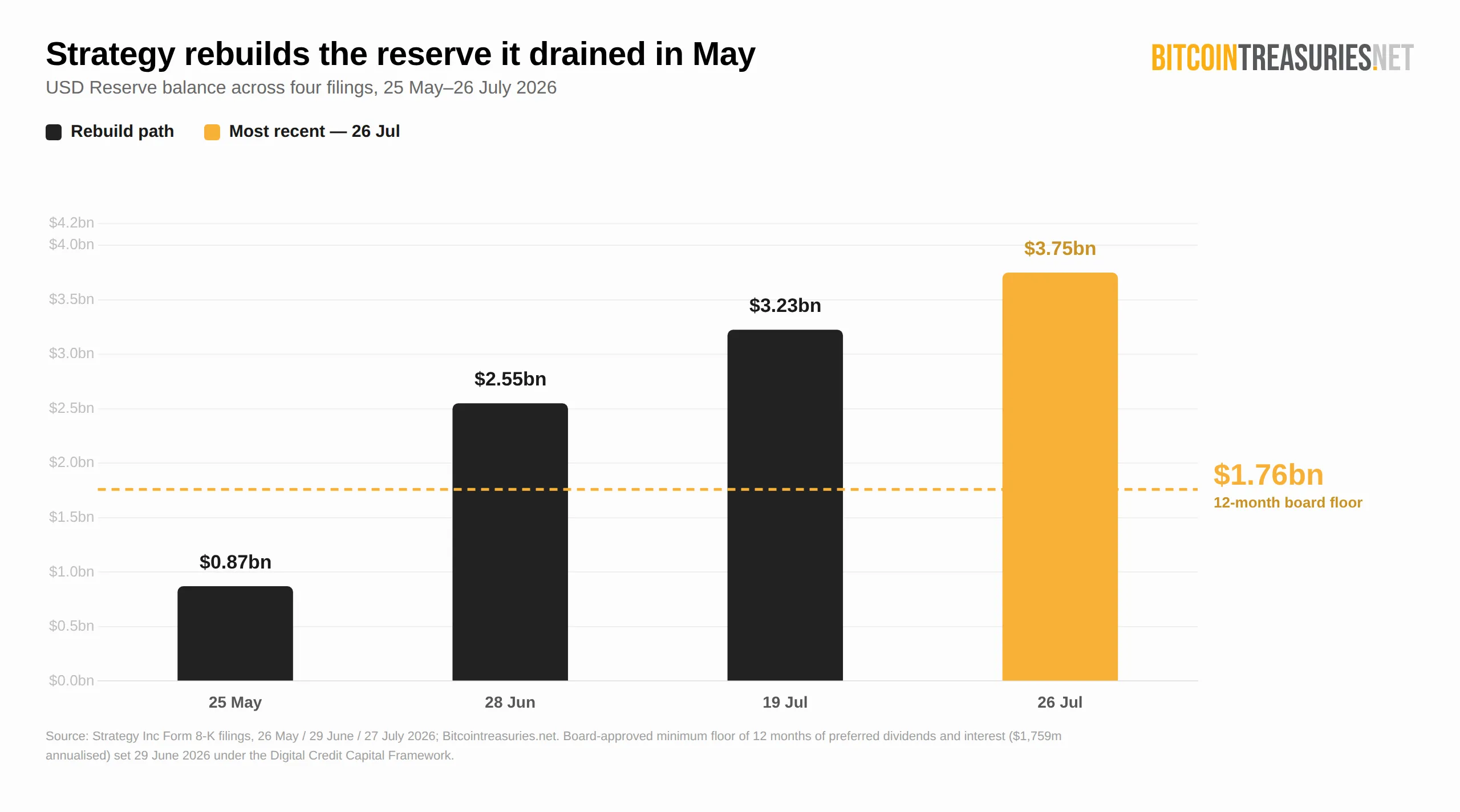
USD coverage has seen an increase of $2.879 billion in sixty-two days, roughly $325 million a week. Coverage now sits at more than twice the board's mandated minimum and back above the twenty-four month standard the reserve was originally built to, for the first time since May. None of it came from preferred issuance. Preferred holders received two years of cash coverage without a single additional claim placed alongside them
May and July are the same trade with different money
In May, Strategy bought its own paper at an 8 per cent discount and paid from the reserve. Coverage fell from twenty-four months to six and the preferred broke par within three sessions. In July, it bought its own paper at a 13.5 per cent discount and paid from the ATM. Coverage rose to 25.6 months, the reserve was ring-fenced by policy, and the preferred rose.
The instinct is unchanged and it is a good one. Strategy retires its own securities below par and has picked the discount accurately both times. What changed is the treasury discipline behind it. Saylor's statement that repurchases will be funded outside the USD Reserve is a direct answer to May. The June framework's twelve-month floor, breachable only with board authorisation, is the same answer written down so it survives the next drawdown.
The buffer carries a cost. Roughly $1.99 billion sits above the mandated floor earning something close to the prevailing short-dated Treasury yield of about 4 per cent, while a claim yielding 13.87 per cent to retire trades at 86.5 cents. On the excess that is nearly ten points of spread, or in the order of $197 million a year.
Strategy is paying it knowingly, and the case that it is cheap is strong. STRC accounts for $1.255 billion of the $1.759 billion annual obligation. Whether it returns to par depends on the market believing the dividend is covered in cash irrespective of bitcoin, and twenty-five months buys that belief across a full drawdown cycle in a way that six did not. Reopening STRC issuance at par would fund years of the carry in a single quarter.
The counterweight is that common paid for it. Gross bitcoin per share has fallen from 220,900 sats on 25 May to 206,388 today, a decline of 6.6 per cent, while holdings rose by 37 coins.
The monetization option is what makes the buffer credible
The BTC Monetization Program adopted on 29 June authorises bitcoin sales to fund the reserve, service dividends and interest, and finance up to $1 billion each of the digital credit and common repurchase programmes. Nothing obliges Strategy to use it, and holdings have been flat all week.
Read as a credit input rather than an ideological one, it is what makes the coverage figure hold under stress. The monetisation authority gives the reserve a second refill valve that does not depend on anyone wanting to buy MSTR at a premium. Against roughly $55 billion of bitcoin NAV, a top-up of the size delivered this quarter costs a fraction of a per cent of the stack.
Strategy has now established two things in sequence. It will dilute common to support preferreds, and it will sell bitcoin to do the same if conditions require. Both feed one objective, which is defending a $100 mark on an instrument that has not held it since June.
What the next filing settles
The dividend framework points in one direction. Strategy's published guidance evaluates the rate each month against Stretch's VWAP: below $95.00 recommends an increase of 50 basis points or more, $95.00 to $98.99 recommends 25 basis points or more, and $99.00 to $100.99 anticipates no change. The one-month VWAP sits at $82.70. It is not close.
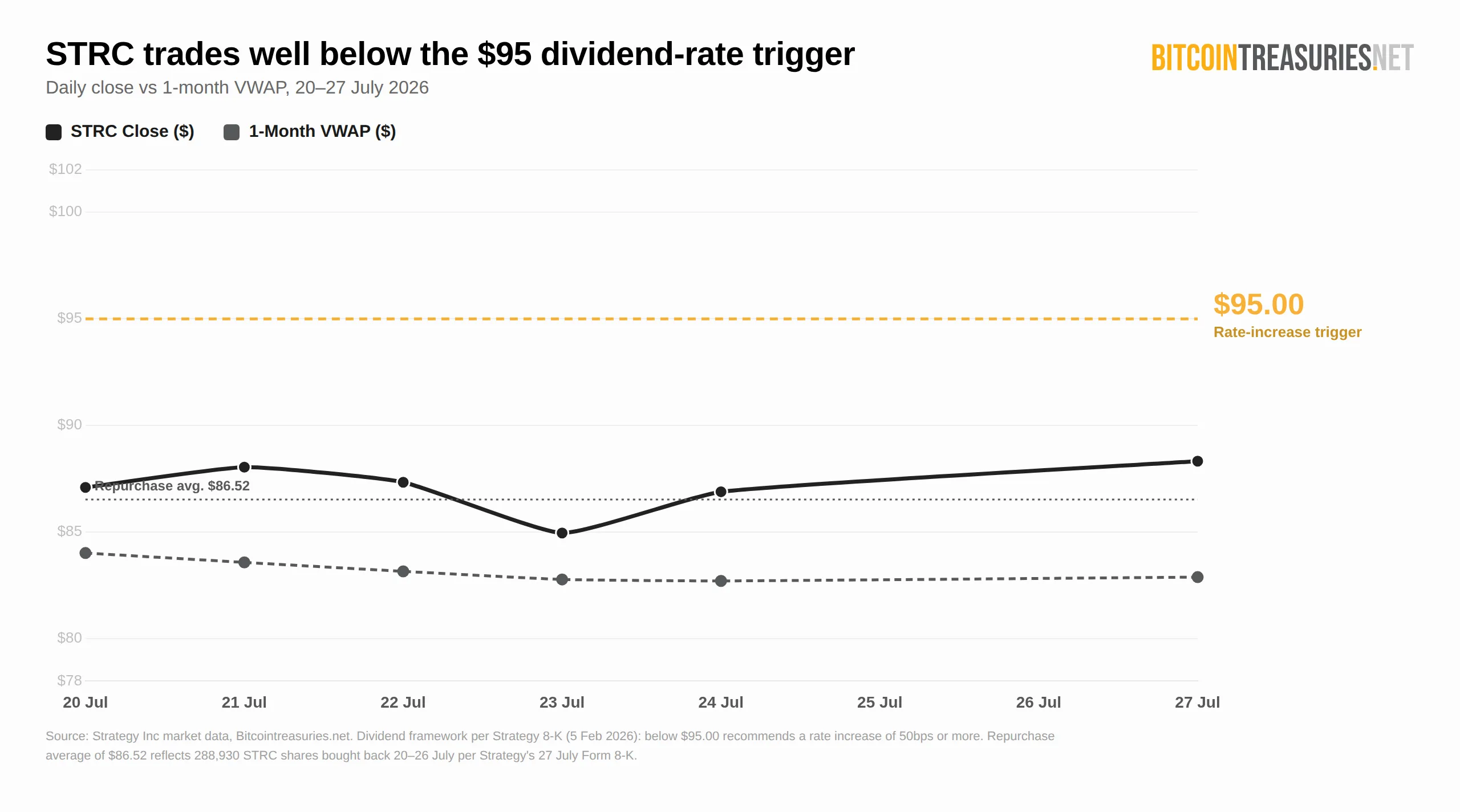
Each 50 basis point step adds roughly $52.3 million a year to the cost base at current notional. The July repurchase removed $3.467 million. The two levers are working against each other, and the retirement lever is currently smaller by a factor of fifteen. Buying back stock at a discount reduces the coupon bill. Failing to lift the price above $95 raises it, permanently, on the entire remaining balance.
Record date is 31 July and the payout lands on 15 August. Between now and the next 8-K, four things are worth watching: whether the repurchase pace scales toward the $975 million authorisation or stays at probe size, whether the ATM keeps running with mNAV pinned near 1.00x, whether the reserve build continues past 25.6 months or plateaus now that the standard has been restored, and whether the monthly VWAP recovers enough ground to matter before the rate is set.
Strategy spent May learning that a good trade funded from the wrong pocket is a bad week. It spent June writing the lesson into policy and July executing against it. The reserve is deeper than it has been all year, the preferred stack has shrunk for the first time, and neither required a single bitcoin to be sold. What the next filing settles is whether $25 million was a probe or a policy.
Want more bitcoin treasury coverage in your search results? Add Bitcoin Treasuries as a preferred source on Google.