



A $12.5 billion net loss dominated the headlines. Strip the accounting and what remains is a company accelerating - more Bitcoin, more preferred capital, and a credit instrument that is becoming the benchmark it set out to be.
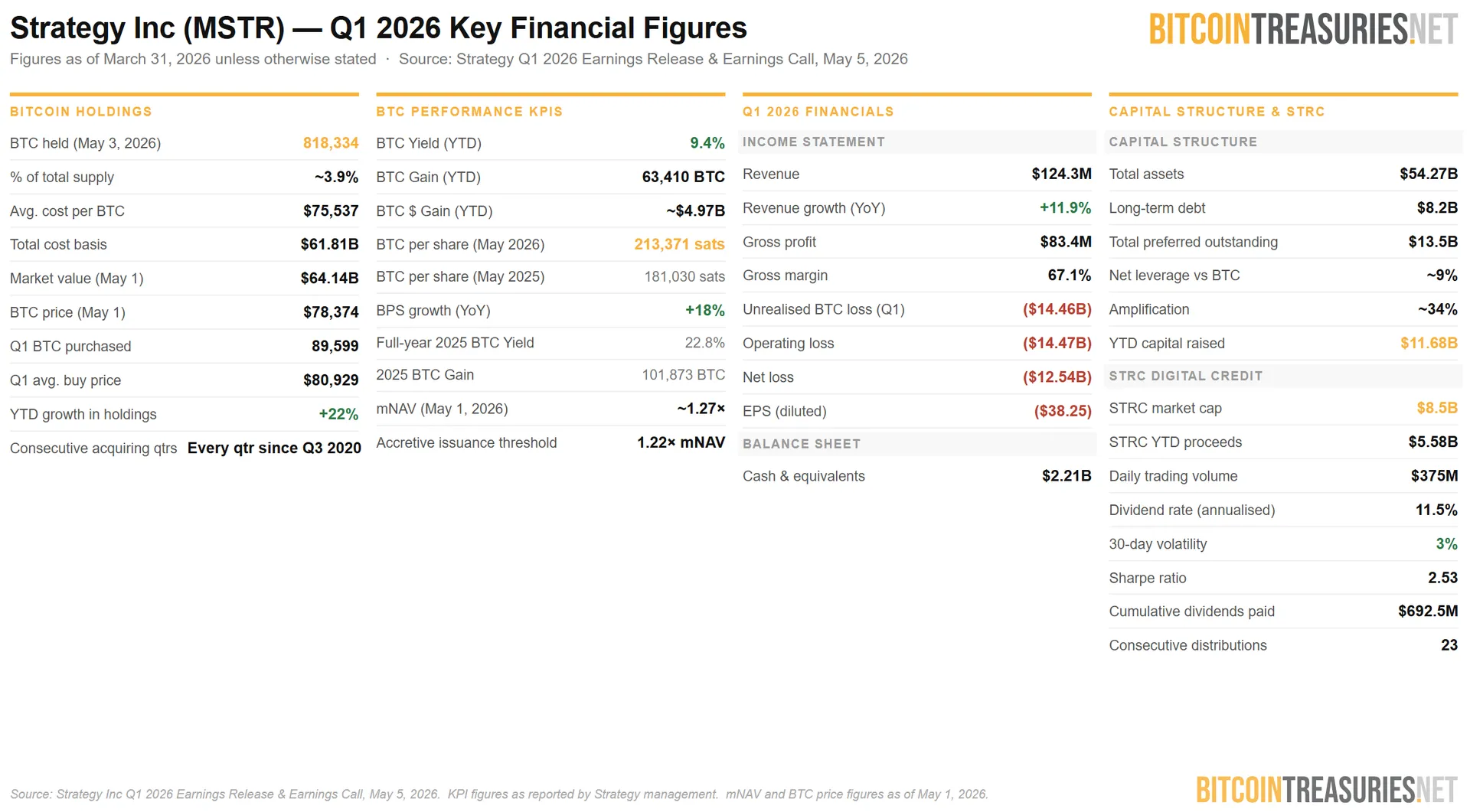
Strategy reported a net loss of $12.54 billion for the first quarter of 2026, or $38.25 per diluted common share. That is the sensationalist headline, but it’s not the full story.
Of the $14.47 billion operating loss, $14.46 billion was a single non-cash line item: unrealised loss on digital assets under FASB ASU 2023-08. Bitcoin ended Q1 at approximately $67,800, down from roughly $87,500 at year-end 2025, and the accounting marked the balance sheet accordingly. The Bitcoin carrying value fell from $58.9 billion to $51.6 billion. By May 1, that position had recovered to $64.1 billion. The loss is a quarterly snapshot of a price that kept moving.
Strip the mark, and the software business generated $124.3 million in revenue - up 11.9% year-over-year - with $83.4 million in gross profit at a 67.1% margin. Cash held near-flat at $2.21 billion versus $2.30 billion at year-end.
There is also a tax note worth understanding. As Bitcoin moved from an unrealised gain at year-end to an unrealised loss at Q1-end, Strategy's $1.9 billion deferred tax liability shifted to a deferred tax asset. A full valuation allowance brought the net balance sheet tax position to zero, producing a non-cash $1.9 billion income tax benefit that partially offset the pre-tax loss. The reported net loss of $12.54 billion reflects this offset. Without it, the headline number would have been worse. The mechanics are accounting-driven; the economics are unchanged.
THE METRIC THAT MATTERS
Bitcoin per share is the number Strategy manages to. In May 2026, it stood at 213,371 satoshis per share - up from 181,030 sats a year earlier. That is an 18% year-over-year increase, and it is the return that matters to long-term holders of the common stock. These sats show the flywheel of accretive dilution working as Strategy intends.
Year-to-date, BTC Yield reached 9.4%. The full-year 2025 figure was 22.8%. Four months into 2026, Strategy has already generated approximately 62% of last year's total BTC Gain - 63,410 BTC against 101,873 for all of 2025. In dollar terms, that translates to approximately $5 billion of BTC $ Gain year-to-date, against $8.9 billion for all last year. The pace is accelerating rather than plateauing as many believed would happen as Strategy grew larger.
The Bitcoin stack itself now stands at 818,334 BTC as of May 3 - approximately 3.9% of all supply, a 22% increase since January 1. Strategy added 89,599 BTC in Q1 at an average cost of approximately $80,929, financed primarily through $5.19 billion in MSTR ATM proceeds and $2.06 billion from STRC. A further 56,235 BTC were added in Q2 through May 3, at a materially lower average of approximately $73,400. Total cost basis sits at $61.8 billion against a May 1 market value of $64.1 billion. The position is in the green.
THE ENGINE
The operationally significant number in this release is not the net loss. It is the growth rate of STRC.
Nine months from launch, STRC has reached $8.5 billion in market capitalisation - the largest preferred stock by market cap in the world. Year-to-date gross proceeds from STRC issuance total $5.58 billion, a 189% increase over the prior comparable period. Of that, $3.51 billion came in Q2 alone, through May 3. The instrument is scaling at record levels and aiding Strategy’s accumulation targets.
Daily trading volume stands at $375 million. Volatility has compressed to 3%. The Sharpe ratio, as cited by management, is 2.53. The dividend rate has held flat at 11.5% annualised for two consecutive months - the first period of stability since launch, after stepping up from 9% across seven consecutive monthly increases. A rate that stops rising because demand is sufficient is a different signal from a rate that stops rising because demand is exhausted. The price behaviour - holding near par throughout - confirms which one this is.
Cumulative preferred dividends now total over $693 million across 23 consecutive on-time distributions. Strategy has also proposed moving STRC payments from monthly to semi-monthly, keeping total economics unchanged while reducing reinvestment lag and tightening the price mechanics around par. The structural logic is focused on the idea that higher payment frequency compresses the duration of reinvestment risk for holders, making the instrument behave more like the credit product it is designed to be.
A secondary ecosystem is beginning to form around it. Management cited $150 million of STRC held in corporate treasuries including Strive and Anchorage, and over $270 million held across DeFi protocols. The distribution channels are diversifying without Strategy having to engineer them.
THE ARCHITECTURE
Strategy's balance sheet currently carries approximately $8.2 billion of long-term convertible debt, $9 billion of preferred equity, and roughly $58 billion of equity. Net leverage against Bitcoin reserves is approximately 9% - or a 10.8x BTC coverage ratio. Management's stated stress case: even at a Bitcoin price of approximately $7,300, a 91% decline from current levels, the reserve would still cover net debt at 1x. The $2.25 billion USD cash reserve provides approximately one and a half years of dividend and interest coverage without touching Bitcoin.
The direction is explicit: retire the convertible debt, grow STRC. Phong Le confirmed on the earnings call that all six convertible bond positions are targeted for elimination - through buyback, STRC swap, or equity conversion - not held to maturity. As long-duration preferred replaces shorter-duration convertible instruments, amplification can increase with lower structural risk. Current amplification sits at approximately 34%. Management sees a path to 50-60% over time.
One clarification for common equity holders: the break-even mNAV threshold for accretive MSTR share issuance is no longer 1.0x. With the preferred stack in place, the real break-even is approximately 1.22x. Below that level, other capital levers are more efficient. The mNAV on May 1 was approximately 1.27x - above the threshold, but not by a wide margin at current prices.
BITCOIN AS MANAGED CAPITAL
There was a strategic signal in the earnings call that deserves more attention than the loss figure it was buried beneath.
Phong Le confirmed, explicitly, that Strategy will sell Bitcoin when it is advantageous to do so - and that when it does, it will sell the highest-cost-basis tranches first. The reason is precise: approximately $2.2 billion in tax benefits sit on the balance sheet from Bitcoin purchased above current market prices. Selling those positions realises losses. Realised losses offset gains elsewhere, reduce future CAMT exposure, and free liquidity without adding a single dollar of new leverage to the balance sheet.
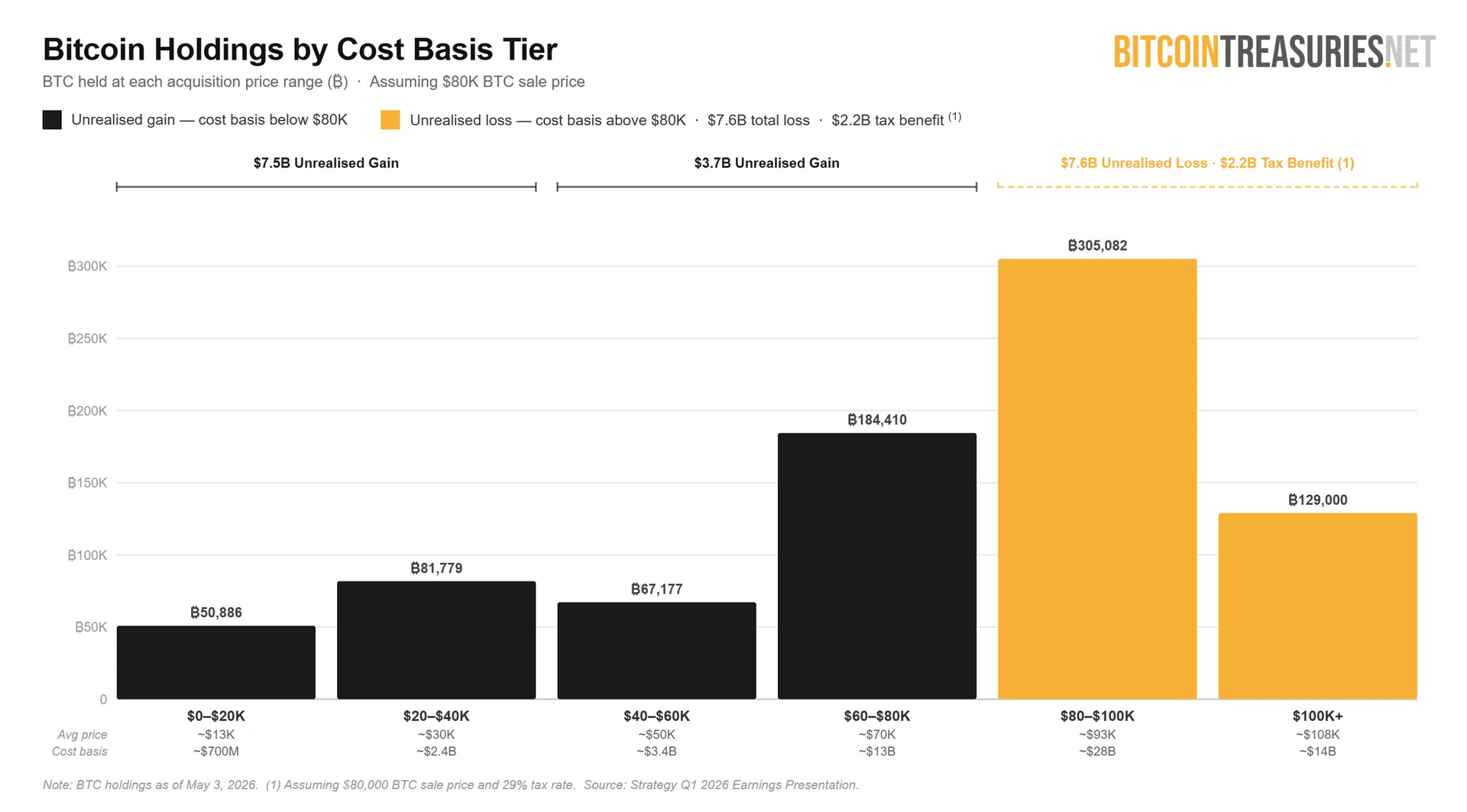
That liquidity can then be redeployed into actions that are directly accretive to Bitcoin per share: retiring low-conversion-price converts that sit below the 1.22x mNAV break-even, buying back MSTR common to reduce the denominator, or building USD reserves to extend dividend coverage. Each of those moves increases BPS more efficiently than issuing new equity at current mNAV levels would.
The framing matters. GAAP volatility - the $14.5 billion operating loss - is not a taxable event. Unrealised appreciation and depreciation under ASU 2023-08 flows through the income statement without triggering tax. A realised Bitcoin sale is different. Strategy can now use that distinction deliberately: book the accounting loss through fair-value marks without tax consequence and separately select which Bitcoin to sell based on where the tax benefit is greatest.
What this signals is a shift in how Bitcoin functions within the capital structure. It is no longer treated as inert reserve and the number that grows and the asset that is never touched. It is instead becoming an actively managed position, optimised around Bitcoin per share, float control, and capital structure efficiency.
WHAT COMES NEXT
Strategy raised $11.68 billion across the first four months of 2026, split roughly equally between common equity and preferred - with the mix shifting sharply toward digital credit over the period. In January, digital credit represented approximately 20% of ATM issuance. By April, that figure had reached approximately 83%. The transition is deliberate and it is accelerating.
The Q1 reported numbers will move headlines. An operating loss of $14.5 billion is a number that demands context, and context is not always what financial media reaches for first. But the structure underneath - a Bitcoin stack growing at 22% year-to-date, a preferred instrument becoming its own asset class, and a balance sheet moving away from short-duration debt toward long-duration credit - is what the next several quarters will actually be measured against.
Want more bitcoin treasury coverage in your search results? Add Bitcoin Treasuries as a preferred source on Google.