



At Bitcoin 2026, Saylor unveiled something larger than a product pitch: nine companies already building financial infrastructure on top of STRC. The instrument has become a base layer.
At Bitcoin 2026 in Las Vegas, Michael Saylor delivered a three-layer diagram. Layer one: Bitcoin, digital capital. Layer two: STRC, digital credit. Layer three: everything being built on top of it.
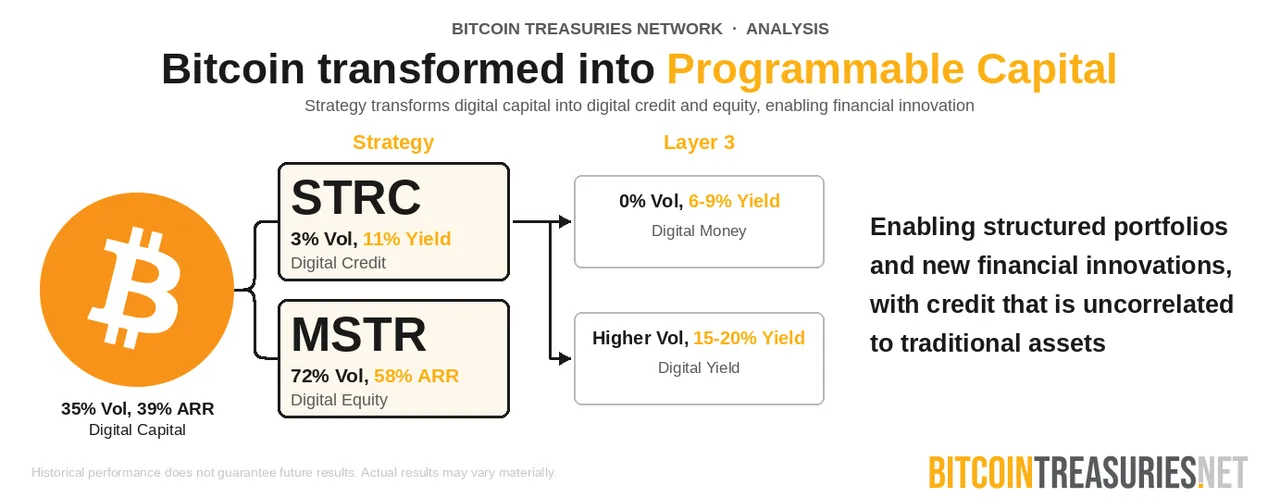
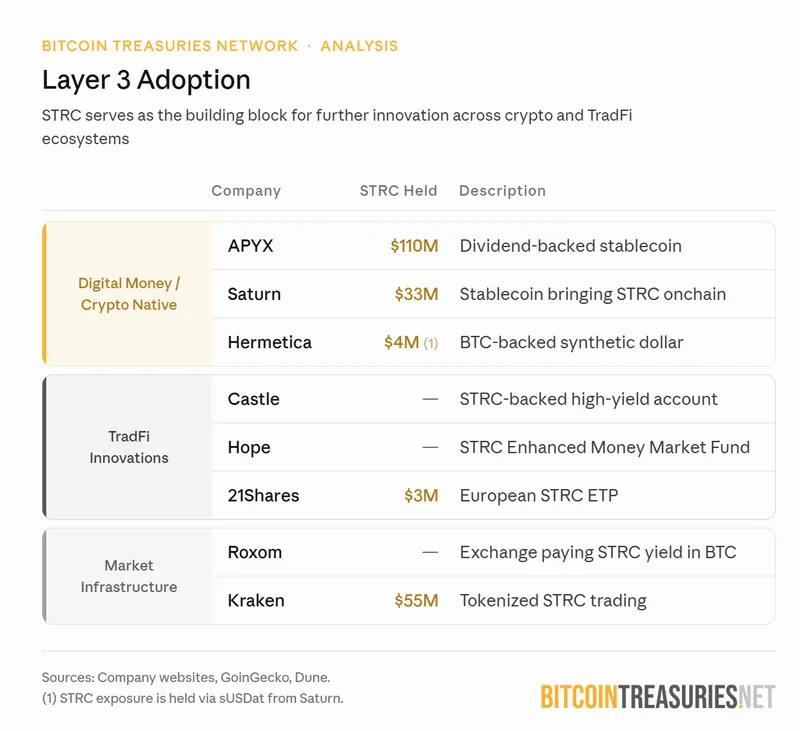
The slide named nine companies. Not nine companies considering STRC. Nine already live, or near-live, with products that take STRC as an input and produce something new - stablecoins, savings accounts, money market funds, European ETPs, tokenised equities, Bitcoin-denominated yield trades. In aggregate, those nine companies hold or represent exposure to over $200 million of STRC between them, with Apyx alone accumulating toward the largest single position outside Strategy itself.
STRC crossed $8.5 billion in notional in nine months, financed the purchase of roughly 77,000 Bitcoin year-to-date, and now anchors an ecosystem that did not exist in any formal sense twelve months ago. The instrument has a credit hierarchy, and the credit hierarchy has a building class. What that class is building is worth examining closely.
The Base Layer Thesis
STRC’s four properties of yield, price stability, perpetual duration, and hard asset overcollateralisation make it a collateral primitive. You can mint stable assets against it. You can route its yield into yield-bearing tokens. You can wrap it in a regulated product and sell it through a broker. You can pay yield in Bitcoin by converting the dollar dividend on settlement.
That is not what preferred stock normally does. Preferred stock normally sits in a portfolio, collects a coupon, and waits for redemption. STRC is being used as infrastructure.
Saylor’s language at Bitcoin 2026 was precise on this: “Digital credit is a killer application of digital capital. Every dollar that flows into digital credit will flow into digital capital.” The architecture he described posits Bitcoin as reserve, STRC as the credit layer, and a class of products issued on top. The nine companies on the slide are the proof of concept.
Digital Money
The most technically complex products in the ecosystem sit in the digital money tier. Three companies - Apyx, Saturn, and Hermetica - have each built instruments that derive yield or stability from STRC, and they are more interconnected than the slide suggests.
Saturn is the foundational protocol. It issues USDat, a non-yielding stablecoin minted against US Treasuries, and sUSDat, the staked version backed by STRC. When users stake USDat into sUSDat, Saturn rotates reserve assets from Treasuries into STRC. The yield from Strategy’s monthly dividend accumulates inside the vault and pushes the sUSDat/USDat exchange rate upward over time. Saturn launched mainnet in April 2026, accumulated $15 million in STRC within the first six days, and has since grown to a reported $33 million in holdings. The team raised $800,000 from Binance’s YZi Labs and Sora Ventures.
Apyx is the largest external holder of STRC by reported figures. It builds on the same yield-bearing collateral logic but runs a two-token model: apxUSD, a non-yielding synthetic dollar backed primarily by STRC, and apyUSD, the staked version that receives all accumulated dividend flow. Because only a subset of apxUSD holders elect to lock into apyUSD, the yield concentrates - Apyx’s documentation describes this as producing 13–20%+ APY on apyUSD depending on participation rates. Holdings progressed from $25 million in mid-March to $80 million by mid-April, with internal dashboards reporting approximately $110 million in total treasury assets by late April. The company is backed by the team behind DeFi Development Corp and integrates with BitGo for custody, live on Ethereum and Base.
Hermetica sits one layer further out. Its product, hBTC, is a Bitcoin-denominated yield vault built on the Stacks network. Deposited Bitcoin is posted as collateral, stablecoins are borrowed against it, and those stablecoins are deployed across three yield sources: Bitcoin futures basis, Stacks dual staking rewards, and STRC yield accessed via Saturn’s sUSDat. The STRC exposure is therefore indirect - Hermetica’s $4 million STRC position as shown on the slide is held through Saturn rather than directly, which the slide’s footnote acknowledges and Hermetica’s own April 2026 press release confirms. The project was seeded by UTXO Management, the asset management arm of Nakamoto, which also produced the Bitcoin 2026 conference.
These three products describe a yield stack: Saturn produces the STRC-backed stablecoin, Apyx concentrates STRC yield into a two-token structure, and Hermetica routes STRC yield into a Bitcoin-denominated instrument. Each requires the one beneath it. The base is STRC.
TradFi Innovations
The TradFi tier represents a different kind of product build, not new financial primitives, but existing regulated structures rebuilt with STRC as the yield source. The contrast here is between technical sophistication and institutional access.
21Shares moved first and most cleanly. It launched the Strategy Yield ETP on Euronext Amsterdam on February 26, 2026. The product holds STRC shares directly, passes through the variable annualised dividend, and carries a 0% total expense ratio. It is the firm’s first equity-linked ETP after a history of crypto-only product issuance and makes STRC accessible to EEA retail and institutional investors through any standard brokerage account. AUM of $3 million reflects a two-month-old product in a niche category; the more significant signal is the regulatory pathway opened.
Castle and Hope are earlier-stage. Castle, a US-incorporated Bitcoin treasury fintech for SMBs backed by Boost VC and the Winklevoss twins, is building toward a high-yield account product backed by STRC - the vehicle through which its Bitcoin-accumulation model would generate the yield it passes to business customers. No AUM figure exists publicly, and the specific product is not yet prominent on its main marketing site. Hope is a UK money market fund concept presented by Henry Bomby of Hope Currencies and James Priday of P1 Investment Services: a structure that blends a conventional money market fund with STRC exposure to generate enhanced yield at lower volatility. No FCA filing or prospectus has appeared in public as of this writing.
Both Castle and Hope are directionally significant - they represent the regulated formats through which STRC yield would reach the broadest mass of traditional investors. But neither has yet crossed from announced to confirmable. The contrast with 21Shares matters: a listed ETP on a major European exchange is a different kind of claim than an early-stage fintech and an unregistered fund.
The TradFi tier will be where STRC eventually reaches scale in institutional portfolios. The infrastructure for that is being assembled. It is not assembled yet.
Market Infrastructure
If the digital money tier builds on STRC and the TradFi tier wraps it, the infrastructure tier makes it liquid, tradeable, and available to market participants who would otherwise have no access.
Kraken is the most significant name in this group. Through its xStocks framework - tokenised equities issued by Backed Assets (JE) Limited and offered to eligible non-US customers - Kraken lists STRCx, a Solana-native token backed 1:1 by an underlying STRC share held in custody. The dividend mechanism is adapted for on-chain settlement: rather than paying cash, STRCx uses a daily multiplier that adjusts the effective balance upward to reflect accrued dividends, net of US withholding tax. The tokens can be self-custodied, used as DeFi collateral, and traded around the clock. Reported STRC exposure underlying STRCx is $55 million. xStocks as a platform crossed $25 billion in transaction volume in its first year and currently lists 100 tokenised assets.
Roxom approaches the infrastructure problem differently. It operates as a Bitcoin-native capital markets platform offering STRC in two configurations: direct purchase with monthly dividends converted from dollars to Bitcoin and credited to the account, and a carry trade where users post Bitcoin as collateral, borrow fiat at approximately 7%, buy STRC, and capture the 11.5% dividend spread. No public AUM figure exists; the platform operates on a whitelist basis for its full exchange product. The concept is precise: it routes STRC’s yield back into Bitcoin, the asset that overcollateralises the instrument generating the yield.
Together, Kraken and Roxom answer a structural problem that direct STRC ownership creates for non-US investors and Bitcoin-native holders. STRCx makes STRC globally accessible in a self-custodial format. Roxom makes STRC yield available without requiring dollar-denominated balance sheet exposure. Both are infrastructure. Both are early.
What the Architecture Means
Nine companies across three tiers do not constitute a mature financial system. They constitute an early one - with the base layer reasonably established, the top layer still thin, and the middle layer beginning to take shape through a combination of regulated products and not-yet-verified ones.
What is already visible is structurally significant. STRC’s properties and rapid adoption has attracted precisely the range of product types those properties logically support. A stablecoin protocol wants yield-bearing, price-stable collateral. A fintech savings product wants a high-yield anchor that does not expose customers to credit duration risk. A tokenisation platform wants a liquid, dividend-paying instrument with institutional legitimacy. STRC satisfies each of these needs differently, and nine companies have built accordingly.
The slide from Bitcoin 2026 named three categories. The categories are the right ones. Digital money at the top, TradFi access in the middle, and market infrastructure at the base - each layer solving the access and liquidity problem the layer above it requires. The architecture is not theoretical. It is running. And it is running on an instrument that did not exist a year ago.
“It's going to cause Bitcoin to back all the stable coins, all the crypto tokens, all sorts of other conventional credit instruments.” Saylor’s framing named 1,000 companies as the eventual opportunity. The nine on the slide are the proof of work.
Want more bitcoin treasury coverage in your search results? Add Bitcoin Treasuries as a preferred source on Google.