



STRC closed at $75.69, roughly a quarter below the $100 it was built to defend, with an intraday low of $73. The 1M VWAP sits at $91.46 and the effective yield has reached 15.19% against an 11.50% coupon. The July rate increase now writes itself. The lever the market is arguing over is the one Strategy has not pulled.
The Rate Rise Is Settled. The Buyback Is the Argument.
Strategy's published guidance leaves no room this month. A full-month VWAP below $95 carries a recommendation of at least 50 basis points. STRC's 1M VWAP reads $91.46 on the company's own dashboard. The threshold is met, the rate has been held at 11.50%, and the effective yield at the market price has reached 15.19% - a gap of 369 basis points between what the coupon states and what buyers are actually demanding. The July recommendation writes itself, and from 11.50% the floor of the next move is 12%. The guidance caps nothing above it.
That guidance is a recommendation, not a covenant. Every change is subject to Board approval and declared only when the Board judges it in the company's interest. This month the distinction is academic. A 369 basis-point yield gap is the exact condition the framework is meant to answer, although as I've argued in previous articles, it has clearly been inadequate at responding to current market pressures quick enough.
But the main argument here sits one lever across. Should Strategy spend cash buying STRC back below par?
The Case For Is an Arithmetic Case. The Accretion Behind It Is Contested.
Joe Carlasare has put the numbers on the table. At $77.26, he argues, buying STRC back beats forcing it to par through rate increases alone. A $500 million buyback permanently retires roughly $647 million of stated preferred claim and removes about $74 million of annual dividend expense, against the roughly $355 million a year that a rate high enough to support par would add. He frames the repurchase as a perpetual return near 14.9%, payback under seven years, and notes that every dollar spent below the $100 stated amount retires about $1.29 of claim. At STRC's lows the trade only improves - closer to $1.37 of claim retired per dollar spent at $73.
One way to develop this is for Strategy to raise a few billion through the MSTR ATM, deploy it partially into a STRC buyback, run the rate increase alongside. Pull supply out of a market pricing a discount, lift the coupon, and the path back into the band is mechanical.
Yet, such a structure assumes the ATM raise is accretive, and that is where the case gets harder than its proponents allow. On a Bitcoin-per-share basis MSTR is trading at an mNAV of roughly 1.02x, and Strategy's own guidance treats 1.22x as the line below which issuing common - once the convertibles and debt ranking ahead of it are accounted for - stops adding Bitcoin per share and becomes dilutive . By that measure, raising common here to buy back preferred is not accretive for shareholders. The CEBE frame disagrees: with the credit stack measured on its own terms, the same 1.03x reads as a premium, and the trade looks accretive after all. Two credible measures, two answers. The buyback's case rests on which denominator you trust, and that is not a settled question.
The Case Against Is a Credibility Case, and the Two Sides Are Not Arguing About the Same Thing.
Samson Mow does not dispute the maths. He concedes it makes economic sense. His objection is precedent. Defend the instrument by buying it back once and you establish that this is how STRC gets defended, and that expectation becomes an attack vector. He points to the $1.5 billion repurchase of the 2029 convertible, bought at a discount and still received poorly, as evidence that a clean trade on paper does not buy a clean reception. His path is slower and more subtle. Rebuild the USD Reserve, follow the rate guidance, pay the dividends as usual. I tend to agree. The market is freaking out after another big drop in Bitcoin price paired with FUD about Strategy's ability to pay dividends. Once it realises that MSTR already has: 9.8 months USD coverage, 29.4 Years Bitcoin coverage and also crucially the optionality to sell MSTR to increase cash reserves, it will stop panicking and STRC will slowly return to par.
I do agree that the 2029 buyback landed badly because Bitcoin was falling at the time, not because buybacks are mistrusted. Mow grants it also. The concession moves the weight of his argument off the convert episode and onto the structural claim, and the structural claim survives. Spend the balance sheet to manage a preferred's price and the market learns the issuer will do it. A market that has learned that will test it again.
So one camp is costing the trade and the other is pricing the signal. Carlasare is right about the return on capital. Mow is right that the return on capital is not the variable that matters when the thing being bought is confidence. A buyback at a quarter below par does not read as strength. It reads as a company reacting to its own share price. That is the opposite of what a credit instrument needs its issuer to project. It is crucial for us to consider the possible second-order consequences which come with these decisions.
Optionality Is Worth More Held Than Spent.
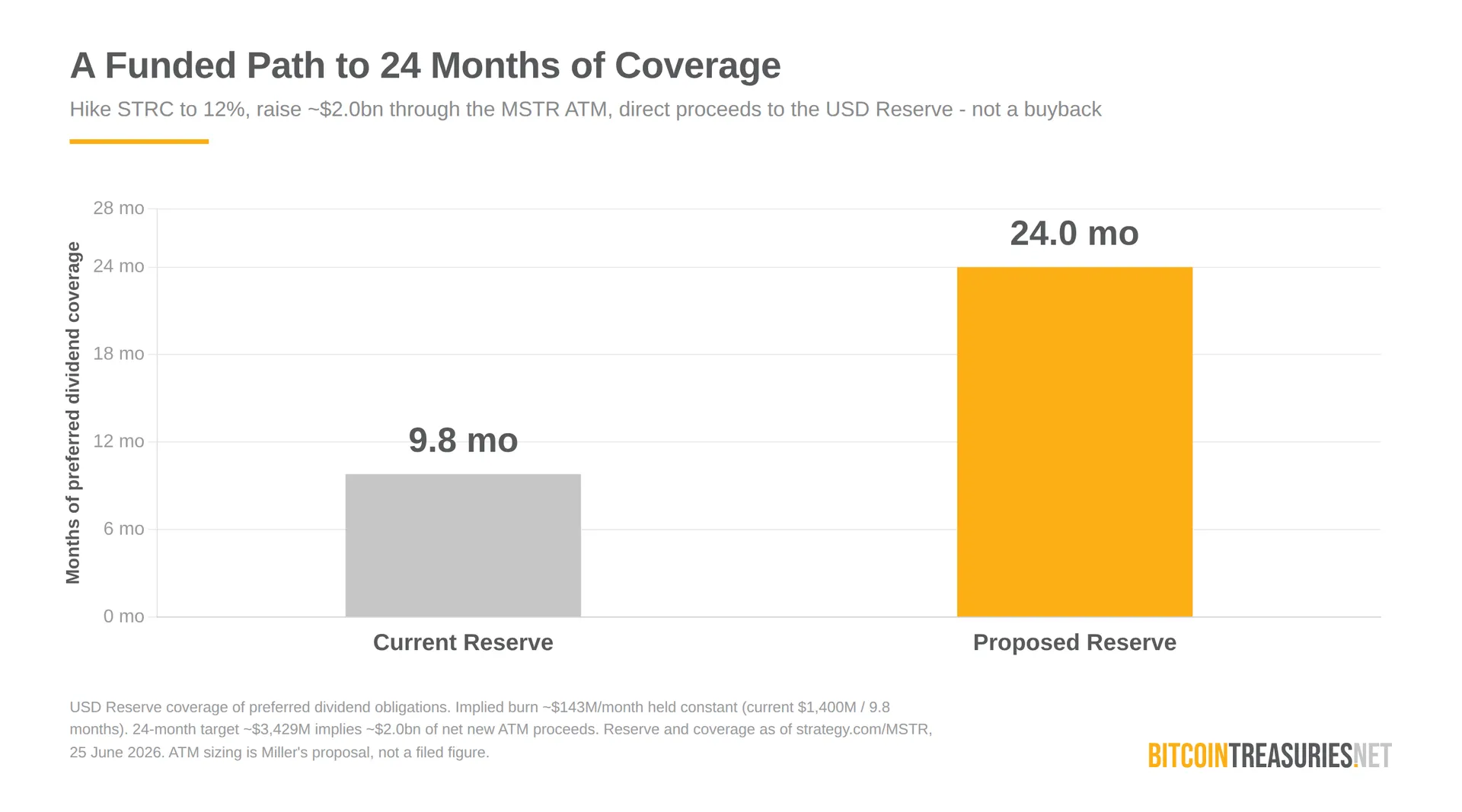
Strategy holds 847,363 Bitcoin behind a $50.6 billion reserve, the largest treasury position in the world. Its USD Reserve, drawn down to $900 million on 1 June, has been rebuilt to $1.4 billion - about 9.8 months of dividend coverage. That recovery is the point. Strategy is already walking the patient path; the reserve is climbing without a buyback, and the rate guidance is about to do its work on schedule. Its own scenarios show it can fund that reserve further by selling MSTR or Bitcoin, or by selling STRC to buy MSTR, each path carrying a different cost to BTC yield. That breadth is the asset. Spend cash to chase STRC back to par and Strategy converts optionality into a commitment, at the widest discount, in the gesture most easily read as defensive.
9.8 months of coverage is not comfortable, and that is the honest tension in the restraint case. But a reserve that is rising answers it better than a buyback that depletes it. Rebuilding from strength honours the framework the company has already published and holds every other lever for a moment when pulling one would signal confidence instead of alarm.
The buyback is a tool Strategy should keep sharp and keep sheathed. I think the argument for buybacks has its place, and is credible, but if I could make the decision, I would let the dividend rate go up to 12% and emphasise this is now the floor for the forseeable (signalling further rate rises to come) and then I would commit Strategy to building towards a 24 month coverage in the USD Reserve. Signalling to the market is a key way for the company to restore the massive damage to confidence done by the dramatic price action of STRC.
The Close
What Strategy does on 1 July will tell the market which instinct is running the treasury. A rate rise in line with the guidance, paired with the reserve rebuild already under way, says the company trusts its own framework and is not panicked. A cash buyback announced into a quarter-below-par discount says it does not. STRC will find its way back to par on the strength of the issuer behind it. That strength is best shown by the lever Strategy chooses not to pull.
Want more bitcoin treasury coverage in your search results? Add Bitcoin Treasuries as a preferred source on Google.