
Strive Announces Daily Dividend Payments for SATA Preferred Stock



Strive announced today, May 14, that SATA will pay dividends every business day beginning June 16. The mechanics are a genuine capital markets innovation. The reason Strive built them is not what the headline suggests.
Six times since SATA's IPO on November 10, 2025, the same pattern has appeared. Volume runs at roughly 0.8 times the 20-day baseline in the sessions before the monthly ex-dividend date. On the day before ex-div it reaches 1.9 times. On ex-div itself it hits 2.0 times. Then it drops below baseline and stays there for five sessions.
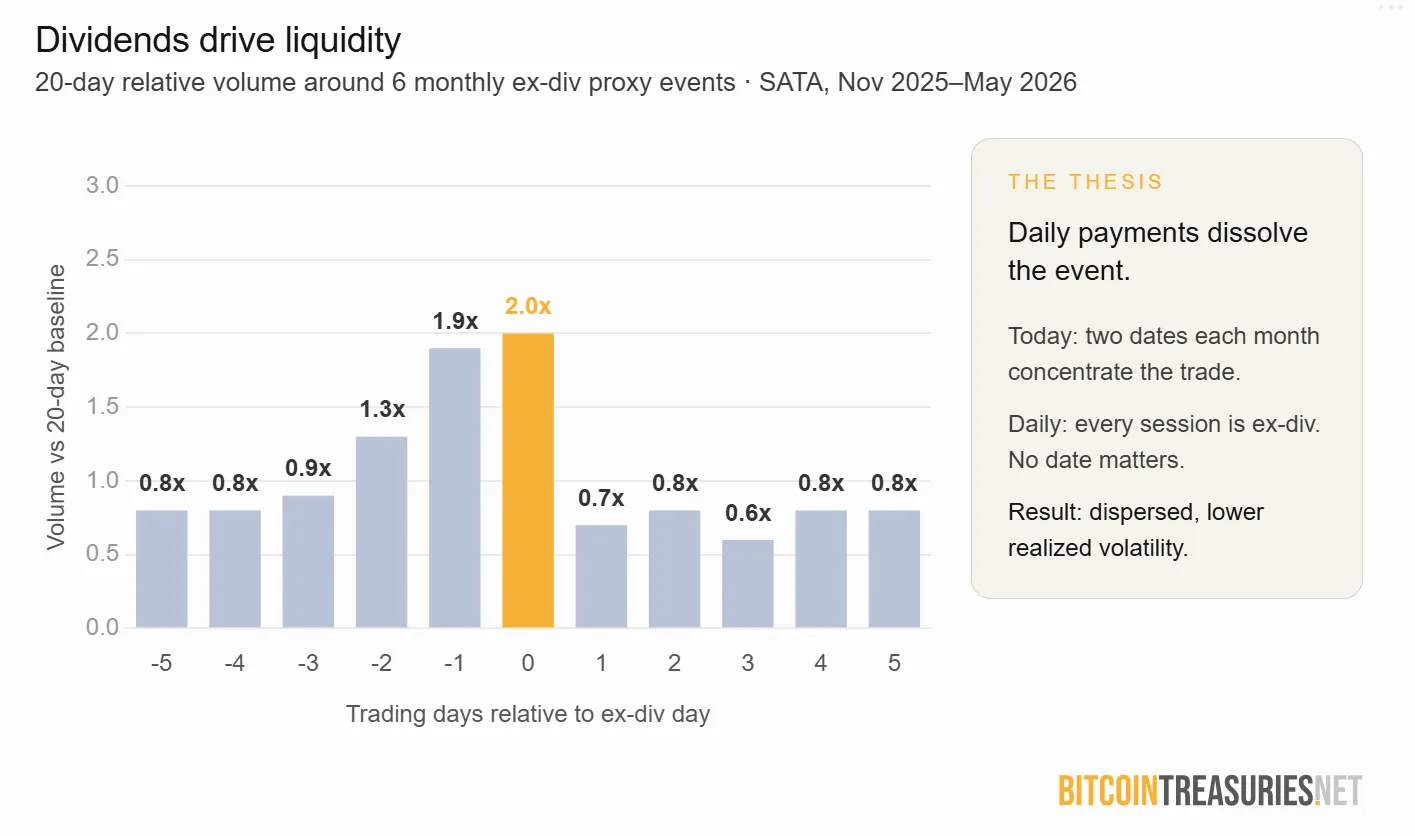
Strive mapped this across all six monthly ex-dividend dates between November 2025 and May 2026. The conclusion was unambiguous. "The dividend mechanism itself is the largest non-fundamental driver of SATA price action today," the investor presentation states. Twelve cash-flow events per year were concentrating volume, dislocating price, and then reversing - not because of anything in the Bitcoin market, but because of the payment schedule.
That is the problem the daily dividend aims to solve. The APY lift, the compounding arithmetic, the marketing tagline - those are all downstream. The primary decision was structural in order to dissolve the event by making every session the event.
The Architecture
Three things had to be true before daily dividends were possible.
The first was a clean balance sheet. During the period from April 1 to May 12, 2026, Strive retired the remaining $10 million in legacy Semler Scientific convertible debt. As of May 12, the company carries no short or long-term debt. No margin requirements. No encumbered Bitcoin. The 15,009 Bitcoin on Strive's balance sheet - approximately $1.2 billion at current prices - sits free and unencumbered. A daily dividend commitment against a balance sheet with debt covenants or margin call mechanics is a different instrument. Against perpetual preferred equity only, it is a funding promise backed by a reserve, not a forced-liquidation risk.
The second was a reserve. Strive holds more than 18 months of SATA dividend coverage in USD and marketable securities. That position includes a $50.5 million holding in Strategy's STRC preferred stock as of March 31, 2026, and $87.6 million in cash and equivalents as of May 12. Against approximately 4.96 million SATA shares outstanding at a $1.08 monthly dividend per share, the coverage arithmetic holds regardless of Bitcoin's near-term price. Matthew Cole was precise on this point in the investor presentation: the reserve exists to manage the product responsibly through Bitcoin volatility, not to fund it indefinitely.
The third was operational. Daily payment required rebuilding relationships with Nasdaq, the DTCC, the transfer agent, and outside counsel. Every single actor in the settlement chain had to be reconstructed for a payment cadence that had no precedent. "Getting here was not obvious," Cole said. "It took months of work across Nasdaq requirements, DTCC mechanics, our transfer agent, our lawyers, and the operational details of what was actually possible. Whenever the answer looked like no, our team kept pushing."
Three conditions: clean balance sheet, funded reserve, rebuilt settlement infrastructure. Strive met all three before making the announcement.
The Mechanics
The calculation adds one step to the existing monthly formula. Monthly dividend: $100 stated amount multiplied by 13% annual rate, divided by 12. Daily dividend: that same monthly amount divided again by the number of business days in the relevant calendar month. For July 2026, with 22 business days, the daily dividend is $0.04924 per share. The monthly cumulative total is preserved. The daily amount floats with business day count - months with fewer business days carry a slightly higher daily figure, months with more carry a lower one.
Record date for each payment is close of the immediately preceding business day. Payment follows on the same business day. Holidays produce no dividend; the following session's record date snaps back to the close of the last active business day. The investor presentation calls this the "holiday hop."
The transition runs in two phases. The final monthly dividend: declared May 13, record date June 1, payment June 15. Then a stub period from June 16 to June 30 - ten business days - at $0.05416 per share per day, for a period total of approximately $0.54 per share. Full daily operation begins July 1.
Dividends are declared monthly for the following month's period. The formula, the record date mechanics, the holiday treatment, and the stub period are defined in the governing documentation. The stated rate - currently 13.00%, raised from 12.75% effective May 16 - remains a board-set variable reset monthly.
The APY Argument
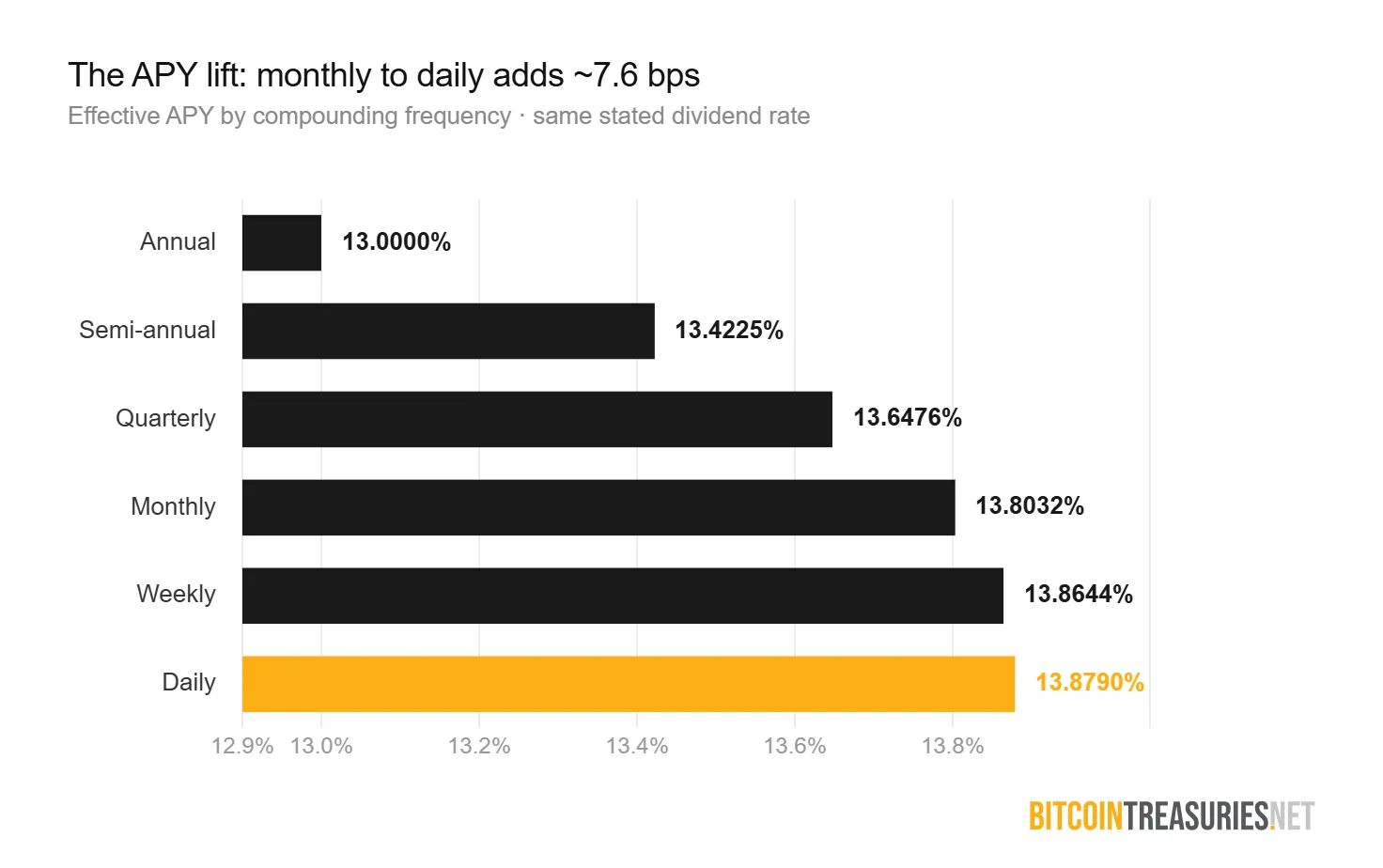
The compounding arithmetic is real but modest. Moving from monthly to daily compounding at a constant 13.00% stated rate raises the effective APY from 13.8032% to 13.8790%, a lift of approximately 7.57 basis points. On $100 stated par, the year-one gain is $0.08. On a $100 million position, roughly $76,000 in year one, accumulating to approximately $2.4 million over ten years before reinvestment. Jeff Walton, presenting the APY section, made no attempt to oversell it: "Modest on its own. Material at scale and in combination with the structural benefits."
The comparison that carries more weight is against the income universe. At 13.0% annualised against a $1 million allocation, SATA generates $130,000 in annual income. HYG, the high-yield bond ETF, generates approximately $64,000 at current yield. A representative money market fund sits at $39,000. The differential over money market on a $1 million allocation is $91,000 per year. The risk profile is categorically different in the eyes of the legacy financial system. SATA is not FDIC insured, is not collateralised by Strive's Bitcoin holdings, and carries no redemption guarantee. But for allocators who understand what Bitcoin-backed perpetual preferred equity is, the income gap is not incremental.
The Downstream Argument
The section of the investor presentation that has received the least attention is the one that may matter most over time.
Walton framed it directly: daily payments are a building block for products that cannot be built on monthly-paying instruments. He identified four. ETFs, where daily payment aligns natively with NAV calculation and eliminates the monthly pricing discontinuity that a lumpy preferred creates. Stablecoins, which by design cannot distribute yield to token holders - SATA at 13% APR paid daily is the complement, not the competitor. Tokenisation, where fractional real-time settlement on blockchain rails maps naturally to a daily payment cadence. Structured products, where continuous cash flow is materially easier to underwrite and rate than twelve annual step-payments.
The conceptual frame Strive is using is Bitcoin's financial layer two. Bitcoin is layer one: raw commodity, long horizon, high volatility. The financial layer two is daily-paid yield, low volatility, short horizon - accessible to the capital allocator who will never self-custody but will hold a listed security that does.
Whether Strive executes on that roadmap is an open question. The architecture is coherent.
The Competition
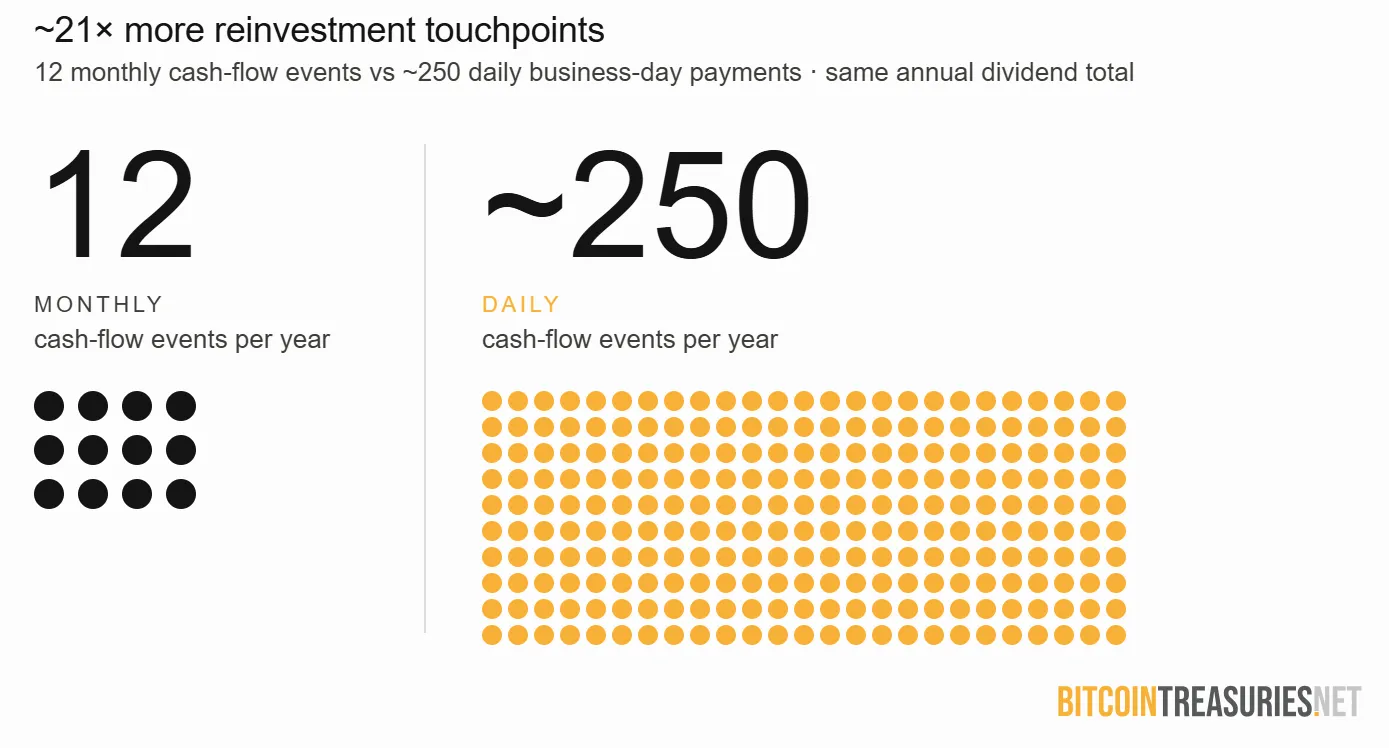
SATA is the second perpetual preferred in the Bitcoin treasury company category, following Strategy. Last month, Strategy announced a proposal to move its STRC instrument from monthly to semi-monthly payments, pending shareholder vote - twelve cash-flow events per year to twenty-four. Strive, effective June 16, will be at approximately 250. The frequency gap between the two instruments is not gradual. It is a structural divergence that will matter to ETF product teams, structured note underwriters, and yield-desk allocators matching payment cadence to downstream obligations.
The balance sheet structures behind those instruments are also different. Strategy combines convertible notes, ATM common equity, and a layered preferred stack - STRK, STRF, STRD, STRC - against 818,869 Bitcoin. Strive holds 15,009 Bitcoin financed entirely through perpetual preferred equity, with no debt. Strive's amplification ratio from preferred equity exceeds 40% as of May 9, 2026, which makes it the highest among Bitcoin treasury companies by its own calculation. The bet Strive is making is that a cleaner, less levered structure, combined with a payment innovation the market has not seen before, compounds Bitcoin per share more reliably over time than a more complex capital stack.
What Remains
Three questions the next twelve months will answer.
The first is rate sustainability. SATA's 13.00% dividend is not fixed - it is a board decision reset monthly. It has moved from 12.25% at inception to 13.00% today. The reserve funds the near term. The question is whether Strive's Bitcoin Yield - 11.1% in Q1 2026, 4.6% quarter-to-date as of May 12 - sustains the accretion needed to support the preferred obligation at current rates without diluting common equity holders past the point of value creation.
The second is the Sharpe ratio trajectory. SATA's inception-to-date price-only Sharpe is 0.56. Including dividend accrual, it is 1.06. Strive's argument is that daily payment will dampen the price-volatility component further as the monthly ex-dividend event dissolves into the background. SATA has realised 26% annualised volatility since IPO against Bitcoin's 47% and ASST's 119% - a beta to Bitcoin of 0.30 against ASST's 1.53. If the microstructure thesis holds, that beta compresses further after June 16. If it does not, the volatility rationale for daily payment was weaker than Strive's own data suggested.
The third is the stress test. SATA holders received $6.36 per share in return-of-capital dividends since inception, including the May 15 payment, while Bitcoin fell approximately 24% from the IPO price. SATA held near par. The 18-month reserve is the mechanism behind that stability. A sustained Bitcoin drawdown beyond that window, without capital markets access to rebuild the reserve, is the scenario where the preferred-only structure faces its first genuine test.
In 1612, the Dutch East India Company paid the first recorded cash dividend in history. In 1969, Realty Income moved to monthly. That was the standard for fifty-seven years. Strive is claiming it has moved to daily, an idea that has survived legal and operational scrutiny across Nasdaq, the DTCC, and transfer agent architecture that had never handled the problem before.
The APY lift is 7.57 basis points. The compounding is real and the comparison to the income universe is favourable. Neither is the point.
The point is that twelve concentrated cash-flow events per year were producing the largest non-fundamental driver of SATA's price volatility - documented, mapped, and solved by the company itself. Daily payment dissolves the event. Every session is ex-dividend day. No date matters more than another.
SATA daily dividend payments begin June 16, 2026. The stated annual dividend rate is 13.00% as of May 16, 2026. Data sourced from Strive's May 14, 2026 press release, Q1 2026 financial statements, and May 2026 investor presentation.
Want more bitcoin treasury coverage in your search results? Add Bitcoin Treasuries as a preferred source on Google.