



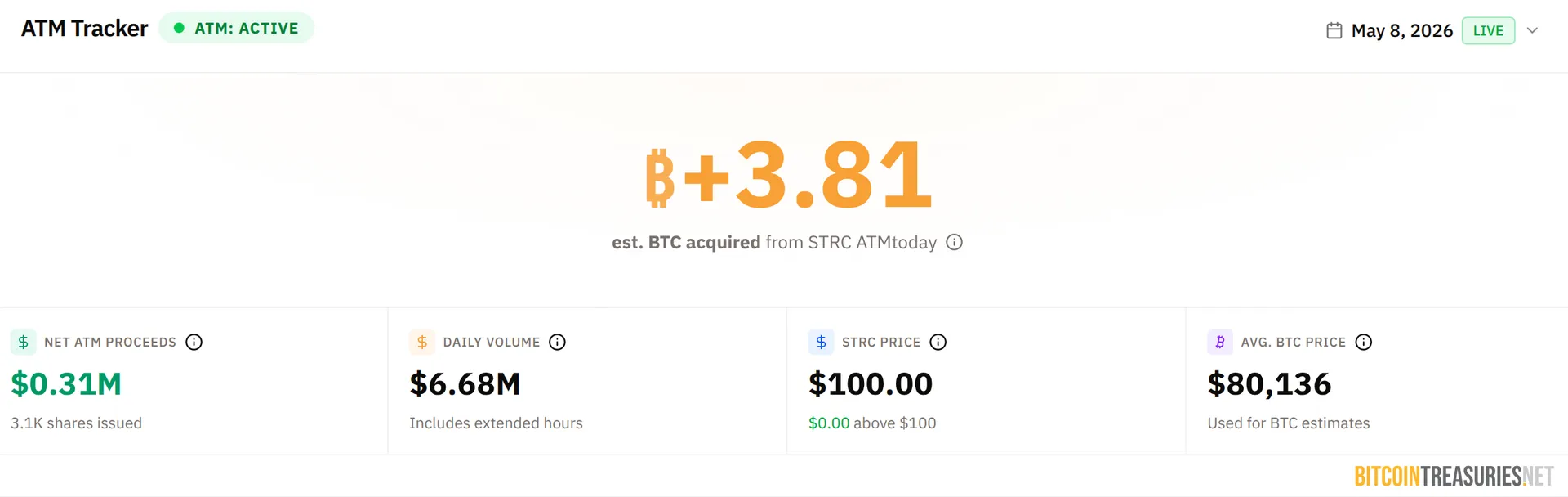
It took longer than usual this month for Strategy’s flagship Stretch preferred stock (STRC) to hit par, but it finally did so today in pre-market trading, touching the $100 mark for the first time in the current cycle.
To put the timing into context: last month STRC reclaimed par on March 30 ahead of the April 15 ex-dividend date, giving Strategy roughly two full weeks of efficient capital raising and aggressive Bitcoin accumulation. This time around, with the May 15 record date now just one week away, the window has shrunk to fewer than five remaining trading days. Whether STRC can generate the explosive volumes seen in prior months remains to be seen, but at first glance it appears to be an uphill battle.
The U.S. market has yet to fully open as of this writing, so the true scale of today’s Bitcoin accumulation is still unknown. We will provide live updates in follow-up coverage. Right now, according to our real-time STRC Bitcoin accumulation tracker, Strategy has raised enough capital through STRC to purchase approximately 3.81 Bitcoin.
This is not to downplay Strategy’s remarkable achievement with the product. STRC has quickly become one of the world’s most liquid preferred stocks, delivering a historic rise in both trading volume and institutional adoption despite being only about ten months old. The economic incentive for investors to buy STRC before the ex-dividend date remains unchanged from previous cycles: a reliable 11.50% annualized variable-rate monthly cash dividend, engineered for price stability near the $100 par value through Strategy’s dynamic rate adjustment mechanism.
One of the largest holders of STRC, Apyx, told BitcoinTreasuries.net that last month Strategy had sufficient demand to raise nearly double the amount of capital actually deployed but chose not to. That pent-up demand could now rush in with less than a week to spare, potentially creating a sharp acceleration in buying pressure.
Still, the late arrival at par has sparked speculation. Some market observers point to large holders repeatedly selling into the market at exactly $99.98, effectively capping the price just below the ATM threshold and delaying new share issuance.
Others cite recent headlines around Strategy’s willingness to sell Bitcoin to help fund dividend obligations. While the math strongly supports the move any BTC sold would be more than offset by the fresh capital raised at favorable terms, headline readers may interpret it as the first visible “crack” in the company’s Bitcoin-maximalist stance. In reality, executives have framed it as a flexible capital-structure tool designed to be accretive to Bitcoin per share over the long term.
Whatever the precise reasons for the delayed recovery, the core appeal of STRC endures. The instrument continues to channel fixed-income capital from pension funds, insurance companies, money-market funds, and retail investors directly into physical Bitcoin, all while offering low volatility, monthly cash payouts, and often favorable tax treatment as return of capital.
Strategy retains billions in dry powder under its at-the-market programs. With STRC now back at par, the accumulation engine is once again primed. Whether this compressed timeline produces another record-breaking week or a more measured ramp-up, we will be tracking every BTC purchased in real time.
Stay tuned to BitcoinTreasuries.net for the latest on STRC volumes, Bitcoin purchases, and the broader implications for corporate Bitcoin treasuries. The Stretch strategy continues to evolve, but its role as the most efficient Bitcoin capital-formation vehicle in the market remains firmly intact.
Want more bitcoin treasury coverage in your search results? Add Bitcoin Treasuries as a preferred source on Google.