



Nine months ago, STRC didn't exist. Today, it purchased more bitcoin in a single session than Strategy bought in all of August 2025. Tomorrow, STRC goes ex-dividend for the ninth time – and the demand has never been stronger.
Tomorrow, Strategy’s Variable Rate Series A Perpetual Stretch Preferred Stock goes ex-dividend for the ninth time. For anyone who has tracked this instrument since its IPO last July, the occasion is worth marking. Not because anything dramatic is expected to happen, but because drama is precisely what no longer happens.
When STRC launched at $90 per share and settled to a $100 par target, the post-ex-dividend sell-off was an open question. Preferred stocks routinely drop by the dividend amount on their ex-date as buyers who missed the record date reprice. In August 2025, STRC closed $3.05 below par on its first ex-dividend date. In September, it closed at $3.10. The instrument was working as designed, but the market hadn’t yet decided how quickly it wanted to bring prices back.
Eight months later, the answer is clear.
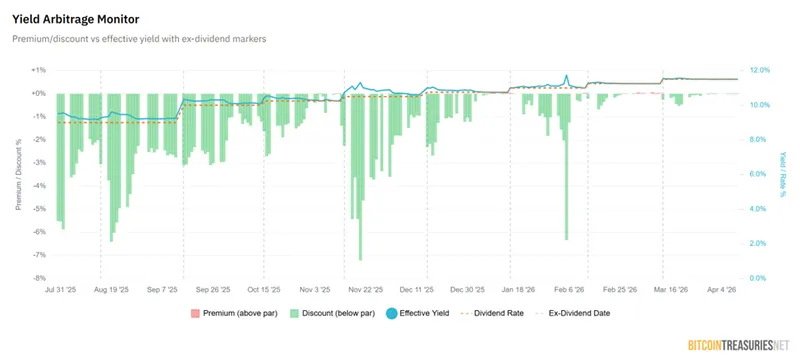
The Sell-Off Is Shrinking
The post-ex-dividend closing price tells the story month by month. When we look at the closing price after the ex-div date, we can see a trend forming.
August: $96.95. September: $96.90. November slipped back to $97.76. Through December, the stock had yet to demonstrate that a clean, fast return to par was structurally reliable.
Then January arrived. STRC closed at $99.99 after its January 15 ex-dividend date. February: $99.80. March: $99.69. Three consecutive months inside a $0.31 band below par, with recovery times measured in single-digit trading days rather than full monthly cycles.
By late March, STRC had bounced back faster than its historical average, requiring roughly nine days to return to $100.
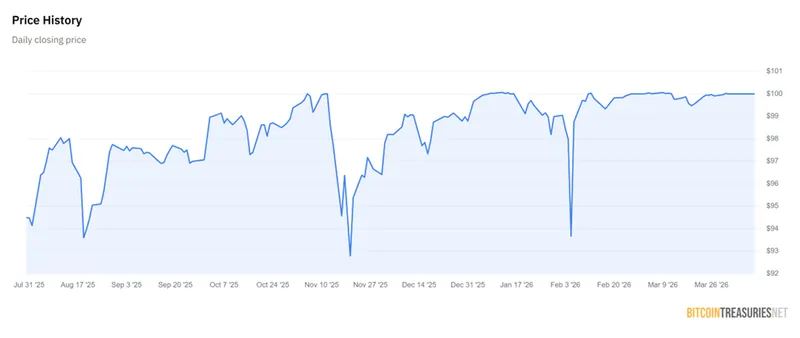
The Mechanism Is Working
STRC’s variable dividend rate is the structural engine behind this stability.
Rather than a fixed yield, Strategy’s board adjusts the rate monthly using a published framework tied to STRC’s five-day volume-weighted average price. If STRC trades below $95, a minimum increase of 50 basis points is triggered, and a move of at least 25 bps is triggered between $95 and $99. Trading above $101 invites a reduction or a follow-on offering.
From launch through March, that mechanism produced seven consecutive rate increases, from 9.00% to 11.50%, adding 250 basis points in total. Each increase raised the income proposition for new buyers, creating demand pressure that pulled the price back toward $100 whenever it dipped. The mechanism acts as a price thermostat — when STRC runs cold, the yield gets hotter.
For April, Strategy held the rate at 11.50%. This was the first time since launch that the rate was not increased. The board cited a 30-day VWAP of approximately $99.95, squarely within the no-change band.
The STRC thermostat has reached its target temperature. The system was successful.
What STRC Has Funded
Since the March 13 ex-dividend date, Strategy has acquired approximately 42,166 BTC for close to $2.98 billion, bringing total holdings to 780,897 BTC — roughly 3.7% of the total supply that will ever exist. STRC initially acted as the supporting act to the ATM, but it has quickly become the primary engine for the Strategy accumulation machine.
The week of March 9-15, Strategy deployed approximately $1.57 billion to purchase bitcoin, with roughly 75% funded via STRC ATM sales. The April 6-12 purchase of 13,927 BTC for $1 billion was funded entirely through STRC. When Strategy needs capital to accumulate, it is increasingly reaching for Stretch first.
Trading volume has tracked this expanding role. The day before last month’s ex-dividend date — March 12 — STRC recorded 7.47 million shares traded, a single-session record equivalent to roughly $747 million in dollar volume.
On Monday, we reached over $1 billion with two days to go. By the end of today, we will likely eclipse that figure. Month by month, more capital is moving through this instrument.
Yesterday, Strategy deployed STRC to purchase approximately 11,500 BTC. This absolutely destroyed the previous daily record of approximately 4,038 BTC. To put that into perspective, STRC allowed Strategy to purchase over 0.05% of Bitcoin that will ever exist during one trading session.
What Tomorrow Might Show
The most recent post-ex-dividend trough was a low of $99.69. The trend line is simple enough to invite a question: Will STRC close tomorrow above $99.69? Does the market, which has learned this instrument’s rhythm over eight ex-dividend cycles, finally price the sell-off away entirely?
There is nothing guaranteed about that outcome. The dividend amount of $0.9583 per share at 11.50% on $100 par still creates a mechanical incentive to sell after the record date. Macro conditions, bitcoin price movements, and broader risk sentiment all bear on intraday trading in a preferred stock that sits at the apex of a Bitcoin treasury capital structure.
Yet we see a pattern developing. Each month, the market absorbs the dividend payment with less disruption than the month before. The instrument’s holder base — roughly 80% retail, with institutional names including BlackRock, Fidelity, and Capital Group — has developed a working understanding of how STRC behaves around its ex-date. That understanding is itself a form of market infrastructure.
STRC launched nine months ago, priced at $90. It has since funded billions in bitcoin accumulation, delivered 100% return-of-capital tax treatment, and held its rate at 11.50% against a 30-day VWAP of $99.95.
An instrument that has not existed for a full year is already trading like one that has been around much longer. The question for tomorrow is whether the market is ready to show it.
Want more bitcoin treasury coverage in your search results? Add Bitcoin Treasuries as a preferred source on Google.