
Strategy's Hidden Funding Spread - And Why It Changes Everything



When Strategy disclosed its mNAV accretion floor at Q1 2026 earnings, it wasn't issuing guidance. It was publishing the architecture of a synthetic funding curve - and confirming that the metric most investors treat as a sentiment gauge has become the primary variable in the company's cost of capital.
Before STRC, mNAV Was Decorative
For the first four years of Strategy's Bitcoin accumulation programme, mNAV - the ratio of the company's market capitalisation to the value of its Bitcoin reserves - functioned as a valuation premium. It told you how much the market was paying above the underlying asset. Analytically useful, operationally inert. Nothing in the capital structure was contingent on where it traded.
That changed with the launch of STRC.
The Instrument That Converted mNAV Into a Spread
Launched in July 2025, Strategy's Variable Rate Perpetual Stretch Preferred Stock is now the largest tradable preferred equity instrument in the world at $8.5 billion outstanding.
Critically, STRC is not a fixed-rate instrument. It is a perpetual floating-rate preferred with SOFR as its contractual floor. Saylor described it at Q1 earnings as a perpetual swap: "We're paying SOFR plus a credit spread. We are taking back the Bitcoin return. The debt is never coming due." The stochastic cost of capital, accounting for SOFR cycles and credit spread compression over time, is in Strategy's own modelling closer to 875 basis points than 11.5%. The headline yield is a current condition, not a permanent funding cost.
What STRC does to the capital structure is introduce a live funding obligation the equity engine must service. The efficiency with which MSTR issuance covers that obligation is a direct function of where MSTR trades relative to its Bitcoin NAV. mNAV became the spread.
The 1.22x Floor
At Q1 2026 earnings, Phong Le said what the market has been slow to absorb: "Bitcoin per share accretion is our primary goal. mNAV is an input. The threshold for Bitcoin per share accretion when selling our equity and buying Bitcoin is increasing over time. Where it used to be a 1.0x mNAV, as we add debt and as we add preferred primarily to our structure, the break-even increases. Right now, it's about 1.22x."
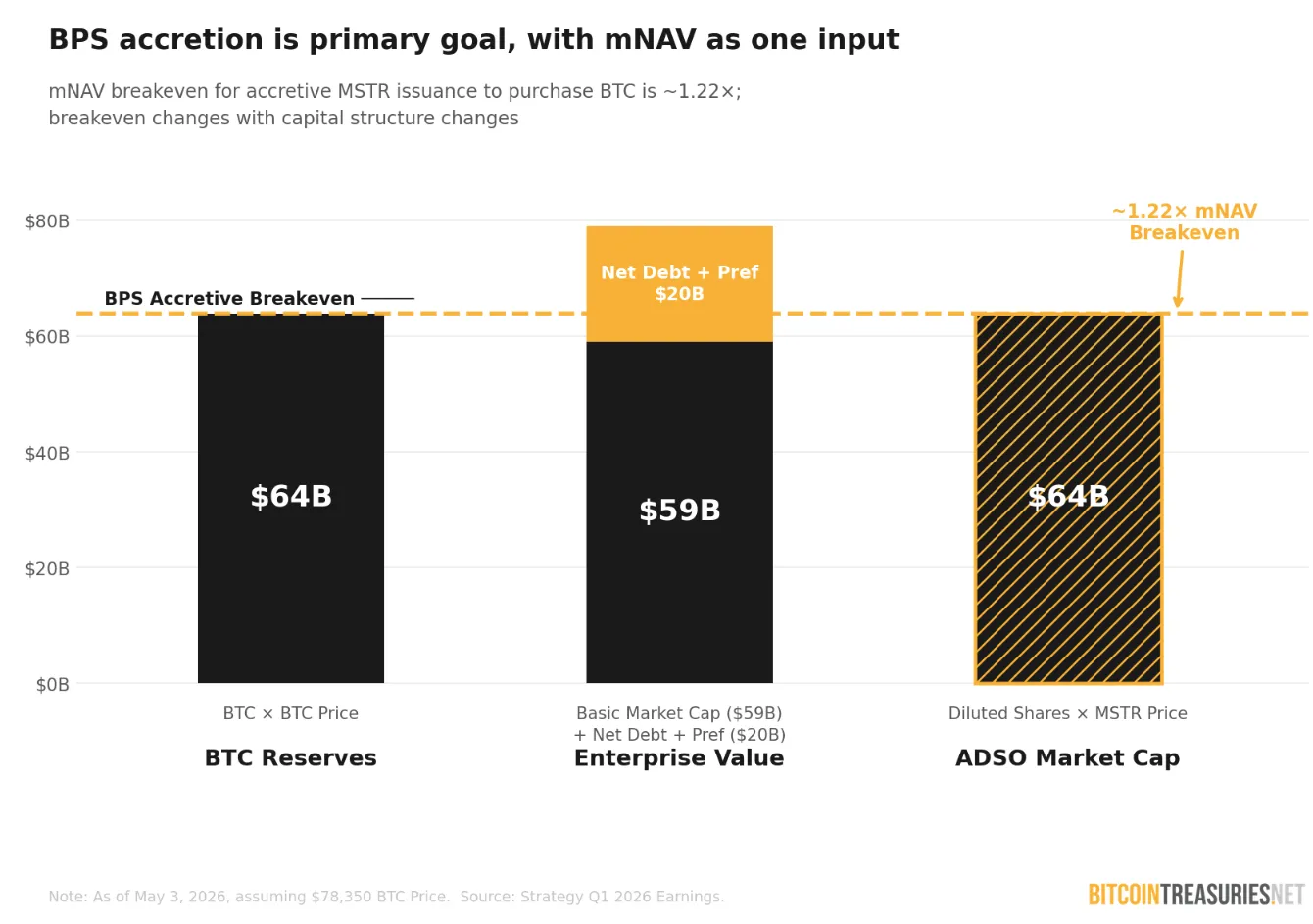
The 1.22x level is not a target. It is an accretion floor - the level below which issuing MSTR equity to buy Bitcoin becomes dilutive on a Bitcoin-per-share basis. At exactly 1.22x, the trade breaks even: equity is sold at a premium just sufficient to offset all senior obligations - $8.2 billion in convertible notes and $9 billion in preferred equity - with zero marginal BPS gain. Above it, every additional point of premium generates positive carry. Below it, the logic inverts.
Phong Le drew out the operational consequence directly: below 1.22x, it is more efficient to sell Bitcoin than to issue equity. "It is actually more accretive for us to sell Bitcoin and pay off our dividends than it is above 1.22x mNAV." Strategy has publicly confirmed it will sell Bitcoin when equity is trading weak. The premise that Strategy would never sell Bitcoin is retired on its own terms, not under duress.
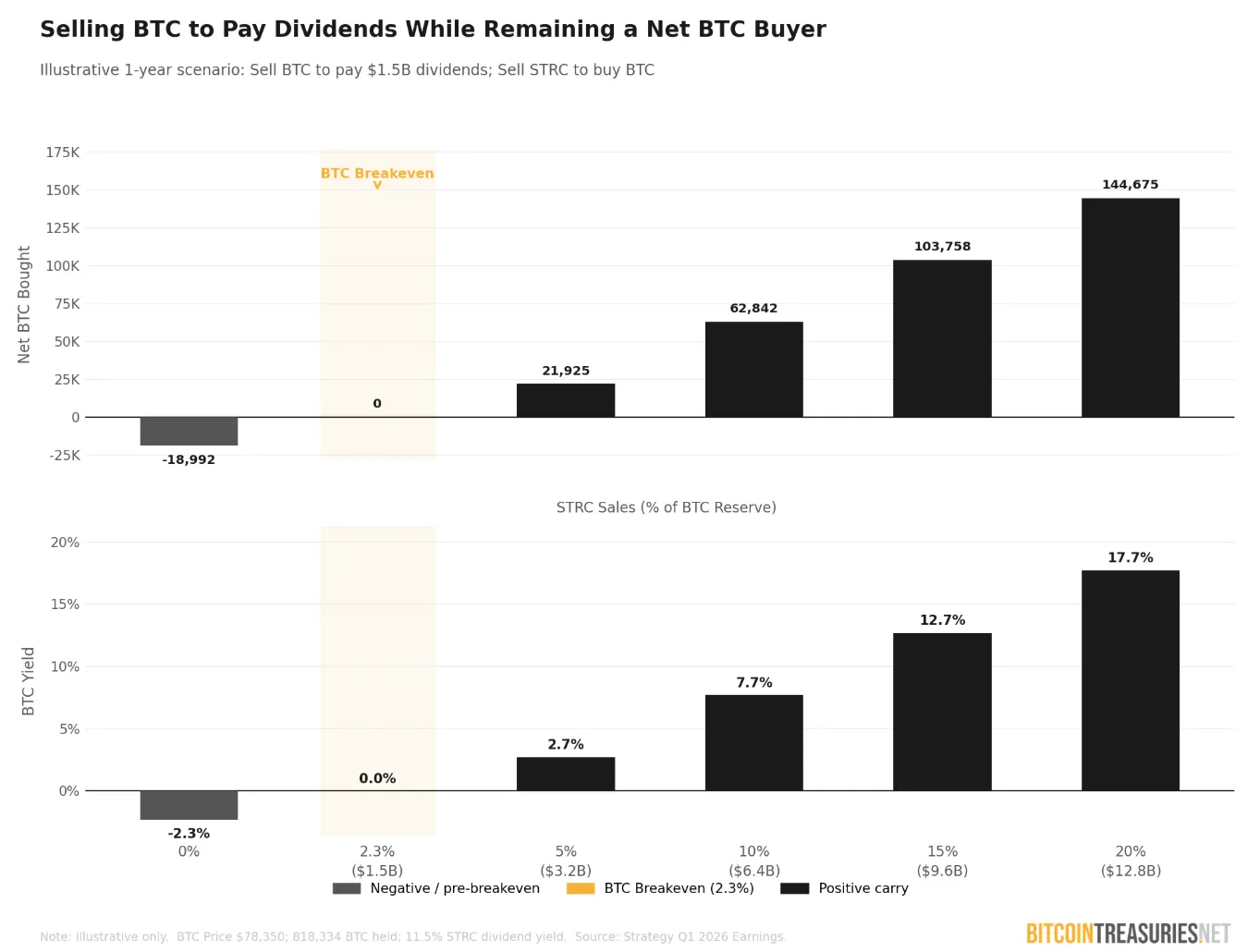
The floor is not static. It was 1.0x when the capital structure was simpler. It has risen as converts and preferreds were layered in, and will fall back toward 1.0x as Strategy retires its six convertible notes - a stated objective. The floor tracks the capital structure in real time as a derived output.
The Shape of the Curve
Saylor provided the actual funding curve data at Q1 earnings. Funding $1 billion of dividend obligations via MSTR equity at exactly 1.22x mNAV costs 156 basis points of BTC per share - roughly equivalent to selling Bitcoin directly to cover the same obligation. At 2.0x mNAV, that cost falls to 83 basis points. The mNAV level governs the dilution cost of servicing preferred obligations.
Analyst Grain of Salt ( @Z06Z07 ) was among the first to frame this publicly: the real spread is not STRC yield versus SOFR, but mNAV premium versus STRC funding cost. The heat map - red at destructive regimes through to dark green at convex accretion - is directionally accurate. One clarification is warranted: the 1.22x floor already incorporates the STRC funding cost. It is not separately subtracted from the mNAV spread. What the spread above 1.22x measures is marginal accretion efficiency above break-even, not gross carry minus funding drag.
BTC Yield as Sustainability Threshold
Strategy's BTC Yield - the percentage change in Bitcoin holdings per assumed diluted share - was established structurally at Q1 earnings: "Our objective is to double Bitcoin per share in seven years. Doubling Bitcoin per share in seven years implies about a 10% annualised BTC yield."
That 10% is not a near-term target. Strategy's FY2025 BTC Yield guidance ran at 22–26%, reflecting the pace of an accelerated accumulation cycle. The 10% is the structural floor of which the minimum annualised accretion rate at which the long-term promise holds. With YTD 2026 BTC Yield at 9.4% through four months, during a bear cycle, the system is tracking its minimum viable rate. BTC Yield is the output variable of the entire machine. mNAV and STRC cost together determine its magnitude.
What This Means for the Sector
Strategy is the only Bitcoin treasury company to have published an explicit mNAV accretion floor. The implications extend beyond its own capital structure.
A published floor implies a published discipline. Below 1.22x, Strategy does not issue equity to buy Bitcoin - it sells Bitcoin, retires debt, or deploys reserves. The capital structure responds to the mNAV signal dynamically. That is a different operating posture than the unconditional accumulation reflex that characterised 2020–2024, and it sets a precedent the rest of the sector will eventually have to meet.
For every other treasury company operating without an equivalent framework, the question is now unavoidable: at what mNAV does your equity issuance stop being accretive?
The floor will fall as converts are retired. Tracking that number across successive earnings calls is now a meaningful capital discipline indicator rather than just a valuation gauge.
Before STRC, mNAV told you what the market thought of Strategy. After STRC, mNAV tells you how Strategy runs its business. The distinction is not semantic. It is the difference between a gauge and a policy rate.
Want more bitcoin treasury coverage in your search results? Add Bitcoin Treasuries as a preferred source on Google.