



The fee is 0.14%. The story is nine years of institutional capitulation, 16,000 financial advisors, and $9.3 trillion in client assets finally pointed at Bitcoin.
Morgan Stanley's spot Bitcoin ETF - ticker MSBT, listed on NYSE Arca on April 8 - gives investors clean, 1:1 price exposure to Bitcoin at the lowest fee in the US market. No leverage. No corporate risk. No yield.
Compare it to the other instruments in this ecosystem. MSTR equity is leveraged exposure - Strategy's capital stack of convertible debt and perpetual preferred securities amplifies Bitcoin price moves in both directions. VanEck's research puts MSTR's 30-day historical volatility at roughly 113%, against Bitcoin's own 55%. The investor buying MSTR is making a bet on Bitcoin and on the financial engineering layered on top of it - the mNAV premium, the capital raise cadence, the accumulation flywheel. That is a fundamentally different risk profile to holding a spot ETF. MSTR has risen roughly 250% since IBIT launched in January 2024; IBIT has gained around 55% over the same period.
Then there is STRC - Strategy's Variable Rate Series A Perpetual Preferred Stock, currently yielding 11.5% annually, paid monthly. And Strive's SATA, recently raised to 13%. These instruments are not price plays. They are income instruments. The investor buying STRC or SATA is not seeking Bitcoin beta - they want yield denominated in the Bitcoin economy, with the Bitcoin treasury companies' balance sheets as counterparty. It is a structurally different product serving a structurally different need.
MSBT sits at the other end of this spectrum entirely. It is Bitcoin exposure with none of the above complexity - no leverage, no mNAV, no preferred stock, no yield. For the advisor managing a high-net-worth portfolio who needs a clean, regulated allocation to Bitcoin, that simplicity is exactly the point. This is appealing; we've seen 13 consecutive days on inflows.
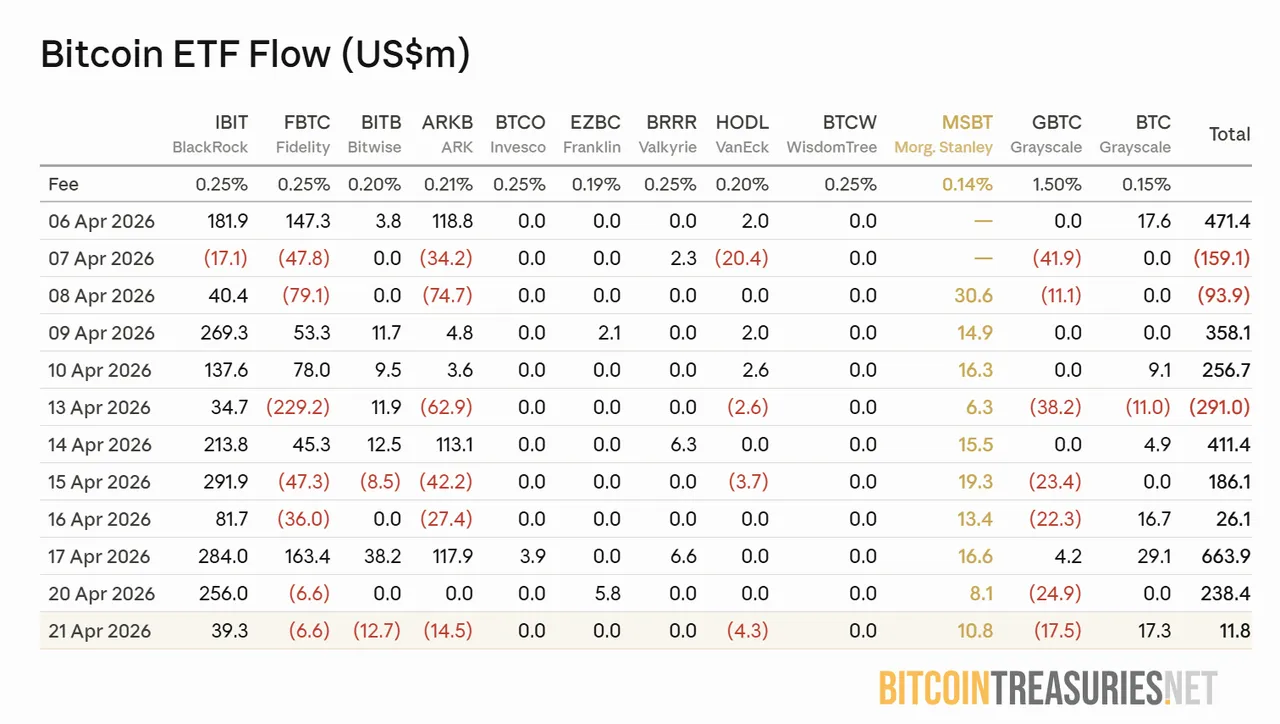
What differentiates MSBT from IBIT is not the eleven basis points, it is the channel. Morgan Stanley employs approximately 16,000 financial advisors. Its wealth management division reported fee-based client assets of $2.79 trillion and net new assets of $118 billion in Q1 2026 alone, per the company's earnings release filed with the SEC on April 15. Apply the bank's own two-to-four percent crypto allocation guidance - issued by its Global Investment Committee in October 2025 - to that fee-based base, and the theoretical addressable flow sits between $55 billion and $111 billion.
Before MSBT existed, Morgan Stanley's advisors who recommended Bitcoin ETFs were directing client capital to BlackRock and Fidelity. The management fee left the house. MSBT redirects that fee. More importantly, it gives advisors a proprietary product they can recommend within the firm's own positioning framework - at the allocation level the firm itself has defined as appropriate. That changes the internal incentive structure thoroughly.
Amy Oldenburg, Morgan Stanley's head of digital asset strategy, noted in March 2026 that roughly 80% of crypto ETF activity on the firm's platform is still coming through self-directed accounts rather than advisor-managed portfolios. That figure matters. It means the advisor-guided channel - the one MSBT is specifically built to activate - is largely untapped.
How Far They've Come
The institutional context is worth acknowledging. In December 2017, Morgan Stanley analyst James Faucette published a research note concluding Bitcoin's fair value could be zero. On April 8, 2026, the firm's CEO put its name on a spot Bitcoin ETF. The journey from one to the other - through Gorman's years of scepticism, through Pick's Davos remarks about escape velocity, through the GIC's October 2025 report framing Bitcoin as a scarce asset akin to digital gold - took less than nine years. That shows the maturation of Bitcoin as an asset class.
Who This Investor Is
The two-to-four percent allocation guidance tells you the investor profile precisely. This is not the investor who has studied mNAV compression or understands how STRC's variable rate mechanism has behaved across seven consecutive monthly increases. This is the cautious, fiduciary-guided, high-net-worth client who wants Bitcoin represented in a managed portfolio without engaging directly with the asset. For that investor, the Morgan Stanley brand, the advisor relationship, and the familiar ETF structure are the conditions that make the allocation possible at all. Two to four percent is not conviction capital. But across Morgan Stanley's client base, it is not a small number either and once it becomes a standard line item in managed portfolios, the barrier to increasing it over time drops.
Looking Forward
MSBT is one piece of a larger build. Morgan Stanley is simultaneously launching retail spot Bitcoin trading for self-directed clients in the first half of 2026, using Zerohash for custody and settlement infrastructure - advisor-guided ETF exposure at one tier, direct retail trading underneath. They are building the architecture of a multi-channel Bitcoin distribution system built inside one of the largest financial institutions in the world.
Goldman Sachs has already filed for a Bitcoin Premium Income ETF using options strategies. The second wave of bank-issued Bitcoin products is forming, and it is moving toward structured income and yield - not more spot ETFs.
The deepest question is what happens to Bitcoin's demand structure if advisor-guided allocation becomes a permanent channel rather than a one-time event. Financial advisors at this level establish positions and hold them. If two to four percent in Bitcoin becomes conventional across the wealth management industry, the market acquires a durable buyer class - patient, fiduciary-guided capital - that did not meaningfully exist five years ago.
A firm that once put Bitcoin's fair value at zero is now the first major bank to put its name on a spot Bitcoin ETF. The question now is scale.
Want more bitcoin treasury coverage in your search results? Add Bitcoin Treasuries as a preferred source on Google.