
How Metaplanet Bought a $13 Million Shortcut for Its Preferred Shares



The acquisition of Siiibo Securities is dressed up as Project Nova. Read more carefully and it looks like a licence to go around the exchange rules blocking Mars and Mercury.
The $13 Million Problem Solver
Metaplanet announced on 12 June that it has signed a share-transfer agreement to acquire 100 per cent of Siiibo Securities Co., Ltd. for ¥2.1 billion, or roughly $13.1 million. The deal is expected to close on 13 July. Siiibo will be rebranded Metaplanet Securities Inc. and slotted inside the group as a wholly owned subsidiary.
On its face, the acquisition is straightforward: Japan's largest corporate Bitcoin holder, sitting on 40,177 BTC as of 31 May 2026 - the third-largest corporate Bitcoin position in the world - is buying a small Tokyo brokerage to gain distribution reach into a household savings market Gerovich puts at ¥1,140 trillion ($7.4 trillion).
Dig into what Siiibo actually brings and the strategic logic sharpens considerably. Siiibo holds a Type I Financial Instruments Business Operator registration under Japan's Financial Instruments and Exchange Act. That licence is the permission slip for structuring and distributing securities products to retail investors in Japan. Metaplanet, as a Tokyo Stock Exchange-listed operating company, did not have one. Now it will.
What Siiibo Is
Founded in January 2019, Siiibo built its name in Japan's online corporate bond market - a segment historically walled off from retail investors by minimum ticket size and distribution infrastructure. The company backed more than 40 corporate issuers across more than 100 bond offerings, building the most substantial operational track record in Japan's retail private placement bond market.
The firm is small and, by available accounts, loss-making at the operating level. Its value to Metaplanet is not the income statement. It is the licence and the digital platform sitting behind it. Metaplanet is acquiring regulatory infrastructure, not revenue.
Gerovich was direct on this point: "By bringing Siiibo's Type I registration and online securities platform into the group, we will develop and distribute bitcoin-related yield products directly to Japanese investors, supported by the 40,177 BTC on our balance sheet." Project Nova - Metaplanet's stated medium-to-long-term strategy to build a Bitcoin-centric financial ecosystem in Japan - gets its first concrete move.
The Preferred Equity Problem This Solves
In November 2025, Metaplanet announced a two-tier listed preferred share programme: Mercury, a perpetual convertible instrument modelled on Strategy's STRK paying 4.9 per cent in yen with quarterly dividends, and Mars, a shorter-duration high-yield instrument modelled on Strategy's STRC. The company intended both to list on the Tokyo Stock Exchange, positioning them as the sixth and seventh listed preferred equities in Japan - and the first-ever perpetual preferred shares the market had seen.

On 13 May 2026, Gerovich disclosed that both listings had been delayed. The reasons were structural, not regulatory hostility. Japanese exchange rules require preferred dividends to be backed by sustainable, recurring cash flows assessed across multiple market conditions. Metaplanet's Bitcoin Income Generation Business had six quarters of operating history. The exchange wanted more. Separately, Metaplanet's ambition to pay monthly dividends - against a Japanese norm of annual or semi-annual payouts - required building dividend infrastructure that did not yet exist.
The company was caught in a familiar position for innovators in Japan's capital markets: the product is ready, the investor demand plausibly exists, and the regulatory framework is designed for a market that has not yet seen the instrument you want to issue.
The Siiibo acquisition does not dissolve this problem. The exchange listing constraints on Mars and Mercury remain. Metaplanet still needs to demonstrate track record. But the Type I licence changes the geometry of the situation in one important respect: Metaplanet no longer requires exchange listing as the sole pathway to distribute Bitcoin-linked preferred instruments to Japanese retail investors. A company with a Type I licence can structure and distribute financial products directly - private placement, direct offer, online platform - without routing everything through a listed market.
The implication is not stated anywhere in Metaplanet's Project Nova materials. It does not need to be. The infrastructure to conduct private placement of yield-bearing securities is now inside the group. Siiibo's existing bond platform is already configured for exactly this mode of distribution.
A Parallel Track to 100,000 BTC
The scale argument matters here. Metaplanet held 40,177 BTC against targets of 100,000 BTC by end-2026 and 210,000 BTC by end-2027. That capital programme requires sources of capital that go beyond moving-strike warrants and common equity dilution. Preferred instruments - whether listed or privately placed - represent a structurally different cost of capital: senior to common equity, offering fixed yield, and capable of drawing investors who cannot or will not hold common stock in a Bitcoin treasury company.
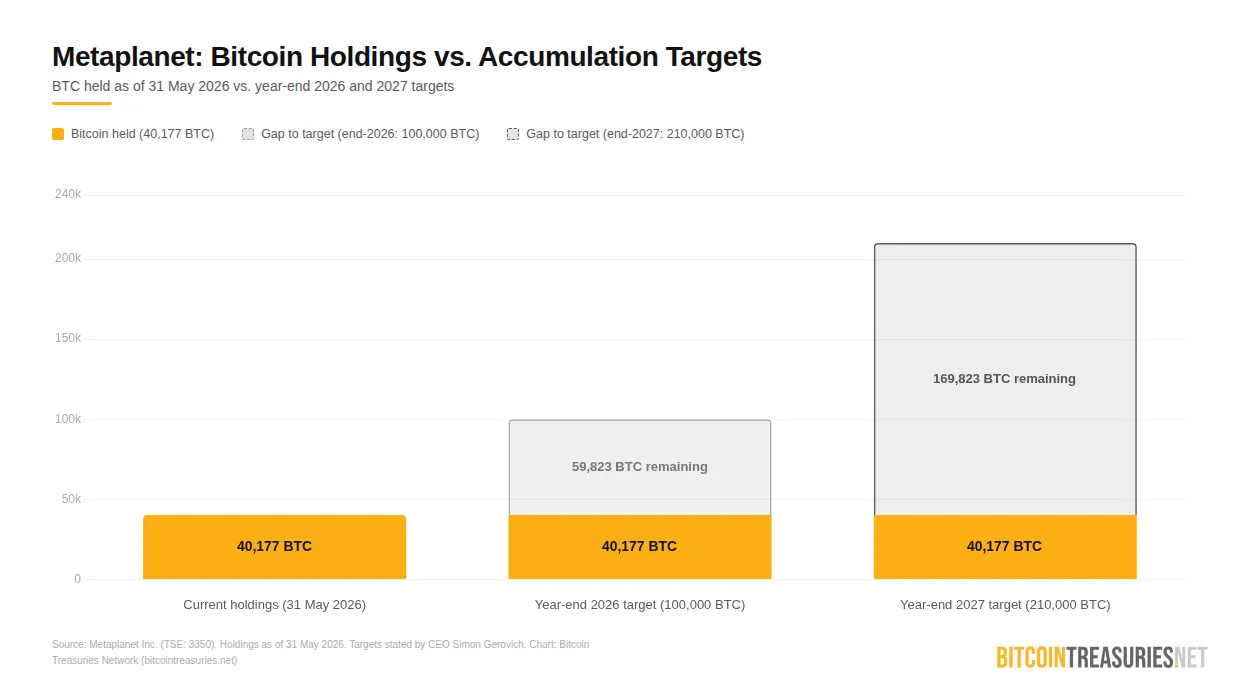
The $7.4 trillion sitting in Japanese household cash and deposits is the addressable market Gerovich keeps returning to. For most of those savers, buying Metaplanet common stock - a single company with a leveraged Bitcoin position, down roughly 82 per cent from its year-ago high - is not an accessible risk. A yen-denominated, yield-bearing, Bitcoin-linked security sold through a regulated platform is a materially different proposition. It meets them where their existing risk tolerance sits.
Siiibo's 40-plus issuer network and 100-plus bond track record gives Metaplanet Securities an operational standing start for exactly this kind of product. The company does not need to build credibility in Japan's retail bond market. It acquired it.
The Constraint That Remains
None of this eliminates the exchange's cash-flow requirement. If Metaplanet wants Mars and Mercury listed on the Tokyo Stock Exchange - which would provide secondary market liquidity, price discovery, and broader institutional access - it still needs to demonstrate that its Bitcoin Income Generation Business produces stable returns across adverse market conditions. A Q1 2026 that generated ¥114.5 billion in non-cash mark-to-market losses, however operationally profitable the underlying business, is not the track record an exchange requires.
The moving-strike warrant mechanism Metaplanet uses in place of the ATM issuance that Japanese rules prohibit creates its own friction. Strategy can continuously reload capital through its STRC ATM programme; Metaplanet's equivalent requires sequential warrant exercises and third-party allotments. Private placement distribution through Metaplanet Securities does not fix that capital-raising cadence. It is a distribution pathway, not a capital structure solution.
What the Siiibo acquisition does is buy Metaplanet time and optionality. The exchange listing for Mars and Mercury may come when the operating track record is long enough to satisfy exchange rules - Gerovich has said the company remains committed to listing. In the interim, Metaplanet Securities gives the company a compliant, regulated mechanism to test product-market fit, build a yield investor base, and generate the operational evidence an exchange will eventually want to see.
Project Nova's First Move Is Its Most Revealing
Metaplanet spent two years building the largest Bitcoin treasury in Asia through a combination of moving-strike warrants, bond issuance, and common equity raises. Project Nova represents the pivot from accumulator to platform. The Siiibo acquisition, small in cost terms at $13.1 million, signals that the platform phase has begun.
The preferred equity programme was announced in November 2025 with momentum behind it. By May 2026, it had stalled. By June 2026, Metaplanet owns a Type I licence. The sequencing is not coincidental.
Whether Gerovich frames this as an acceleration of the preferred timeline, a parallel track, or simply the opening move of a broader financial ecosystem story, the practical effect is the same: Metaplanet now has the regulatory standing to distribute Bitcoin-linked yield products to Japan's retail investors without waiting for the exchange to update its framework. It paid $13 million for the right to stop asking for permission.
Want more bitcoin treasury coverage in your search results? Add Bitcoin Treasuries as a preferred source on Google.