
How Preferred Equity Is Separating Bitcoin Treasury Winners in 2026



Five Bitcoin treasuries, one capital structure spectrum, and a sorting mechanism the market has begun pricing in real time.
The recent 2026 rally has shown, in live market data, exactly what a preferred equity stack does to a Bitcoin treasury company's equity returns. The companies running one are pulling ahead. The companies building toward one are watching closely.
The variable separating Bitcoin treasury company returns in 2026 is not the size of the Bitcoin position. It is capital structure.
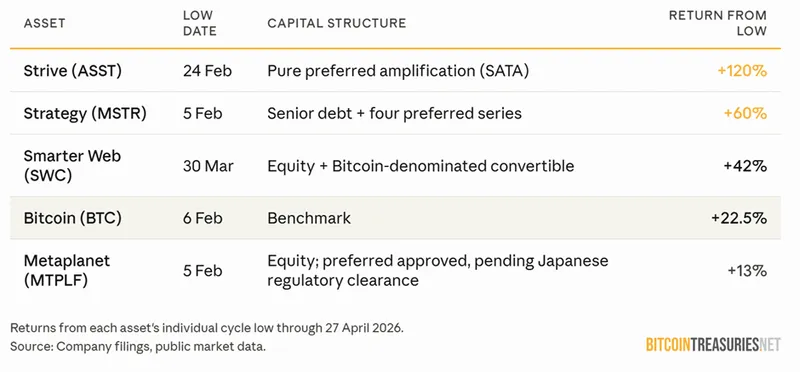
Strategy is up roughly 60% from its 5 February low. Strive is up around 120% from its 24 February low. Bitcoin itself is up 22.5% from its February 6th floor. Both treasury companies are outperforming the underlying asset by a wide margin, and both are doing so through the same mechanism: preferred equity instruments that raise capital at a fixed or variable cost, buy Bitcoin non-dilutively, and concentrate residual upside in common shares. The Smarter Web Company, running equity and a Bitcoin-denominated convertible, has returned 42% from its 30 March low - a strong result for a structure that does not yet include preferred. Metaplanet, holding roughly 40,000 BTC and operating in the world's third-largest equity market, is up 13% from its February 5th low - behind Bitcoin on this measure, but for reasons that have nothing to do with the quality of its balance sheet or the ambition of its capital structure plan.
The distinction that matters is between live amplification and approved amplification. Metaplanet has shareholder-approved preferred instruments - MARS and Mercury - that are designed and ready to deploy. What it does not yet have is the regulatory infrastructure to issue them. Japan's capital markets operate under a different set of rules than New York, and those rules are taking time to work through. The market is pricing the gap between approved and live. When that gap closes, the return profile changes.
The Stack
A Bitcoin treasury company is a stack of claims on a Bitcoin balance sheet. The order of the claims determines who absorbs dilution, who collects fixed payments, and who captures residual upside. From top to bottom: senior debt, senior preferred equity, junior preferred, common stock.
Senior debt sits highest. It pays a fixed coupon, holds a hard maturity, and captures none of the equity upside. Below that, senior preferred - Strategy's STRF and STRC, Strive's SATA - pays a fixed or variable yield, sits perpetually on the balance sheet, ranks senior to common but junior to debt, and captures none of the equity upside either. Junior preferred - Strategy's STRK and STRD - adds conversion features that introduce equity-linked optionality. Common stock sits at the bottom and holds everything that is left.
Each layer raises capital at a different cost and transfers Bitcoin upside down to the next. The metric that ties the architecture together is Bitcoin per share. Strategy reported a Bitcoin Yield of 22.8% for full-year 2025 - a 22.8% increase in Bitcoin per diluted share over twelve months - and 9.5% year-to-date in 2026 as of 19 April. That number is the output of an amplification machine running at scale.
Strategy: The Full Stack at Scale
Strategy holds 818,334 BTC, acquired at an average cost of $75,537, against roughly $8.25 billion in senior debt and four publicly traded preferred series. Each preferred has a defined function. STRF, a 10% fixed-rate perpetual, raises capital from traditional fixed-income buyers. STRC is currently paying 11.5%, is engineered to trade near $100 par and absorbs flow from buyers seeking a high-yield cash equivalent. STRK adds a conversion feature that gives institutional buyers Bitcoin-linked upside. STRD sits between.
STRC is non-dilutive to common shareholders by design: STRC capital flows in, Bitcoin is purchased, Bitcoin per common share rises. Through this single channel Strategy added nearly 80,000 BTC during the first sixteen weeks of 2026 - more than three times what BlackRock's IBIT added over Q1 despite $8.4 billion of inflows.
Strive: One Instrument, Used Aggressively
Strive has described itself as the first Bitcoin treasury company amplified exclusively through perpetual preferred equity. The instrument is SATA - Variable Rate Series A Perpetual Preferred. The company has stated that it intends to retire its remaining Semler Scientific legacy debt and fund all further Bitcoin accumulation through SATA issuance alone.
The cadence is visible in the holdings progression. Strive entered 2026 with under 8,000 BTC. After closing the Semler Scientific acquisition on 16 January, the balance reached 12,798. By 24 April it stood at 14,557. The SATA dividend has been adjusted upward three times - 12.25%, then 12.75%, then 13.00% - each move accompanied by fresh Bitcoin purchases and oversubscribed follow-on offerings. The 1.32 million-share follow-on in late January drew over $600 million in demand against a $225 million target.
From its 24 February low, ASST is up 120%. The structure has only one instrument and no debt target on the other side of it. That is the cleanest expression of the amplification thesis currently trading at a 42.8% ratio.
Where the Stack Has Yet to Arrive
Smarter Web bottomed at 26p on 30 March and trades around 37p - a 42% gain on a capital structure that consists of equity, an at-the-market programme, and a Bitcoin-denominated convertible bond. There is no preferred. CEO Andrew Webley has been explicit about how he sees future options for a preferred instrument, contingent on UK market conditions. The British preferred equity market for Bitcoin treasuries does not yet exist at scale; Smarter Web has done as much as the existing toolkit allows.
Metaplanet is the most structurally interesting company in this comparison - not because it is lagging, but because it is the furthest along in building a full preferred stack outside the United States, in a market where that has never been done before.
The company holds 40,177 BTC and announced a two-tier preferred structure - MARS and Mercury - in November 2025. MARS is engineered as senior, non-dilutive, adjustable-rate preferred equity. Mercury is junior, fixed at 4.9%, with a long-dated conversion option. Shareholder approval was secured in December. Neither has yet been issued.
The reason MARS and Mercury have not yet traded is structural, not strategic. Japan's capital markets operate differently from the US. As Metaplanet CEO Simon Gerovich has noted, the at-the-market share sale mechanism that Strategy uses to continuously fund Bitcoin purchases through both its common stock and preferred programmes is not available in Japan in the same form. Rather than an ATM, Metaplanet deploys a moving strike warrant mechanism - a structure it has already used at scale for common equity raises, including a $5.4 billion warrant programme announced in 2026 - and it intends to apply that same mechanism to the MARS and Mercury preferred issuances.
Building that infrastructure for a new instrument class, in a preferred market where only five perpetual instruments are currently listed, takes time. Metaplanet is not waiting on intent. It is working through a genuinely novel issuance process in a market that has never seen Bitcoin-linked perpetual preferred equity before.
Risks
The amplification thesis carries its own risks. Preferred dividends are a fixed obligation regardless of Bitcoin's price - a sustained drawdown pressures treasury companies to service coupons from a shrinking asset base, or to issue dilutive equity to cover them. As more treasury companies compete for the same pool of preferred buyers, cost of capital may rise and amplification ratios will compress. The structures that look cleanest in a bull market are also the ones most exposed if conditions reverse. That is not an argument against amplification - it is the argument for doing it with balance sheet discipline rather than at any cost.
What Comes Next
The benchmark is now set by the companies running live preferred stacks, and everyone else is measured against it. The focus now is how quickly the capital markets infrastructure required to run it can be built in each jurisdiction.
The amplification gap is a function of capital markets infrastructure as much as company strategy. Where preferred buyers exist at depth - the US currently - the structures clear. Where they do not, treasury companies are building the toolkit one instrument at a time. The data on whether announced amplification eventually closes the gap with live amplification will arrive with the first Metaplanet issuance. The data on the upper bound of pure preferred amplification is being produced by Strive in real time.
Want more bitcoin treasury coverage in your search results? Add Bitcoin Treasuries as a preferred source on Google.