
Exclusive: Dylan LeClair Says Metaplanet’s Next Move Is a Monthly-Dividend Bitcoin Preferred



In an exclusive first English interview since the deal closed, Metaplanet's Dylan LeClair explains why a ¥2.1 billion securities licence matters more than its price tag - and why the company's plan was never to be a firm that only buys bitcoin.
On 13 July, Metaplanet completed its acquisition of Siiibo Securities and renamed the Tokyo brokerage Metaplanet Securities. The headline price - ¥2.1 billion, roughly $13 million, common and preferred shares combined - is a rounding error against a balance sheet that now holds more than 43,000 BTC. What Metaplanet bought was not a business. It was a Type I Financial Instruments Business Operator registration, the licence Japanese law requires to structure and distribute financial products to retail investors. Siiibo itself is small and loss-making. The registration is the asset.
Dylan LeClair, Head of Metaplanet's treasury strategy, is blunt about what the licence changes.
"The headline price of $13 million doesn't even begin to account for all the strategic optionality for us into the future," he said. "The type one license that the firm has, right now it's pretty narrow. It's a bond brokerage house. But with that license, basically it opens up a lot of strategic optionality for us into the future to do anything a traditional securities firm would do with a Bitcoin focus."
That is the frame LeClair returns to throughout a fifty-minute conversation conducted days after the deal closed. Metaplanet is not adding a subsidiary. It is acquiring the right to become a financial institution.
Watch the complete conversation on our YouTube channel, and subscribe to catch every BitcoinTreasuries.net interview with the people building the Bitcoin treasury sector.
The plan was never to only buy bitcoin
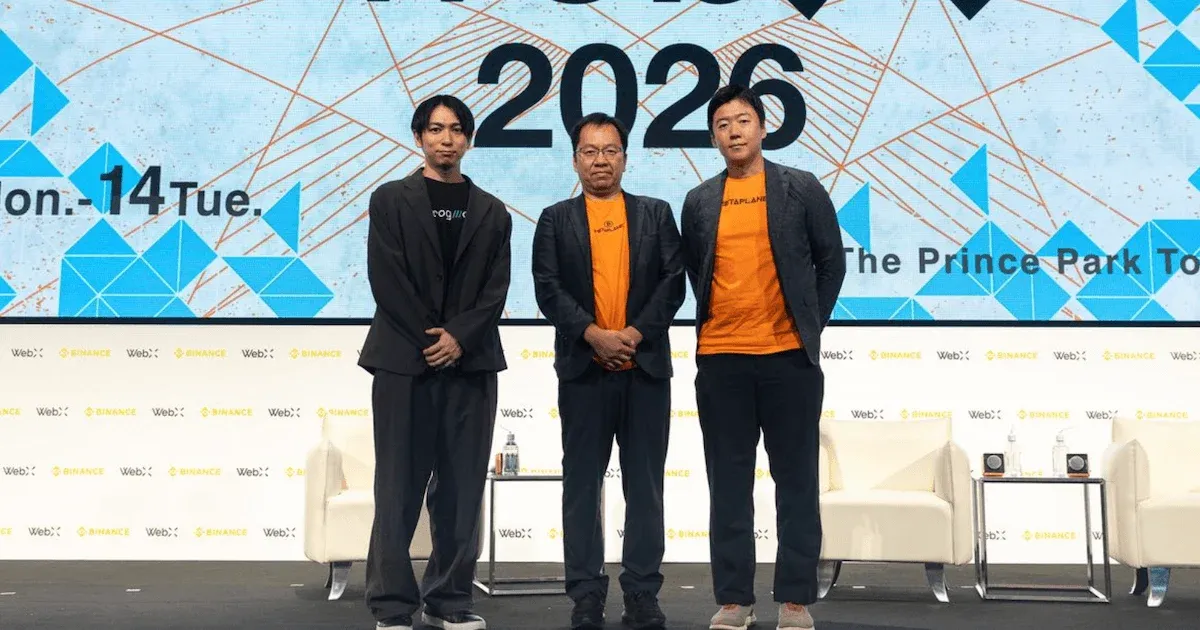
The criticism LeClair has heard most often is that Metaplanet is a company that buys bitcoin and does nothing else. He treats it as a failure of imagination.
"People for a long time were saying we're just a company that buys Bitcoin and does nothing else. And I think that was a very short-sighted vision," he said. "We're not buying Bitcoin just for no purpose. The purpose is to build a monster balance sheet in an asset we have conviction in. And then that unlocks everything else we want to do."
The unlock has a name. Project NOVA is Metaplanet's medium-term plan to build what LeClair calls a "neo financial institution on a Bitcoin standard" - a company that holds bitcoin and originates, distributes and manages bitcoin-linked financial products. The securities licence is the first concrete step. It was not a sudden pivot. Back in October, Simon Gerovich flagged the intent to use bitcoin as collateral. A sign of the vision to come.
"The market was like, don't do anything other than acquire Bitcoin, stay focused," LeClair recalled of that period, when the stock traded at six or seven times mNAV and US retail sentiment ran hot. "There's a time and a place for that. But for us in Japan, the big opportunity is to be a neo financial institution on a Bitcoin standard."
The analytical core of that vision is a comparison LeClair draws carefully. A bank takes deposits as liabilities and invests the proceeds at a spread. Strategy issues perpetual preferreds as liabilities and puts the proceeds into bitcoin. The mechanics rhyme. The difference is the funding.
"If you think of a neo bank on a Bitcoin standard, what is strategy doing? They're issuing obligations, liabilities in the form of perpetual preferreds," he said. "It's just the liabilities aren't overnight deposits. They're perpetual preferreds that can't be called in."
He is precise about not overstating the parallel. A bank has a specific legal meaning and a specific regulatory treatment. Metaplanet is not that. The point is the structure: liabilities on one side, a productive bitcoin balance sheet on the other, a spread in between.
What the licence actually opens
Ask LeClair what the Type I licence lets Metaplanet do that it could not do before, and the answer runs wider than most readers assume.
Siiibo built a digitally native, online-only securities platform. Over roughly seven years it ran about 100 bond issues from more than 40 issuers - venture debt, private placements, small deals averaging five to ten million dollars. It never made a splash. What matters is that the rails were built from scratch and built digital, with no physical branches and no mailed paperwork to onboard. In a market where a public issuer still ships dividend cheques in manila envelopes across the island chain to 250,000 shareholders, that infrastructure is the point.
The daily-dividend problem makes the constraint concrete. Strive shocked the sector with daily dividends on SATA. The mechanism is elegant: take a security that pays semi-annually and move it to daily payments, and you strip a meaningful chunk of realised volatility out of the instrument.
"If you're trying to engineer or synthetically engineer a low volatility security, daily, high frequency dividend or interest payments is really, really important," he said. "But in Japan, it's physical mail. We're going to be shipping manila envelopes across the island chains to shareholders. And we have 250,000 shareholders. So it's a lot of paper. Something like a daily dividend under the current infrastructure is not feasible."
The bearish read is that this is a problem. LeClair's read is that it is a business.
"A skeptic or a bear would say, well, that's a problem. But the optimist would say, let's build the rails."
The licence is also a time machine. Equity trading is not available at Metaplanet Securities today - you cannot buy stocks there. But a Type I licence turns a years-long application for that functionality into a far shorter one.
"If you wanted to apply for that functionality from scratch without a type one license, it could take years," LeClair said. "With a type one license, it's a much, much more expedited process."
A marketplace, not a captive channel
The most common misreading of the deal, in LeClair's telling, is that this is simply a way for Metaplanet to fund itself.
That reading is not wrong. Having an in-house issuance channel as a wholly owned subsidiary is strategic. But LeClair insists it is the smaller half of the story.
"People are only viewing this as a Metaplanet thing, but in reality, we want this to be a Bitcoin adjacent Japanese capital market channel," he said. "We want Metaplanet Securities to be a one stop shop for all of the picks and shovels that an institution or a corporate would need to access the asset class and to access their capital structure."
The setup here is a structural gap in Japanese credit markets. There is no high-yield market in Japan. The domestic corporate bond market is investment grade almost end to end. Siiibo's small book of venture issues priced at credit spreads around 500 basis points - so with base rates near 1%, issuers were paying investors roughly 6% for private-company risk. LeClair sees that spread, and the yield-starvation behind it, as the opening.
His ambition is for Metaplanet Securities to sit at the centre of Japan's bitcoin economy and to earn a spread on the traffic through it. Corporate adoption, when it returns, will need infrastructure. Individuals can buy bitcoin on an app. Institutions cannot.
"For an institution, it's a bit different. Do I have capital to deploy? Am I raising equity? Am I raising debt?" LeClair said. "We want this to be the everything Bitcoin financial services company in the Japanese market. And that should not only be a capital market access channel for us, but also should be a pretty solid revenue generating business on a long time frame."
The East-West bridge
The most distinctive claim LeClair makes is jurisdictional, and it turns on a persistent feature of Japanese markets: the yield gap between the dollar and the yen.
Dollar-denominated debt has been a large business in Japan for years precisely because domestic yields were so low - Nomura built a franchise selling USD paper to Japanese retail chasing a higher coupon. LeClair frames Metaplanet, domiciled in Tokyo with US subsidiaries, as a two-way conduit across that gap.
"The yield disparity in dollars versus yen is about 3%," he said. "If there's a fixed income security in the United States that pays 12%, like SATA or stretch, then that can be translated into a yen denominated instrument with no FX risk at say 10%."
The mechanism cuts both directions. Yen instruments into dollars, dollar instruments into yen. LeClair calls it a blank whiteboard.
"We're domiciled in Japan, our HQ is in Japan, but we are a global institution that's essentially functioning as a bridge between the East and the West capital markets."
He is candid that the current licence does not stretch that far yet. The step change was getting a Type I licence inside the group. Everything downstream is expansion from that base, not a promise the base can already deliver.
Building on Stretch
LeClair spends real time on where the digital-credit category is heading, and the answer is that Stretch and SATA are building blocks, not finished products.
His argument leans on a distinction he makes repeatedly and precisely: a perpetual preferred looks, feels and acts like a credit instrument, but it is legally equity. That matters because it unlocks a vast pool of capital that wants exactly that profile - and it also means, at the extreme, that a preferred issuer cannot be forced into bankruptcy by its dividend, because the board is not legally obliged to declare one.
The building-block thesis follows. Take a low-volatility Stretch-like instrument and someone else can tranche it, over-collateralise it, and engineer the last ten to twenty points of volatility out of it entirely - or lever it the other way for more yield and more risk.
"You can tranche stretch and overcollateralize it, kind of like CLOs or CDOs," LeClair said. He is quick to defuse the obvious association. "Those have a bad name, but collateralized debt obligations aren't inherently bad themselves. They only have a bad rap because people watched the big short. It's just they were filled with securities that had false credit ratings and were backed by toxic assets."
The limit LeClair draws is important, and it is where Metaplanet Securities earns its keep. Perpetual preferreds cannot fit every box. There are trillions of yen in Japan that need actual credit - a one-year bond, a five-year bond, thirty-day commercial paper. A preferred cannot serve that mandate. A securities firm with a Type I licence can build instruments that do.
Metaplanet's own preferred programme sits alongside this, not in place of it. LeClair confirmed the company is still working towards a Tokyo Stock Exchange listing of a perpetual preferred, with monthly dividends the goal - an ask no Japanese issuer has met, against a market convention of twice-yearly payments. Two securities are already outlined: Mercury, a convertible preferred closer in spirit to Strategy's Strike, offering common-stock upside with downside protection; and MARS, an adjustable-rate security modelled on Stretch. LeClair described the listing ambition as unchanged.
The infrastructure to do more is now assembling. On 10 July, Metaplanet, Metaplanet Securities, JPYC and Progmat - the security-token issuer spun out of Mitsubishi UFJ - announced a joint study into bitcoin-backed digital credit, targeting instruments that trade and settle around the clock and accrue interest daily. It is a feasibility study, not an issuance; no yields, structures or dates are set. But it names the real obstacle plainly. The barrier to 24/7 on-chain settlement is not technology. It is Japan's Companies Act dividend and record-date systems, its shareholder-registry administration, and its book-entry infrastructure. The manila envelopes, in other words. The study is the beginning of an attempt to route around them.
The gut check
The interview was conducted against an ugly tape. Bitcoin has spent three consecutive quarters lower. Metaplanet's own recent disclosures carried large net-income losses driven by mark-to-market impairment. STRC, Strategy's flagship Stretch preferred, touched a record low near $72 in June, roughly 28% below the $100 it is designed to hold. LeClair is unbothered by any of it, and says so at length.
His framing is historical. Strategy adopted bitcoin in 2020, was hailed as visionary, and twelve months later was written off by the Wall Street Journal as a failed experiment. By mid-2023 the market had reversed itself. LeClair sees the same pattern replaying in Japan, one cycle behind.
"Bitcoin bear markets really test your conviction," he said. "We're not making decisions on what's the cost basis of the position over the next quarter. We're interested in building this for the long term. Mark to market volatility is not going to deter us."
He points to two facts he considers underappreciated. First, the impairment losses are cosmetic against balance-sheet reality. Metaplanet's equity ratio sits around 20%, which by the standards of Japanese corporates is strong and under-levered. Second, the shareholder base has grown through the drawdown, not shrunk - roughly doubling over twelve months to 250,000, even as the stock fell.
On the institutional side, LeClair returns to career risk, the concept he uses to explain why regulated access channels expand a market rather than cannibalise it. When IBIT launched, the consensus held that MSTR's premium would collapse. Instead the mNAV multiple expanded, because a BlackRock endorsement stripped the career risk from every institutional allocator who had been afraid to be the only buyer. Japan, in his reading, has not had that moment yet. Bitcoin only recently gained recognition as a financial asset in the Japanese regulatory framework; the institutional career risk is still on. He expects it to lift on a one-to-two-year horizon, and Metaplanet to be positioned as the play when it does.
The clearest recent test of the category came not from Japan but from Virginia. When bitcoin fell from $80,000 toward $60,000, the market convinced itself Strategy would pause its preferred dividends. It did not. Strategy disclosed on 6 July that it had sold 3,588 BTC for roughly $216 million - its largest-ever disposal - to fund preferred distributions and rebuild its dollar reserve. LeClair reads the episode as vindication, not weakness.
"Saylor was like, look, we sold 3,000 Bitcoin. The market didn't even notice until I posted the disclosure. We paid the divs, chill out," he said. "You finished the quarter by selling no stock, by selling no preferreds, issuing no securities, and you just used the fortress strength of your balance sheet to pay the dividend obligation."
He is willing to grade Strategy's management honestly. The communication around the dividend reserve was mishandled, the market said so loudly, and the team is rectifying it by building cash. But the instruments bent without breaking, and that, LeClair argues, is what the category needed to demonstrate before it could mature.
What happens next
LeClair's closing argument is about seasoning, and it is the most concretely useful thing he says about the five-year picture.
A large share of institutional fixed-income capital does not touch a new instrument. Pension funds and similar allocators wait for an instrument to trade for one, two, three years before they will look at it. Every fortnight a Stretch dividend gets paid - up market, down market, sideways - builds the track record that widens the pool of eligible buyers.
"Some people will say, I'm not going to talk to you until this thing has dividends paid for three years," he said. "So every two weeks that goes by and the dividend gets paid builds credibility, builds track record, and opens up the universe of investors that can participate."
That mechanism points to a cost-of-capital path. STRC yields 12% today because it is new, because bitcoin is out of favour, and because the convertible-bond overhang muddies its credit perception. LeClair expects the rate to fall over time as the instrument seasons and the converts roll off.
"Stretch is not gonna be a twelve percent instrument forever," he said. "Over time the cost of capital will come in. It should float to ten and then under."
For Metaplanet, the seasoning clock is a gating factor on its own listing. Japan's regulators want to see eight quarters of track record on its bitcoin income-generation business. LeClair says the company has seven and the eighth is close - a box he calls hugely important to check before an IPO.
None of this is fast. LeClair says it himself, more than once: things in Japan move slowly, and Metaplanet moves as fast as its counterparties let it. The manila envelopes are real. The high-yield market does not exist yet. The institutional audience has not arrived. What Metaplanet has bought, for the price of a rounding error, is the right to build all of it - and the eight-quarter clock, the seasoning clock, and the next bitcoin bull market are the three timers now running in parallel.
The question the deal poses is no longer whether Metaplanet is a company that only buys bitcoin. It is whether a bitcoin balance sheet, wired into a licensed securities platform in the most yield-starved major market on earth, compounds into something the incumbents cannot answer. LeClair has spent 27 months betting it does.
Want more bitcoin treasury coverage in your search results? Add Bitcoin Treasuries as a preferred source on Google.