
Digital Credit's First Stress Test: How Leverage Built the Fire That Burned STRC and SATA



Strategy's preferred stock fell to $82.53 intraday on 18 June. The issuer's balance sheet was unchanged. What happened in between is a lesson in how quiet markets manufacture their own crises.
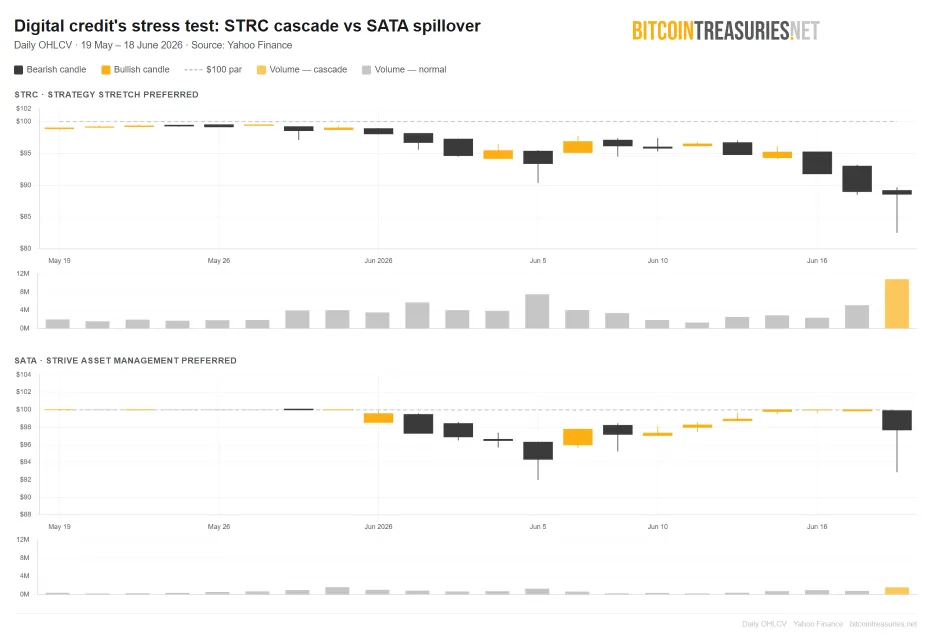
On 18 June 2026, STRC printed an intraday low of $82.53 before closing at $88.59. SATA fell from par into the low $90s, touching $92.88, before recovering to close at $97.71. Neither figure reflected a deterioration in the credit quality of either issuer. Both reflected something more structural - and, in hindsight, more predictable.
The volume data made the mechanism visible. STRC traded 10.6 million shares against a daily average of 3.6 million - nearly three times normal. SATA traded 1.57 million shares against an average of 386,698. For instruments designed to behave like high-yield fixed income, those are not the numbers of an orderly market.
US equity markets were closed the following day for Juneteenth. Whatever healing was going to happen had to happen intraday, or wait until Monday.
How a Liquidation Cascade Works
A liquidation cascade is not a market opinion. It is a mechanical sequence.
It begins with stability. When an asset trades in a tight range for an extended period, it begins to look predictable. Predictability is attractive to leveraged investors because it compresses the apparent risk of borrowing against a position. If STRC has traded between $99 and $100 for months, the logic goes, then financing that position at high multiples seems manageable. The carry yield is high, the expected loss small. It works, until it doesn't.
When prices begin to move against leveraged holders, brokers issue margin calls. Those calls require cash - immediately. The holder has no choice but to sell, regardless of their view on the instrument's underlying value. That selling pushes prices lower. Lower prices trigger margin calls on other leveraged positions. Those holders sell too. The price falls further. The cycle feeds itself, disconnecting entirely from any assessment of credit quality or issuer solvency. As Cole put it: the selling becomes disconnected from fundamentals and becomes driven by balance sheet constraints.
When the forced sellers are finally exhausted, prices overshoot fair value to the downside. Buyers who have been watching from the sidelines step in. Volume spikes, then collapses. Price recovers, sometimes sharply. The instrument that appeared to be in crisis at open looks defensible by close. Nothing about the issuer changed. The leverage changed.
Why STRC, and Why Thursday
The preconditions for 18 June were months in the making.
STRC had spent much of the preceding period trading between $99 and $100. That tightness was, in one reading, a mark of success - the instrument was doing what it was designed to do. In another reading, it was an invitation. Jesse Myers, Head of Bitcoin Strategy at The Smarter Web Company, made the point directly in a post on 18 June: extended calm in a free-market instrument does not eliminate risk, it transfers it. Investors who observe months of sub-one-percent daily range are incentivised to lever up. The carry yield is high; the expected volatility appears low. Leverage accumulates quietly.
SATA's competitive pressure provided a structural precondition. When Strive began paying SATA dividends on a daily compounding basis at a 13% nominal rate, the effective annual yield moved materially above STRC's 11.5%. That differential did not require STRC to fail; it required STRC to reprice. A forced yield comparison between two par-linked instruments in the same nascent asset class is not a neutral event. Some capital rotated. STRC came under incremental downward pressure.
Bitcoin's softening provided the directional trigger. The underlying asset had been declining materially through May and into June, falling below $60,000 briefly in early June for the first time since October 2024. A weakening Bitcoin price does not impair Strategy's ability to pay STRC dividends in the near term - Myers notes the company could sustain payments for 32 years at current levels without any Bitcoin appreciation - but it affects sentiment, and sentiment affects the behaviour of leveraged holders at the margin.
Myers offered one additional mechanism, which he characterises as inference rather than confirmed fact: that opportunistic short-sellers may have identified the elevated leverage in STRC positions and moved to exploit it. By pressing the price down aggressively, shorts could push leveraged holders into margin-call territory, triggering forced selling that validated their short. The short and the cascade become mutually reinforcing. This explanation is not confirmed by Cole or by trading data, but the pattern it describes is not unprecedented in markets with known leverage concentrations.
Two Reads on the Same Data
Matt Cole and Jesse Myers are not in disagreement. They are reading different parts of the same event.
Cole's follow-up post, published the day after the session, focuses on what the trading data shows. The STRC volume profile - modest through much of the decline, then exploding as the price moved from roughly $89 toward the $82.50 low, then subsiding sharply as price recovered - is the fingerprint of a liquidation cascade. Forced selling drives volume, prices overshoot, buyers emerge when the selling is exhausted. Cole is explicit that this was a liquidation event, not a credit event, and that the two should not be conflated.
The SATA profile was different. Volume was consistent throughout the session and the broader week, without the concentrated spike around the lows visible in STRC. Cole's read: the primary stress was in STRC, and SATA's weakness was spillover from the broader selloff rather than a parallel cascade. That distinction matters for how digital credit investors think about cross-instrument contagion going forward. It is not a statement about relative credit quality - Cole is explicit on that point too. Both STRC and SATA remain strong credits. Neither issuer experienced a sudden deterioration in credit quality during the session.
Myers zooms further out. The cascade itself was not an accident. It was the predictable consequence of an instrument that had been trading in a tight range for long enough to attract leveraged carry strategies at scale. The calm created the conditions for the volatility. Myers' inference about short-sellers as an accelerant sits on top of Cole's mechanical account - a possible ignition mechanism for a fire that the leverage had already laid.
What This Means for Digital Credit
The instinct after 18 June is to ask whether STRC and SATA are safe. That is the wrong question. Strategy holds 847,363 BTC acquired at an average cost of approximately $75,651. The dividend obligation is a cash flow question, not a solvency question. The dollar reserve stood at $1.1 billion as of mid-June. Strive maintains an 18-month dividend reserve backed by both cash and STRC holdings. Cole confirmed that reserve remains intact. Neither issuer missed a payment. Neither issuer's credit quality changed on 18 June.
The right question is structural. Par-linked instruments that trade in tight ranges will attract leveraged carry. That is not a flaw in investor behaviour; it is a rational response to the apparent risk profile. The longer the instrument trades at par, the more leverage accumulates. The more leverage accumulates, the more violent the eventual dislocation when it unwinds. Digital credit does not escape this dynamic by being new. If anything, newness amplifies it - thinner liquidity, shorter investor history, fewer natural buyers of last resort.
18 June was the most significant stress test digital credit has faced. The market absorbed it. Buyers emerged at the lows for both instruments. Both securities recovered substantially by the close. Cole called it a constructive outcome and an important data point for the future of the asset class.
Saylor, with markets closed the following day, offered four sentences: "Volatility is never easy. Bitcoin keeps working. So do we."
Want more bitcoin treasury coverage in your search results? Add Bitcoin Treasuries as a preferred source on Google.