



Strategy's bitcoin sale last week isn't a retreat from its "never sell" pledge. It's the completion of a specific, three-part assignment S&P Global handed the company in October, filed in the same order S&P wrote it down.
Strategy sold 3,588 bitcoin for $216 million between 29 June and 5 July, its largest single disposal since it began accumulating in 2020. The first tranche, 1,363 coins, went at $59,256 average on 29-30 June. The second, 2,225 coins, went at $60,773 between 1 and 5 July. Both landed well below the company's $75,476 cost basis. Proceeds funded the quarterly dividends on STRF, STRE, STRK and STRD, the monthly payment on STRC, and rebuilt the USD Reserve to $2.55 billion. Strategy closed the period holding 843,775 BTC.
Michael Saylor posted the numbers on X within the hour. The analyst @ZynxBTC got to the more interesting point a few hours later: this wasn't a company running out of options, it was a company working through a list. The list dates to 27 October 2025, when S&P Global assigned Strategy a 'B-' issuer rating and wrote out, with more precision than rating actions usually offer, what would move it.
The three lines S&P wrote down
S&P's rating cited high bitcoin concentration, a narrow business focus and negative risk-adjusted capital as the core weaknesses, the last driven by the agency's own practice of deducting bitcoin holdings from equity when it calculates adjusted capital. An upgrade inside twelve months was ruled out entirely. Beyond that, S&P said three specific things would move the number: improved US dollar liquidity, less reliance on convertible debt, and demonstrated capital markets access through a bitcoin stress. Not one of these was framed as aspirational. Each came with the kind of specificity that reads as an instruction rather than a wish list.
What the reserve shows when read as a sequence
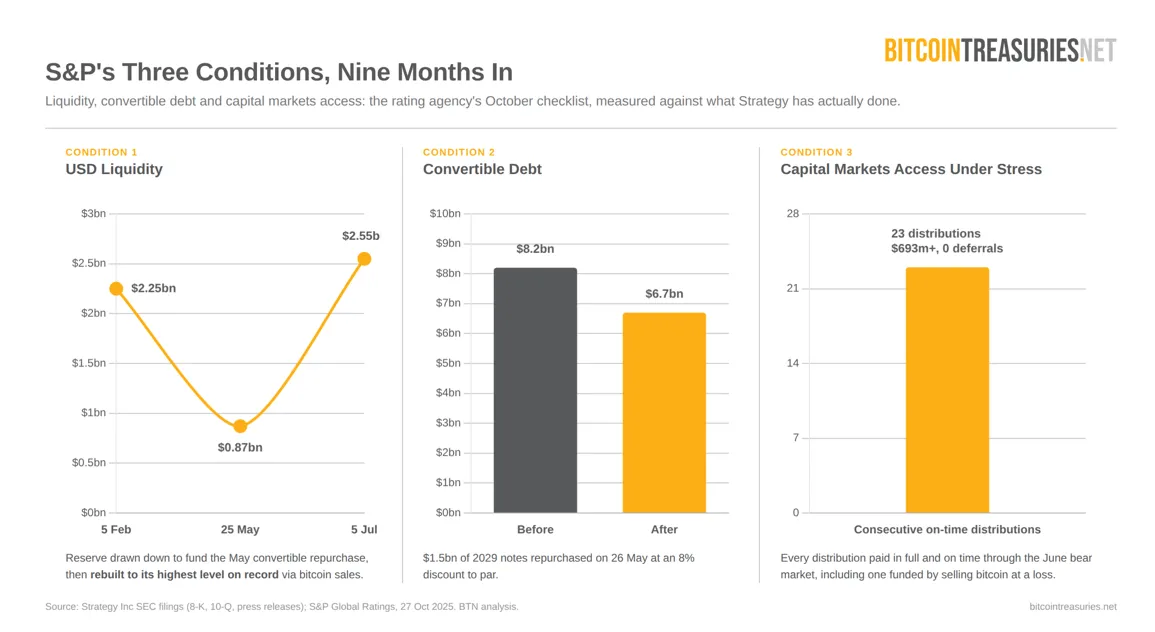
Strategy's USD Reserve stood at $2.55 billion as of 5 July, which by the company's own disclosure represents approximately 17.4 months of preferred dividend and interest coverage, comfortably above the 12-month floor the board itself has set as policy. That is a real buffer, not a marketing number, for a company whose dollar liquidity S&P specifically flagged as thin. The more instructive part is how it got there. The reserve stood at $2.25 billion in early February. By 25 May it had been drawn down to $871 million, spent funding the convertible note repurchase. By 5 July it was rebuilt to its highest disclosed level, largely through the bitcoin sales under the new BTC Monetization Program. A reserve that can be spent for one purpose and refilled through another is a different instrument to a rating analyst than a reserve that just sits there. That is the first condition, addressed with a paper trail.
The debt line moved too
Strategy completed a $1.5 billion repurchase of its 0% convertible notes due 2029 on 26 May, paying around $1.38 billion in cash, an 8% discount to par. That took convertible debt outstanding from $8.2 billion to $6.7 billion, shrinking the exact instrument class S&P flagged as a liquidity risk in a severe bitcoin stress. It happened five weeks before last week's bitcoin sale, on a separate timeline, funded by drawing down the same reserve the sale later rebuilt. The two events are connected by the S&P memo, not by the calendar.
What last week actually tested
The third condition was always going to be the hardest to fake: could Strategy keep paying through a downturn without deferring. Strategy raised STRC's dividend rate to 12% for periods with record dates from 1 July, then, days into a bear market that had already pushed the Bitcoin below $62,000, sold bitcoin rather than miss a payment or draw the ATM further. CEO Phong Le had already put the shift in plain terms when the framework authorising these sales was announced on 29 June: "Strategy is evolving from one-way capital issuance to active capital management." That is the specific behaviour S&P said it wanted to see, stated as policy rather than inferred after the fact from a balance sheet.
What the tape said instead
The market's reaction undercut the scale of the announcement. MSTR fell about 2% on the disclosure, a small giveback after a 21% rally the week before on the Digital Credit Capital Framework announcement, though the stock remains down more than 70% over the trailing year. STRC kept recovering toward $90, still under its $100 stated amount, having traded below $75 the week before. Analysts didn't converge. Benchmark reiterated a Buy on MSTR at $570. TD Cowen cut its target to $260 from $400, citing a weaker bitcoin outlook. Cantor tied the stock's recovery to STRC closing back at par.
What the scorecard doesn't cover
None of this touches S&P's actual arithmetic. Risk-adjusted capital stays negative as long as the agency deducts bitcoin from equity, and no reserve or repurchase changes that treatment. S&P's upgrade language was explicitly pinned to the "longer term," and nothing in the record since October suggests a review is imminent; the most recent confirmation on file is a December reaffirmation at B-, stable. Grayscale's head of research, Zach Pandl, puts the annual cash cost of the preferred stack at roughly $1.5 billion. Covering that bill once by selling bitcoin makes it a standing option, not a last resort held in reserve for emergencies. Strategy's pledge to never sell is no longer literally true, whatever the framework calls the mechanism. S&P never asked for that pledge to hold. It asked whether the company could sell in a controlled way and keep functioning. That is a lower bar, and it is the one cleared last week.
The record since October
Since S&P's rating landed, Strategy has rebuilt its dollar reserve through a different mechanism than the one that depleted it, cut convertible debt by $1.5 billion, and paid every preferred obligation on time through a bear market, including payments funded by selling bitcoin. Three conditions, three responses, in the order S&P wrote them. Whether the agency treats that as sufficient is now a question for its next review, not for the market.
Want more bitcoin treasury coverage in your search results? Add Bitcoin Treasuries as a preferred source on Google.