



BPS tells you what a company holds. CEBE mNAV tells you what you own - and what the market is charging for it. The gap between them is the number that actually matters to common shareholders.
The Default Metric and Its Blind Spot
Bitcoin Per Share is where most analysis starts. Divide total BTC held by shares outstanding and you get a clean, comparable number across every company in the sector. It updates with each filing. It travels well in a spreadsheet. It tells you something real.
It does not tell you who owns it.
When a company issues preferred stock or debt to buy Bitcoin, BPS rises immediately. The company holds more Bitcoin per share - on paper. What BPS does not register is that the new Bitcoin arrived with a prior claim attached. Preferred holders and creditors sit ahead of common shareholders in the capital structure. The Bitcoin is in the warehouse, but a portion of it is spoken for before common equity sees a single sat.
A company issues $3bn in preferred stock and uses the proceeds to buy 33,898 BTC at $88,500. BPS rises 4.8%. Common equity's real exposure does not move at all. The new Bitcoin is exactly offset by the new claim against it. BPS called the gain. The gain was not there.
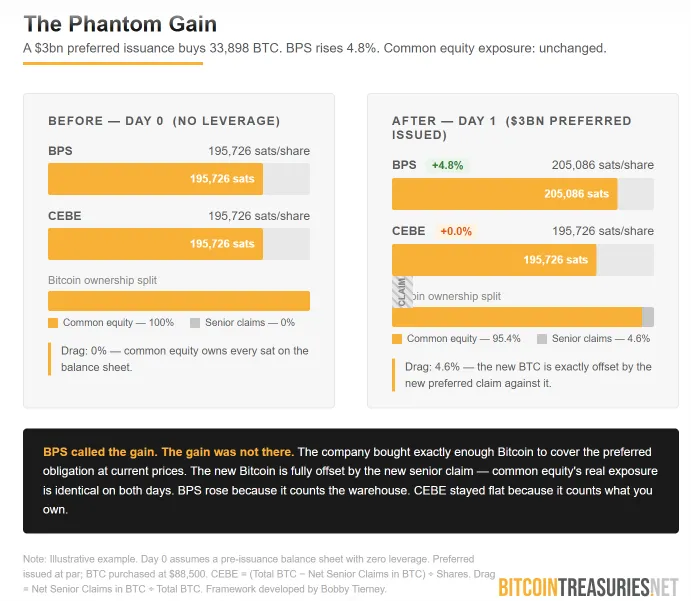
This is the limitation. BPS counts total holdings. It does not deduct what is owed.
The Correction: CEBE
Common Equity Bitcoin Exposure - a framework developed by Bobby Tierney - addresses exactly this. The formula is direct:
CEBE = (Total BTC held − Net Senior Claims in BTC) ÷ Shares outstanding
where Net Senior Claims in BTC = (Debt + Preferred Stock − Cash) ÷ Current BTC Price.
The result is the Bitcoin exposure that actually belongs to common shareholders once all senior obligations have been satisfied. A company running no debt and no preferred stock carries zero drag - CEBE and BPS are identical, and common equity owns 100% of the Bitcoin.
Drag Is Not Static
The most important feature of drag is that it moves without anyone doing anything. Senior claims are denominated in fiat. A $17bn obligation is always $17bn. In Bitcoin terms, it shrinks as the price rises and expands as the price falls.
At $50,000 per BTC, a $17bn claim represents roughly 340,000 BTC. At $300,000, the same dollar figure compresses to under 58,000 BTC. The fiat claim is fixed. Its weight in Bitcoin terms is not.
This is the mechanism the leveraged treasury model is built on. Issue fixed-cost fiat claims today, accumulate Bitcoin, and let appreciation do the work. The math holds - provided Bitcoin appreciates faster than the cost of the capital structure. Four forces drive drag in either direction: Bitcoin price movement (the primary driver, responsible for roughly 80% of the compression effect), how accumulation is funded, deliberate deleveraging, and the dilutive effect of dividend payments.
Not all senior claims behave the same way as the price moves. Fiat-denominated debt and preferred stock compress smoothly - every dollar of Bitcoin appreciation shrinks them proportionally. BTC-indexed obligations, such as Capital B's OCA tranches, step down discretely: compression happens in tranches as rising stock price triggers forced conversion, not as a continuous curve.
The Valuation Layer: CEBE mNAV
Standard mNAV divides market capitalisation by total BTC held. It is a workable shorthand, but it inherits BPS's blind spot: it treats all Bitcoin on the balance sheet as equally owned by common equity, which is only true when leverage is zero.
CEBE mNAV corrects the denominator:
CEBE mNAV = Market Capitalisation ÷ (Common Equity BTC × BTC Price)
The gap between standard mNAV and CEBE mNAV is the drag penalty expressed as a valuation premium. A company trading at 1.5x standard mNAV may be trading at 2.0x CEBE mNAV once leverage is accounted for properly. Investors paying standard mNAV prices while assuming BPS-level exposure are buying more leverage than they realise.
Cycle mNAV extends the analysis across a full Bitcoin market cycle by incorporating the annual cost of the capital structure - the spread between Bitcoin's expected appreciation rate and the weighted average cost of senior obligations. For Strategy, that weighted average preferred cost sits at approximately 9.73%. If Bitcoin compounds at 30% annually, the spread runs at roughly twenty percentage points in common equity's favour. At 8% Bitcoin growth, the spread turns negative and preferred holders extract value from common over time. Metaplanet's capital structure, shaped by Japan's regulatory environment rather than by management choice, currently generates a negative wrapper cost - the structure pays for itself rather than consuming the spread.
The Practitioners Weigh In
Michael Saylor's framing was structural. He positioned BPS and CEBE as tools calibrated to different time horizons rather than rivals. CEBE is the conservative risk metric — the number that matters when liability duration is short and claims could crystallise. BPS is the growth metric - the one that captures upside when long-duration, low-cost liabilities give Bitcoin time to outrun its obligations. "The difference between BPS and CEBE BPS is Amplification," he wrote. "With no debt or preferreds, BPS = CEBE BPS and a Bitcoin Treasury Company should track BTC like an ETF. As liabilities increase, BPS and CEBE diverge, creating the potential to outperform BTC." His further qualification matters: not all liabilities are equal. Short-duration, high-cost structures amplify risk. Long-duration, low-cost structures amplify upside. The quality of the capital structure determines which direction the amplification runs.
Matt Cole, Strive's CEO, arrived at the same destination from a different direction. Strive runs two explicit KPIs - grow BPS before senior claims, and meet all obligations on time - and Cole argued that both analytical paths, run to completion, converge on the same conclusion: disciplined amplification through digital credit can systematically outperform Bitcoin over time. "No single metric tells a full financial picture," he wrote. "The key is understanding the differences and how to use them."
The practitioners are not choosing sides. They are using both numbers for what each does well. The answer, it seems, is that both metrics are correct when applied to different problems.
Reading the Two Numbers Together
BPS tells you what is in the vault. CEBE mNAV tells you what you are paying for your share of it.
The practical check is four numbers, read quarterly. BPS captures accumulation pace. Drag shows how much of that accumulation actually reaches common shareholders. CEBE mNAV shows what the market is charging per sat of real exposure. The spread - Bitcoin's appreciation rate minus the weighted cost of senior obligations - determines whether the capital structure earns its keep across a full cycle.
If all four look healthy, the structure is working. If any turn against you, the picture changes faster than standard mNAV will show you.
Want more bitcoin treasury coverage in your search results? Add Bitcoin Treasuries as a preferred source on Google.