
Bitcoin-Backed Preferred Equity Now Pays Nine-Figures of Dividends. We Mapped Where the $130B Market Goes Next.


New research from BitcoinTreasuries.net and Apyx sizes a $130 billion addressable market for Bitcoin-backed preferred equity — and stress-tests the case in the middle of a drawdown.
Strategy paid $229.5 million in preferred dividends in a single quarter. Investors lined up to receive it. The instrument they were buying barely existed as a Bitcoin treasury financing tool three years ago. Today it holds a defined seat in the global preferred securities market, with a credible path to $130 billion by 2030.
That instrument is preferred equity. Today we're publishing the Bitcoin Digital Credit Report, produced in partnership with Apyx — the first full primer on how it works, who can issue it, what it yields, and where the market goes from here.
The report is free.
Why preferred equity breaks the pattern
Every other Bitcoin treasury financing tool carries a constraint. Common equity is only accretive above 1.0x mNAV; convertible debt dilutes on conversion; collateralized loans carry margin-call risk and maturities that don't fit a multi-decade strategy.
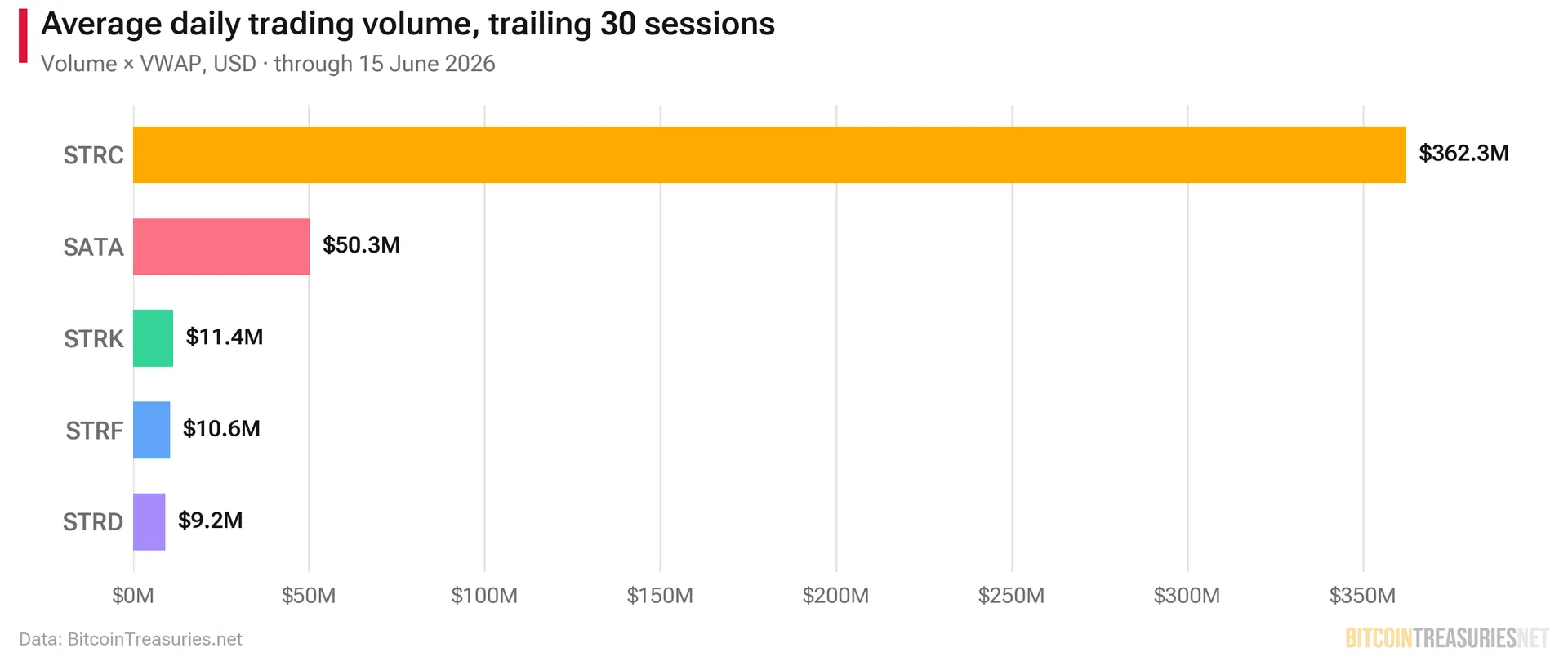
Preferred equity sidesteps all of it — raising permanent capital without dilution, debt, or refinancing risk, and converting Bitcoin's volatility into a yield product income investors can actually own. That's what Strategy does through STRC, STRF, STRK, and STRD, and what Strive now does through SATA.
What the data shows
Collateral coverage is the clearest finding, and the most counterintuitive: it's structural, not speculative. Recent coverage ratios have ranged from roughly 3x to 4.5x — meaning issuers hold $3.00 to $4.50 of Bitcoin for every $1.00 of preferred outstanding.
The 50th-percentile loan-to-value ratio for large-bank residential mortgages in Q3 2025 was 76, meaning banks advance $0.76 to homeowners for every $1.00 of a property's value. In other words, these instruments are far more overcollateralized than the average mortgage, and the collateral is a single liquid asset visible on a public balance sheet.
The five major instruments trade at double-digit effective yields, well above the 3–4% on high-yield savings accounts — and that spread has widened through the recent decline, not narrowed. That matters because a structural case is tested when prices fall, not when they rise. The report documents the full yield band, the mechanism behind the widening spread, the 2025 tax treatment that improves after-tax returns, and a three-scenario model that sizes the market from roughly 1% of the $1.3 trillion global preferred space today to a long-term ceiling near $130 billion.
A new asset category, and what it enables
Conventional credit is built on projected future cash flows. This new category inverts that. Bitcoin-backed preferred equity is supported by capital already on the balance sheet — Bitcoin held by the issuer, economically overcollateralized at several times the value of the preferred outstanding, with cash reserves set aside for near-term distributions. All of it is reported in SEC filings and viewable in real time on public dashboards. You aren't underwriting a forecast. You're reading a balance sheet.
That transparency makes the instrument legible in a way credit rarely is — and legible collateral is composable collateral, capital that can serve as a building block for other instruments. An ecosystem is already forming around exactly that, pioneered by Apyx.
Apyx is the first Dividend-Backed Dollar (DBD) protocol: a stablecoin whose reserve is composed of variable-rate perpetual preferred stock like Strategy's STRC, alongside Treasury bills and cash. The collateral isn't a reserve letter attesting to balances in a private account. It's preferred equity from publicly listed treasury companies, overcollateralized and disclosed in their filings — a reserve you can audit yourself.
Inside the report
The data establishes the category is real. The report answers the harder question — where it goes from here:
Preferred equity compared head-to-head against collateralized loans and convertible debt: where each fits, and where each fails.
The three-scenario TAM model, with the assumptions and probability weights behind every path.
Issuer eligibility, with Jeff Walton, Chief Risk Officer at Strive, on minimum scale and why a clean capital structure matters more than balance-sheet size.
A risk section — the specific conditions under which the structural case breaks.
Read the report
Download the full Bitcoin Digital Credit Report and visit the Digital Credit dashboard to get the latest data on these preferred equity instruments.
If you know one CFO sitting on idle cash this quarter, this is the document they should see before their next board meeting.
Onward, The BitcoinTreasuries.net Team
About Apyx
This report was produced in partnership with Apyx. Apyx is the first Dividend-Backed Dollar (DBD) protocol backed by variable-rate perpetual preferred stock — instruments like Strategy's STRC. For treasuries and allocators exploring preferred equity as a financing tool, Apyx offers a direct way to hold that exposure inside a DeFi ecosystem. Learn more at Apyx.fi.
The Bitcoin Digital Credit Report is research and education. It is not investment, legal, tax, or accounting advice, and it is not an offer or solicitation to buy or sell any security or financial product. Digital assets carry significant risk, including total loss. Readers should conduct their own due diligence and consult qualified professionals before making any investment decision. Not available to readers in restricted territories.
Want more bitcoin treasury coverage in your search results? Add Bitcoin Treasuries as a preferred source on Google.