
Adam Back's BSTR SPAC Vote This Friday Could Make It Bitcoin's Second-Largest Treasury Company


BSTR Holdings goes to a shareholder vote on Friday with 30,021 BTC secured - Samson Mow's read of the capital stack suggests a fully deployed raise could take the company from fifth to second.
Cantor Equity Partners I shareholders convene at 10:00am Eastern on Friday, June 26, in New York - and virtually - to vote on the business combination that brings Bitcoin Standard Treasury Company public under the ticker BSTR. If approved, BSTR Holdings, Inc. will list on Nasdaq, entering the leaderboard as the fifth-largest publicly traded Bitcoin treasury by holdings.
That ranking understates the ambition on paper. The firm has outlined plans to expand reserves beyond 50,000 BTC and is pursuing a PIPE deal worth up to $1.5 billion to fund it. Samson Mow, writing on X on June 23, went further: at current prices, he argued, that $1.5B deployed in full would buy approximately 23,500 additional coins, taking BSTR's total to roughly 53,500 BTC and leapfrogging Metaplanet and Twenty One Capital to second place on the global leaderboard. Mow added that BSTR would simultaneously hold the lowest cost basis of any large treasury company. His conclusion: the market is handing Adam Back a structural advantage by pricing the offering below Strategy's average acquisition cost.
The Capital Stack at Close
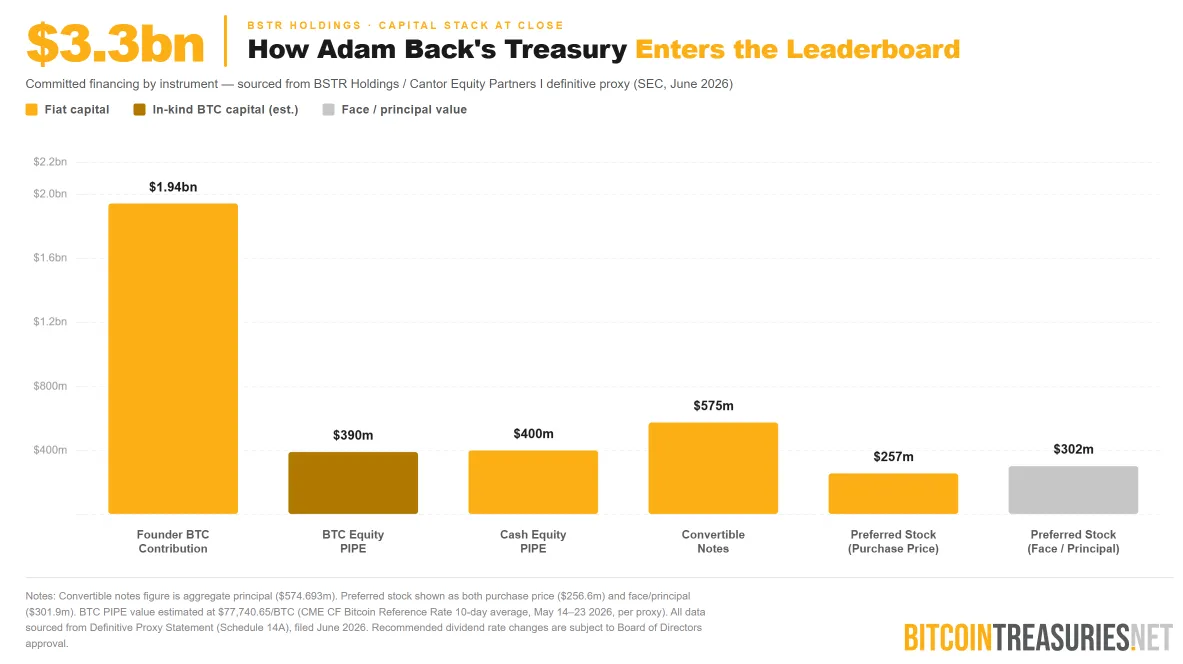
Pursuant to the Business Combination Agreement, 25,000 Bitcoin contributed by the founding entity will form the core of the treasury at close, with an additional 5,021 Bitcoin arriving through a Bitcoin-denominated equity PIPE - the first of its kind in a US SPAC raise. BSTR described the latter as a community-first structure funded entirely through in-kind contributions from Bitcoiners. Together they establish the day-one holding of 30,021 BTC.
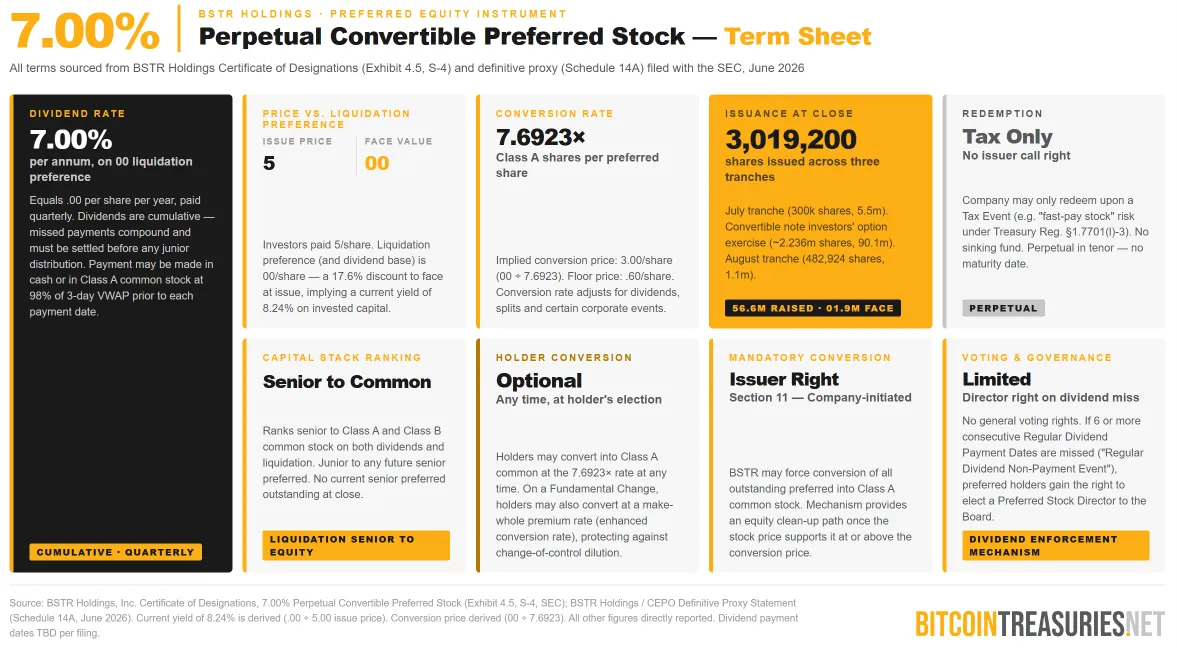
The fiat layer compounds this. The definitive proxy confirms $574.693 million in aggregate principal from convertible note investors, $301.92 million from preferred stock investors across 3,019,200 shares at $85 per share, and $400 million from a cash equity PIPE - a combined fiat commitment of roughly $1.276 billion at close. The preferred instrument carries a 7% perpetual coupon with conversion features, placing it structurally closer to STRK than to STRC on the Digital Credit spectrum - a point of categorisation relevant to how the market will price it relative to Strategy's pure fixed-income stack.
Filed communications describe broader ambitions: instruments issued in multiple currencies and a holding-company model oriented toward acquiring or consolidating other Bitcoin-related companies. That consolidation thesis was articulated publicly by Sean Bill in April 2026. Responding to a question about Satsuma's shareholder pressures, Bill framed the treasury space as one where scale and domain expertise would increasingly determine who survives, positioning BSTR as a Berkshire Hathaway analogue for Bitcoin - actively managing the asset rather than holding it passively.
The Active Management Differentiation
Bill, speaking to NYSE Live in March 2026, described BSTR's distinguishing characteristic as active treasury management: using Bitcoin as a yield-generating and alpha-generating asset rather than a static reserve. The toolkit referenced in SEC filings includes options strategies - specifically put-selling to accumulate BTC at lower prices - basis trades, and arbitrage. Sean Bill's institutional background is referenced as spanning several decades in the hedge fund industry and the pension world, including responsibility for overseeing up to $50 billion of assets and securing what Back and Bill described as Bitcoin's first public pension allocation at Santa Clara VTA in 2021.
The leadership build-out reinforces the institutional positioning. The team added Katherine Dowling from Bitwise as President, with Bill describing her as execution-oriented, and Bob Stefanowski - former CEO of Neom US and CFO of UBS Investment Management - as CFO. The construction is deliberate: technical credibility through Back, institutional portfolio construction through Bill, regulatory navigation and operational execution through Dowling, and TradFi-grade financial governance through Stefanowski.
In a February 2026 interview filed by CEPO, Back stated BSTR's ambition directly: to reach a top-three treasury position by holdings, referencing Twenty One Capital's 43,000 BTC as a near-term target to surpass. That was stated before the vote was scheduled. Friday is the mechanism that begins to make it executable.
What Fifth Place Actually Means — and What It Could Become
The leaderboard context is important. Strategy holds 847,363 BTC, Twenty One Capital 43,514 BTC, and Metaplanet 40,177 BTC as of June 23.
BSTR enters at 30,021 BTC - a gap of roughly 10,000 coins to third place, and roughly 13,500 to second. The stated near-term accumulation target is beyond 50,000 BTC. Mow's scenario - $1.5B fully deployed at roughly $64,000 per coin - gets there in a single capital raise, assuming current prices hold. At $95,000 per coin the same capital buys approximately 15,800 additional BTC, still enough to take the total past XXI's position.
BSTR is also entering at an extremely advantageous time, with BTC sitting on the historically important 200D Moving Average at around $62,000. If BSTR executes its accumulation during a period of lower prices, the blended cost basis across the full 53,500-coin scenario would sit below every major treasury that bought aggressively through 2024 and early 2025. Metaplanet's average acquisition cost is $104,107 per coin by its own disclosures. BSTR's zero legacy exposure is, as Mow framed it, a structural benefit of arriving late.
The Digital Credit Dimension
The preferred instrument deserves separate attention. Adam Back publicly described BSTR's convertible preferred as a STRK-like instrument, noting it was the first US treasury company to secure a cumulative convertible preferred at SPAC raise time. The distinction matters for how this instrument will be assessed as the Digital Credit category develops. The 7% perpetual convertible preferred sits in convertible territory - it is not a fixed-income pure play equivalent to STRC, which carries no equity conversion feature. Whether BSTR pursues a STRC-analogous fixed-rate perpetual instrument post-listing - one without conversion - will determine how much of the Digital Credit capital pool it can address.
The multi-currency instrument ambition noted in filings points toward that direction. A non-converting, fixed-rate preferred denominated in sterling or yen would unlock a different institutional buyer base than the existing convertible stack. BSTR's stated model of consolidation, active management, multi-instrument issuance is coherent with it.
Friday's Weight
The vote on Friday is administrative in form and consequential in substance. A straightforward shareholder approval mechanism resolves nearly a year of SPAC mechanics and puts 30,021 BTC behind a publicly traded ticker with $1.276 billion in committed capital. The stated goal is to scale into a top-three treasury and become a preferred counterparty for large TradFi firms seeking Bitcoin access.
Samson Mow's read of the arithmetic - second place, lowest cost basis, $1.5B deployed in full - is one to watch closely. The inputs are real, the capital is committed, and the founder's own stated ambition, on record with the SEC since February, is the top three. Friday begins the clock.
Want more bitcoin treasury coverage in your search results? Add Bitcoin Treasuries as a preferred source on Google.