


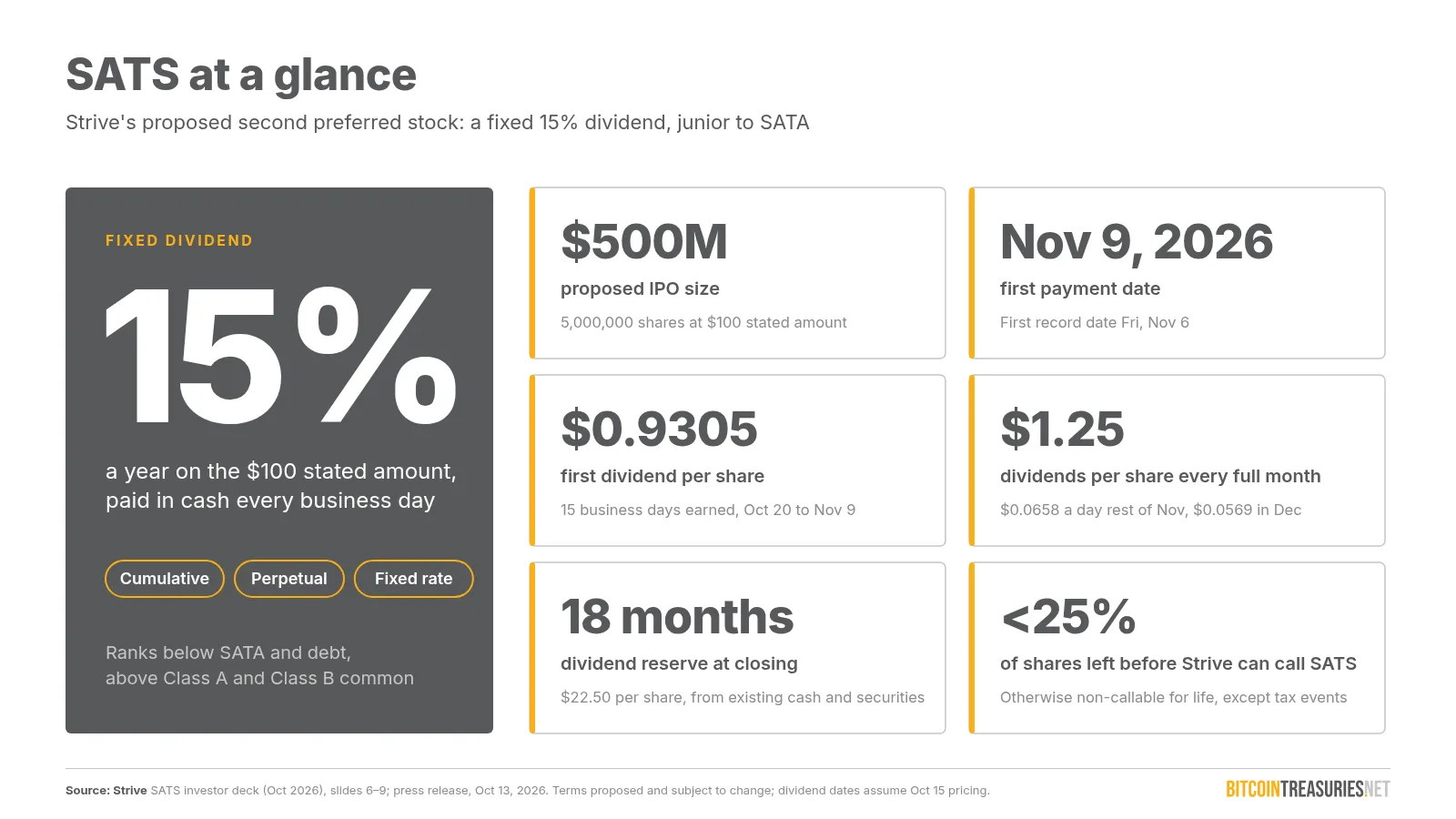
Strive (ASST) is planning to sell another perpetual preferred stock called SATS, which would pay a fixed 15% annual dividend, paid out every business day. The company announced a proposed initial public offering of 5 million shares on October 13 at $100 stated value per share, or about $500 million total, and expects SATS to list on Nasdaq.
Proceeds may be used for general corporate purposes, including buying bitcoin, working capital and repurchases of Class A common stock or SATA, which is Strive's existing preferred.
Chairman and CEO Matt Cole said: "We believe a second pref in our capital structure materially improves the potential total returns for our common equity shareholders over the course of the next several years."
The terms
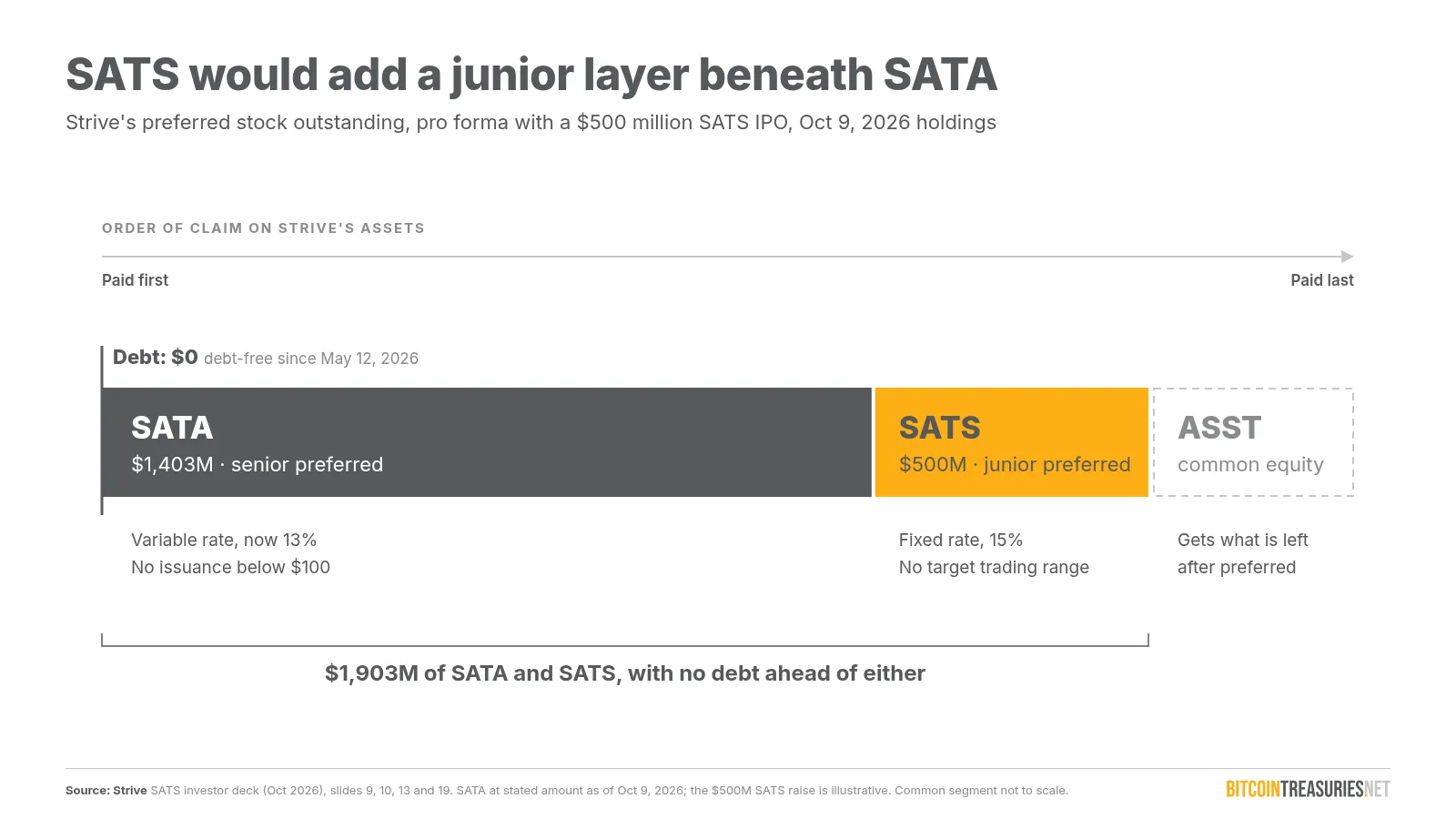
SATS is a cumulative, fixed rate perpetual preferred stock. It ranks below SATA and any debt but above common stock of Strive, both Class A and Class B. It does not have common stock voting rights.
The dividend is 15% yearly on $100 stated amount, and is paid in cash every business day when declared by the board. Any unpaid dividends accumulate and Strive cannot pay dividends on or repurchase junior securities including common stock if SATS dividends are overdue, except for usual exceptions.
The liquidation preference begins at $100 and adjusts to the highest of $100, the last sale price from the day before on days when Strive has sold SATS in the past 10 trading days, and the average price for the last 10 trading days.
SATS has a non-callable status for life with two exceptions: when there is a tax event or less than 25% of issued shares remain outstanding. In either case, the redemption price is the liquidation preference plus accrued dividends. If certain business combinations happen, shareholders can demand Strive to buy back shares at the $100 stated amount plus accrued dividends.
The first dividend
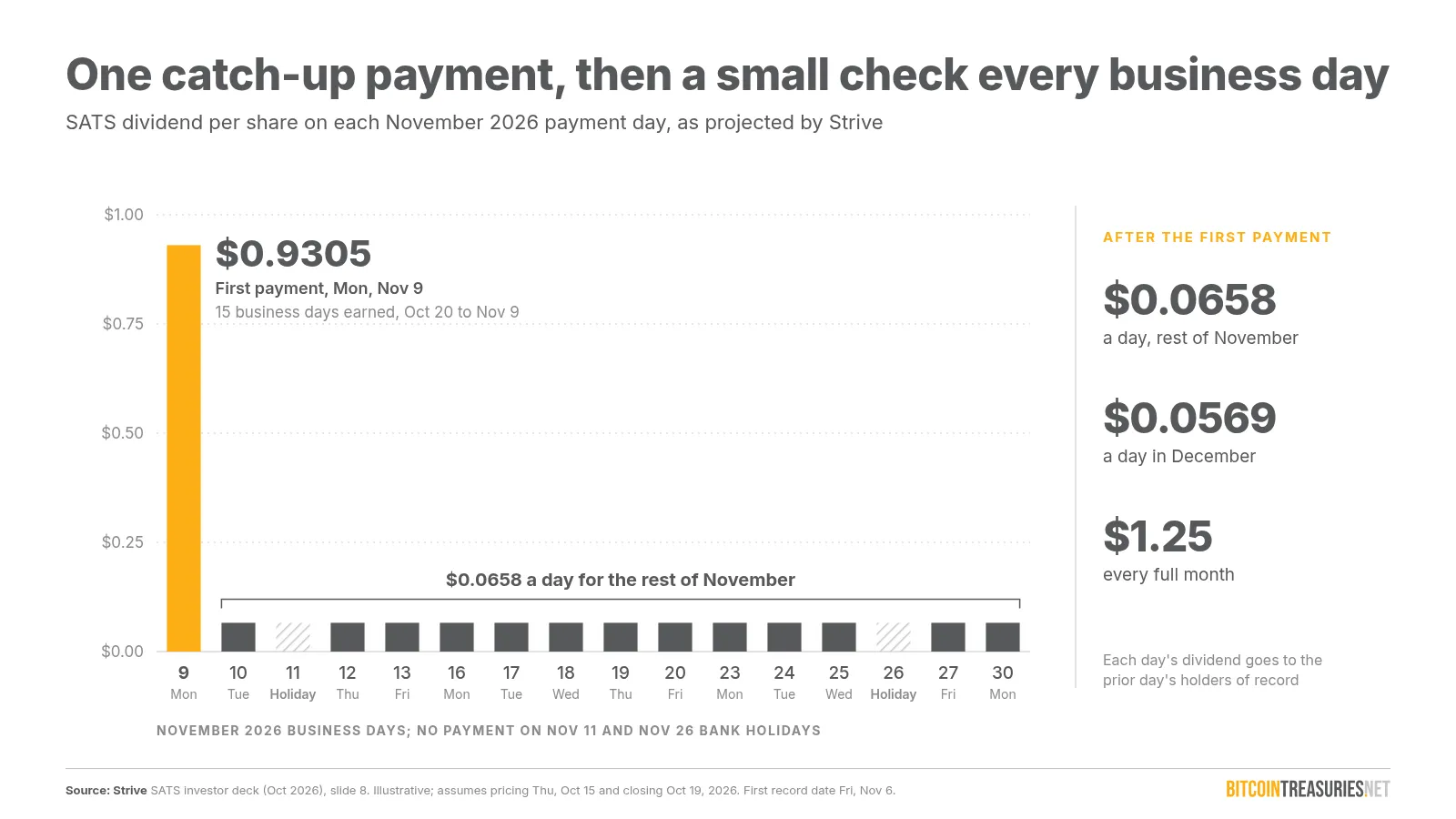
The first record date is Friday, November 6, and the first payment is scheduled for Monday, November 9. Assuming pricing on October 15 and closing on October 19, Strive anticipates the first payment to be $0.9305 per share, covering 15 business days beginning on October 20 through November 9.
Afterward, dividends are paid every business day to the previous day's shareholders of record: $0.0658 a day for the rest of November and $0.0569 a day in December. Amounts vary with number of business days but every full month totals $1.25.
At closing, Strive will retain a dividend reserve of the first 18 months of SATS dividends at $22.50 per share using existing cash and securities.
Where SATS sits
Since May 12, 2026, Strive has had no debt, and none of its bitcoin is pledged. SATA has $1.40 billion outstanding and is senior preferred and has a variable rate now at 13%. SATS would add another $500 million beneath it.
SATA aims to trade near $100 and Strive will not sell it below that price. Cole indicated that this rule was put into Strive's documentation on October 13. He said: "Before it used to be company guidance, it's now a strict policy for SATA."
There is no target trading range for SATS. Strive may set up an ATM program after the IPO and sell more SATS opportunistically.
Cole said that some income investors were uneasy because they were worried that "the interest rate because it's variable might go down and potentially down materially." Institutions wanted a security that could rise in price. "Our most common request that we got was actually something that had more volatility," Cole said. The company argued that making SATS junior, fixed rate and without a trading range should do that.
Why fixed rate, and why now
Strive pointed to the bond market. Of the $42.4 trillion of U.S. Treasuries and corporate dollar bonds from developed markets, 93% or $39.3 trillion is fixed rate debt. Floating rate debt is 3%.
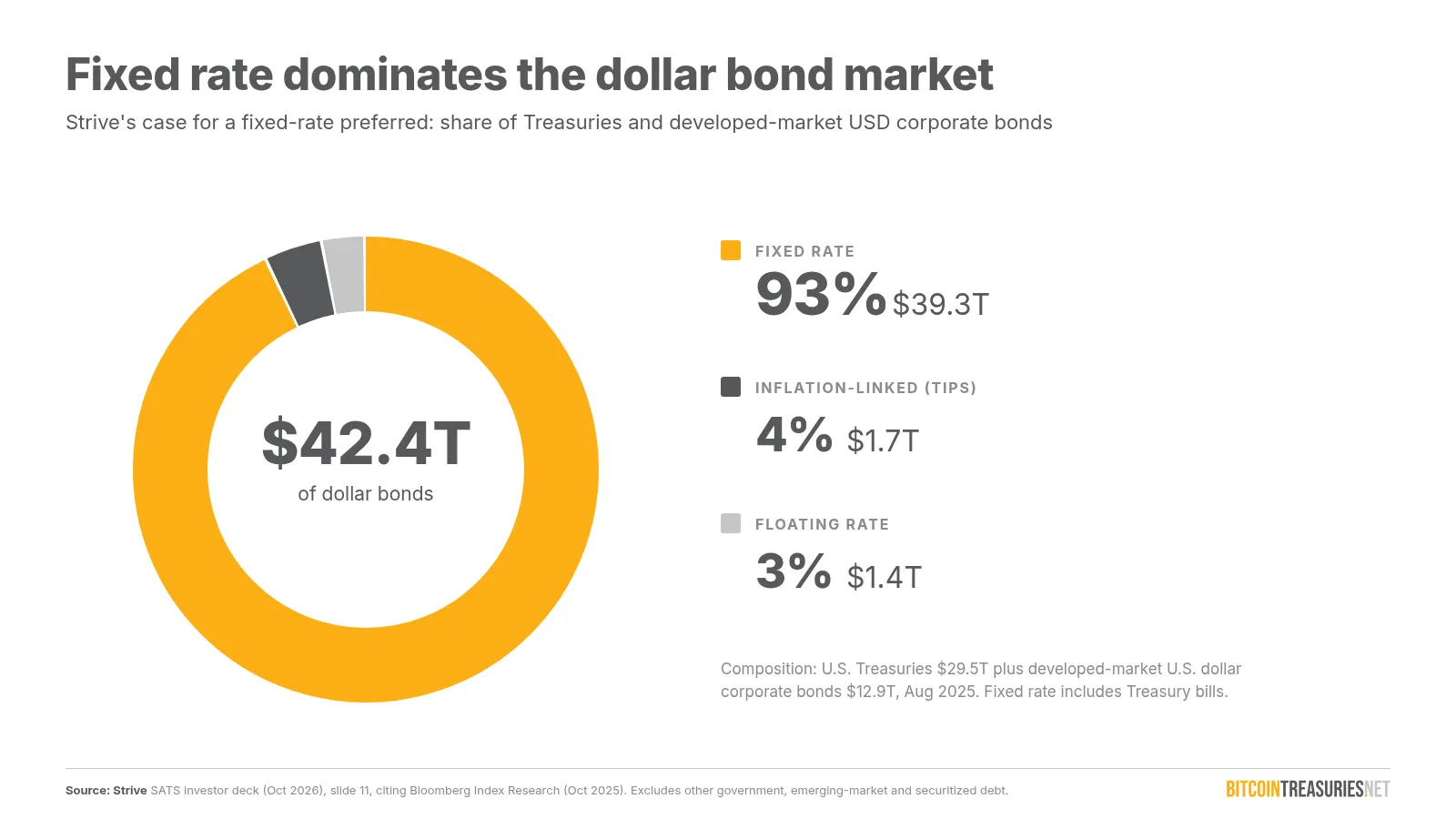
"Our belief is that it's most likely that the biggest idea in digital credit is actually fixed rate," Cole said, and if this is true, "the current success was really just the warm-up for how big this idea could be into the future."
The second reason is access. Since its November 2025 IPO, SATA has traded at $100 or above on 24% of days, and Strategy's STRC on 16% of days since its July 2025 IPO. Both companies plan to sell only at $100 or more and that means "about one in four days or less, we have the ability to issue digital credit," Cole notes.
Timing is based on Strive's amplification ratio. This ratio is the sum of preferred equity and debt divided by the value of its bitcoin. After warrant exercises since September 11, about $306 million of new common equity has been brought in and the ratio has gone down. On October 9, the ratio was at 52%. Strive thinks that it would have been 59% if no exercises had taken place.
On October 5, Strive said that it aims to have amplification over 60% when bitcoin is under $100,000 and to keep that level. "With the expiry of the warrants we felt like now was the perfect opportunity to launch a second preferred equity in our capital structure," Cole said. Strive's target after SATS launch is 60% to 70%.
Coverage
Strive claims SATS benefits SATA holders, since it increases assets without adding anything ahead of them. At $82,500 bitcoin on October 9 holdings, Strive has $2.18 of assets (bitcoin, cash and STRC) for every $1 of SATA. With $500 million worth of SATS, this rises to $2.54. SATS and SATA together have 1.87 times coverage.
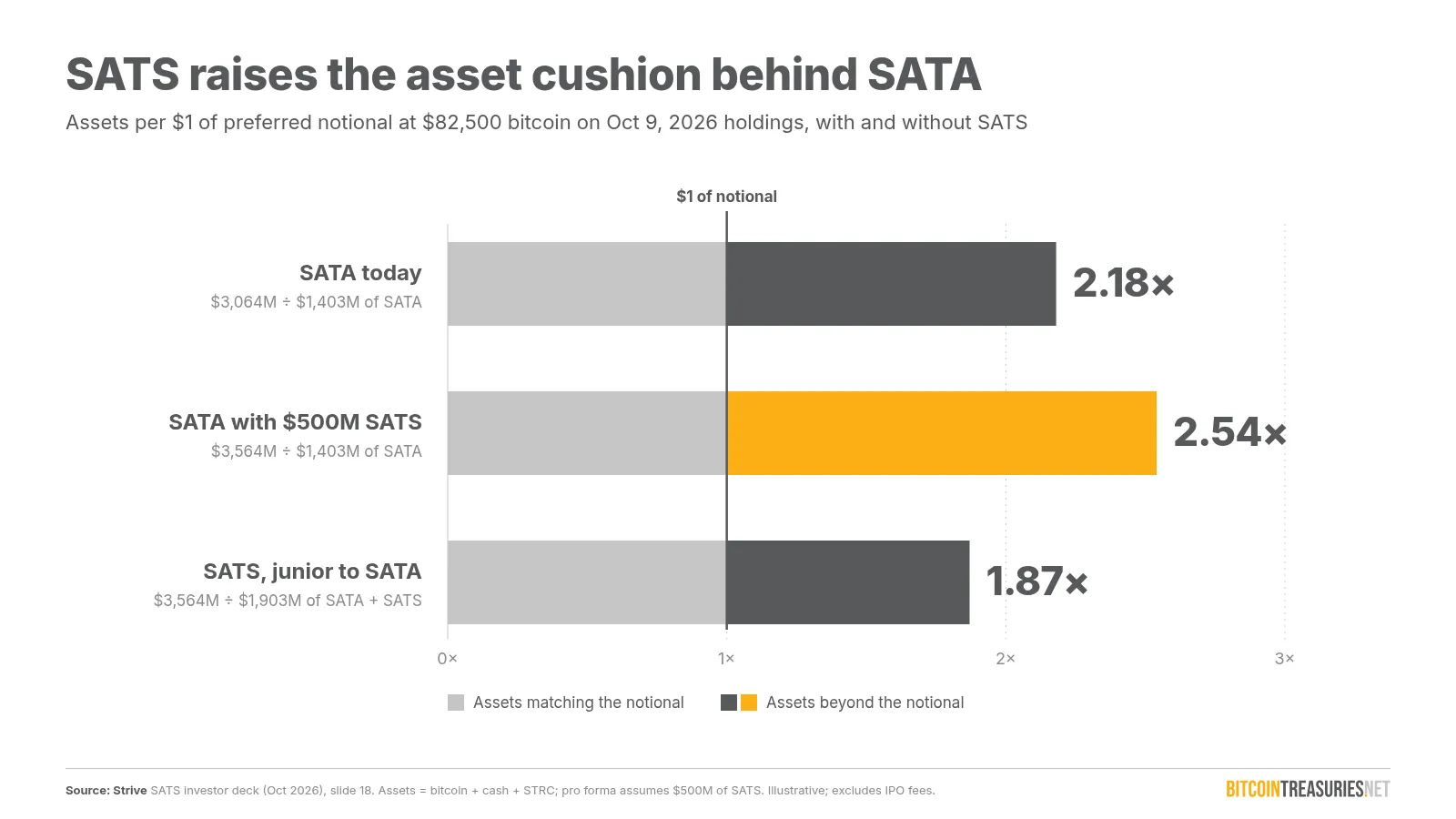
Ben Werkman, Chief Investment Officer, put it in bitcoin prices. Today, assets would fall to SATA's notional if bitcoin dropped 61% to $31,800. With SATS, this drops to $24,800, a 70% drop. For SATA and SATS combined, the level is $38,200, a 54% drop. "This makes SATA very resilient from Bitcoin's volatility," Werkman said.
Pro forma, Strive would have $3.56 billion in assets compared to $1.90 billion in SATA and SATS, and would pay out $257 million a year in dividends. Of $473 million in cash and STRC, $386 million is in dividend reserve or 378 business days. Adding up all assets, coverage is 3,490 business days, about 13.8 years.
At bitcoin's 200-week average of $66,000, Strive says that with no new capital, yield or recovery, assets still cover 2,884 business days, about 11 years. Meanwhile, at $82,500 per bitcoin, the bitcoin alone would suffice for 12 years of dividends.
Werkman stated that the 18-month reserve, raised from twelve months during the bear market in March, was deliberate. "This number was not an accident," Werkman said. "We wanted to align our reserves to meet what we saw in historic bear markets. And that's why we landed on 18 months."
Holdings growth
Strive possessed 5,886 BTC at the end of September 2025 and 32,773 BTC on October 9, 2026. Satoshis per fully diluted share rose by 70% this year, from 17,037 to 28,973.
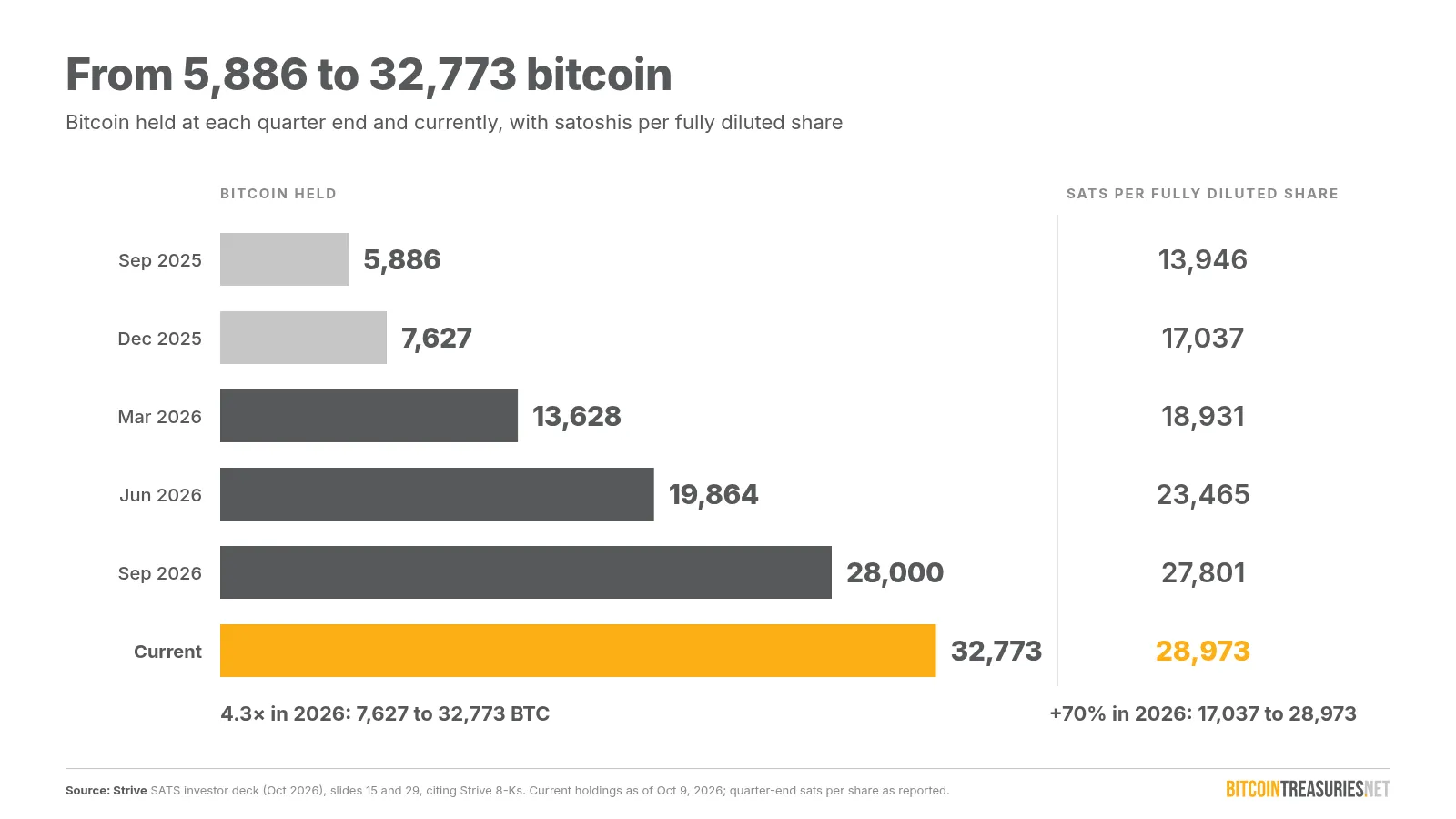
"We are now the fifth largest publicly traded holder of Bitcoin in the world," Jeff Walton, Chief Risk Officer, said.
From September 30, 2025 to October 9, 2026, treasury assets increased by 3.9 times from $0.78 billion to $3.07 billion while bitcoin decreased by 28%; SATA outstanding grew 7 times from $200 million at IPO.
The bitcoin thesis
Strive's planning assumption, not a forecast, is 50% annual growth of bitcoin. That puts a price of about $458,000 at the end of 2030 from $82,500 on October 9. Assuming a low of 30%, that brings the price down to about $250,000 and if it grows at the high of 70%, then the price goes up to about $777,000. For bitcoin to grow at SATS's 15%, it needs to reach around $149,000.
The 50% is rounded down from 65%; this is the historical return after bitcoin visited its 200-week average in 2020 and 2022, adjusted for today's price.
"We do not view this CAGR assumption as a normal distribution," Cole said. "We would actually view it skewed to the upside right now because of a lot of the macro factors that we're seeing come in."
Cole points out that the dollar is the key factor. He cited a 10 year Treasury yield of 5.24%, which is higher than 5.20%, the level where Strive's research team sees Treasury market stress starting. Cole framed it as a choice: policymakers can let long yields rise or act to bring them down, and if they act, the dollar takes the hit. Strive leans toward the second path, with a base case seeing dollar index moving towards 80. "In our view you should be prepared as an investor for a lower dollar over the next several years," Cole said.
Amplification and risk
Walton talked about the structure as slicing bitcoin's trend into layers and said preferreds get income and common stock gets what's left. Since SATA's IPO, annualized volatility has been 103% for ASST, 45% for bitcoin, and 25% for SATA.
"The simple math is 50 minus 15 equals 35%," Walton said. He described the gap between the base case return for bitcoin and cost of SATS. Strive's table shows that at a cost of capital of 15% and bitcoin growth of 50% for four years, moving from 50% amplification to 60% increases the balance sheet multiple from 12 times to 17 times and 70% increases it to 29 times.
"We believe that with the launch of SATS, we'll be able to have the highest amplification among Bitcoin treasury companies in the entire ecosystem by a wide margin," Walton said. Also Walton noted that holding it there in a rising market "will also be one of our biggest challenges."
Strive also showed its downside math. The deck uses 70% as an illustrative maximum. By our math from the deck's figures, that would take about $1.07 billion of SATS, more than double the IPO; the $500 million IPO alone would put amplification near 62%. If sales of SATS took amplification to 70% at $82,500, a drop to the 200-week average of $66,000 would lift it to 88%. At $58,000 it would hit 100%. Bitcoin closed below its 200-week average on 8% of days since 2015, and more than 12.5% below it on 3.5% of days. The lowest close was 35% below in November 2022.
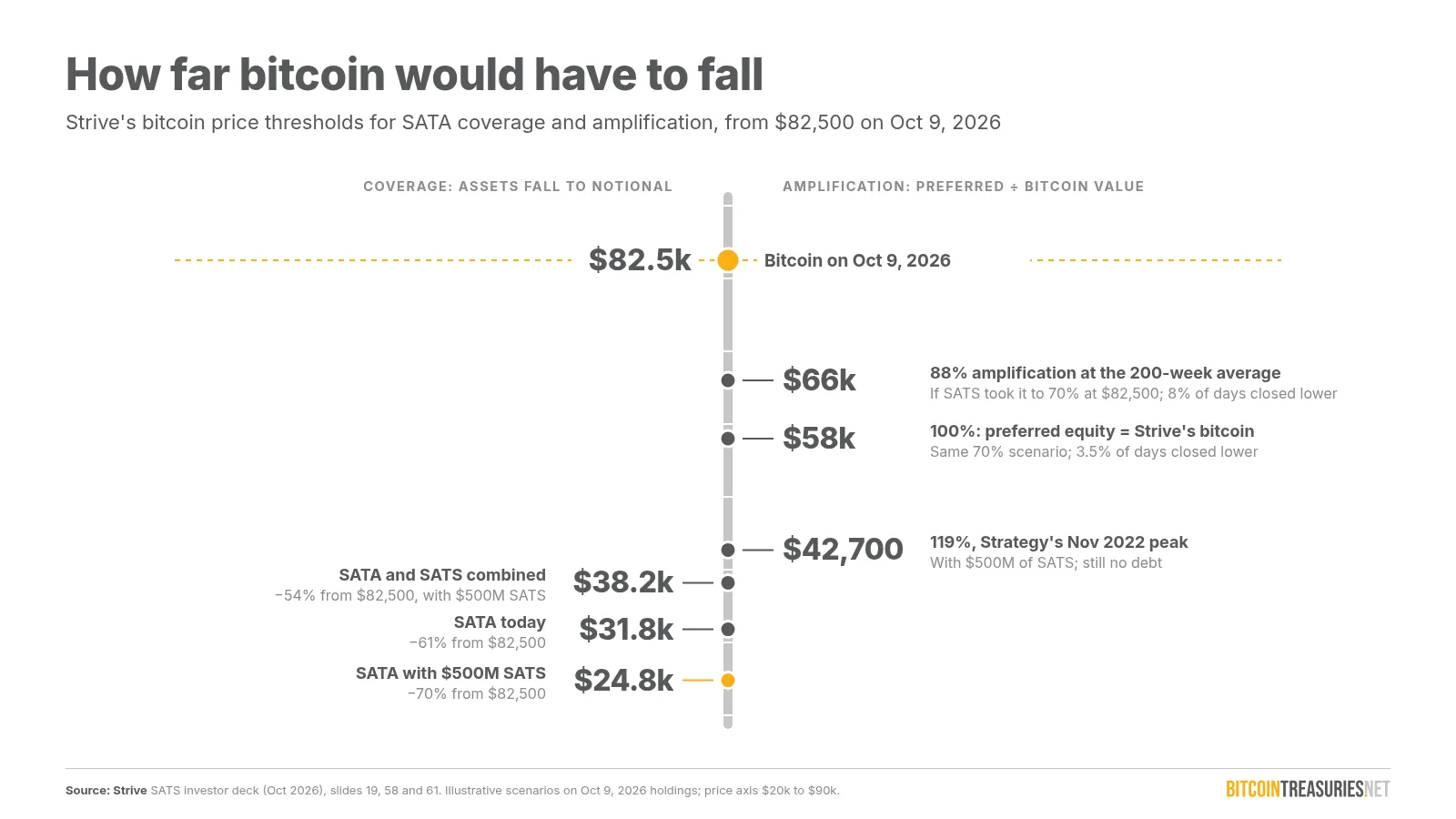
"There is not an amplification ratio that triggers insolvency and we've built our capital structure purposefully this way," Walton said. "We have zero debt on our balance sheet."
Strive compared itself to Strategy in November 2022. At that time Strategy had debt amounting to 119% of the value of its bitcoin and about 35% of its coins pledged. With $500 million worth of SATS, Strive would reach 119% with bitcoin at $42,700, which would be the lowest close relative to bitcoin's 200-week average in history. Strive would still have no debt, no maturity dates and no pledged bitcoin.
Want more bitcoin treasury coverage in your search results? Add Bitcoin Treasuries as a preferred source on Google.