



Strategy raised STRC's dividend, sold Bitcoin, issued common stock and repurchased roughly $2.25 billion of its preferred shares. The recovery shows how much work went into defending a $100 price target and what remains to be proved.
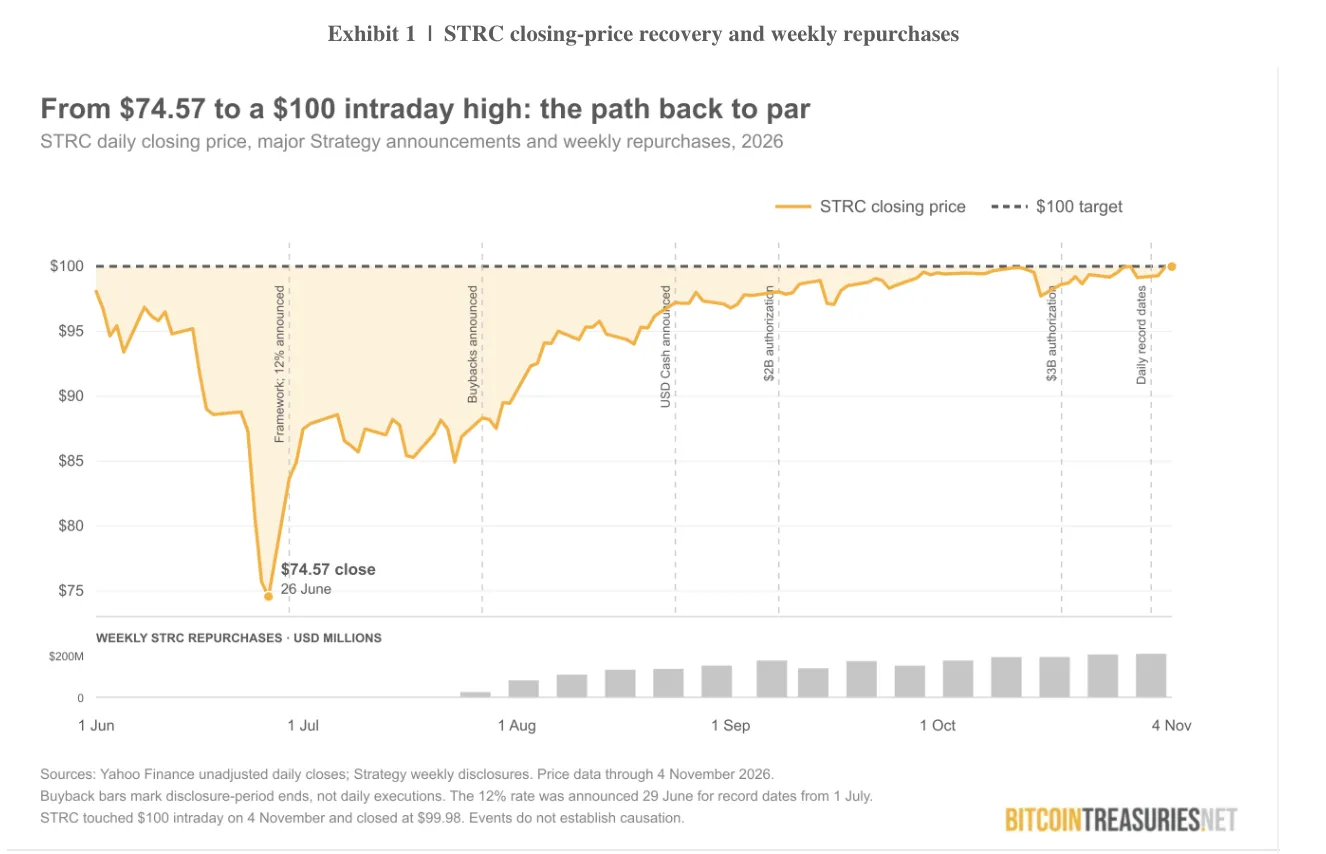
On November 4, 2026, STRC touched $100. It was the first time Strategy's Variable Rate Series A Perpetual Stretch Preferred Stock had reached that level since May. The stock closed at $99.98, just two cents short of its $100 stated amount.
Four months earlier, on June 26, STRC had closed at $74.57 after touching $71.25 intraday. At that closing price, the security offered an effective annual cash yield of 15.42%, even though its declared dividend rate was 11.5%. Investors were demanding considerably more income than the company had designed the instrument to provide at $100.
The recovery was not driven by one announcement. Strategy raised the dividend rate, adopted a liquidity and buyback framework, monetized Bitcoin, issued MSTR common shares, created a second cash pool and spent approximately $2.25 billion repurchasing STRC. It also changed how often shareholders receive distributions, first moving from monthly to semi-monthly payments and then to daily record dates. Bitcoin's rebound helped as well.
Those choices mattered because STRC serves two functions. It is an income security for investors, but it is also a potential source of capital for Strategy. When STRC trades around its $100 stated amount, the company can issue additional shares through its at-the-market program and invest the proceeds, including in Bitcoin. At a deep discount, that issuance channel becomes much less attractive. Strategy's stated policy was to avoid issuing STRC below $100.
The story of STRC's return is therefore also the story of Strategy rebuilding a funding instrument.
The framework that changed the market's expectations
The Digital Credit Capital Framework announced June 29 gave management several tools that had previously been less clearly defined: a board-approved USD Reserve policy, a new dividend-rate policy, authorization to repurchase preferred stock and MSTR common shares, and a program for monetizing Bitcoin.
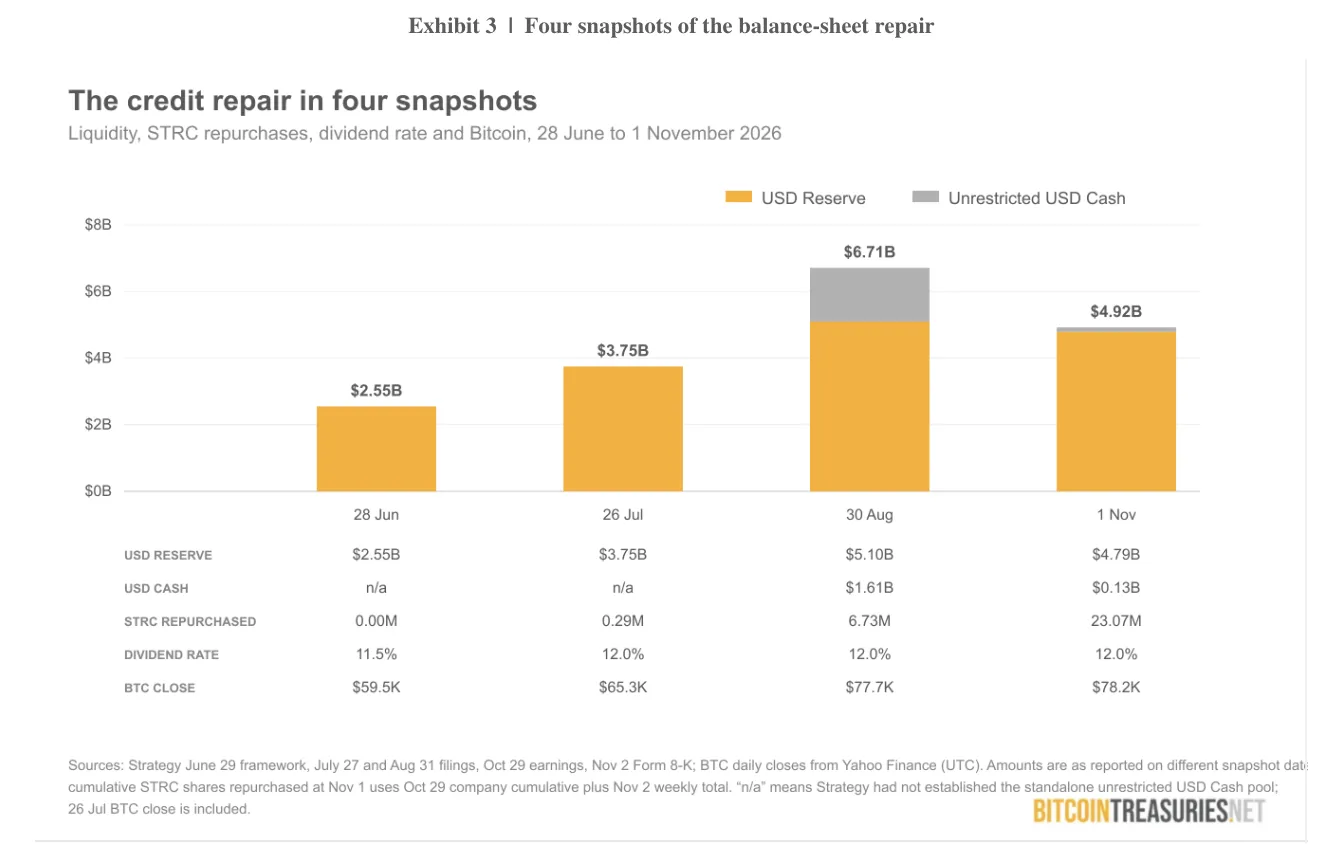
The USD Reserve was approximately $2.55 billion on June 28. Strategy estimated that this covered 17.4 months of preferred dividends and interest expense, and adopted a policy to keep at least 12 months of coverage unless the board approved a reduction. The reserve was designated for preferred dividends and debt interest; using it for STRC buybacks would require separate board authorization.
The company also authorized up to $1 billion of digital credit repurchases, initially prioritizing STRC, and another $1 billion of MSTR common-stock repurchases. Its BTC Monetization Program permitted Bitcoin sales to build or replenish liquidity, pay dividends and interest, or finance eligible repurchases.
The framework changed the way investors could think about STRC's downside. Instead of relying solely on a variable dividend and the market to correct a discount, Strategy now had the authority to buy its own preferred shares when management judged those purchases attractive. The company did not promise a price floor or unlimited buybacks.
STRC closed at $83.67 on June 29, up 12.2% from the prior session's $74.57 close. No company buybacks had yet been disclosed. The timing is consistent with the framework improving confidence, although it cannot establish that the announcement caused the entire move.
The buyback moved from policy to execution
Strategy made its first disclosed STRC repurchases during July 20–26, buying 288,930 shares for about $25 million at an average price of $86.52. Retiring $100 of stated amount for $86.52 reduced future dividend requirements at a discount. It also put the company on the buy side of the market for its own preferred security.
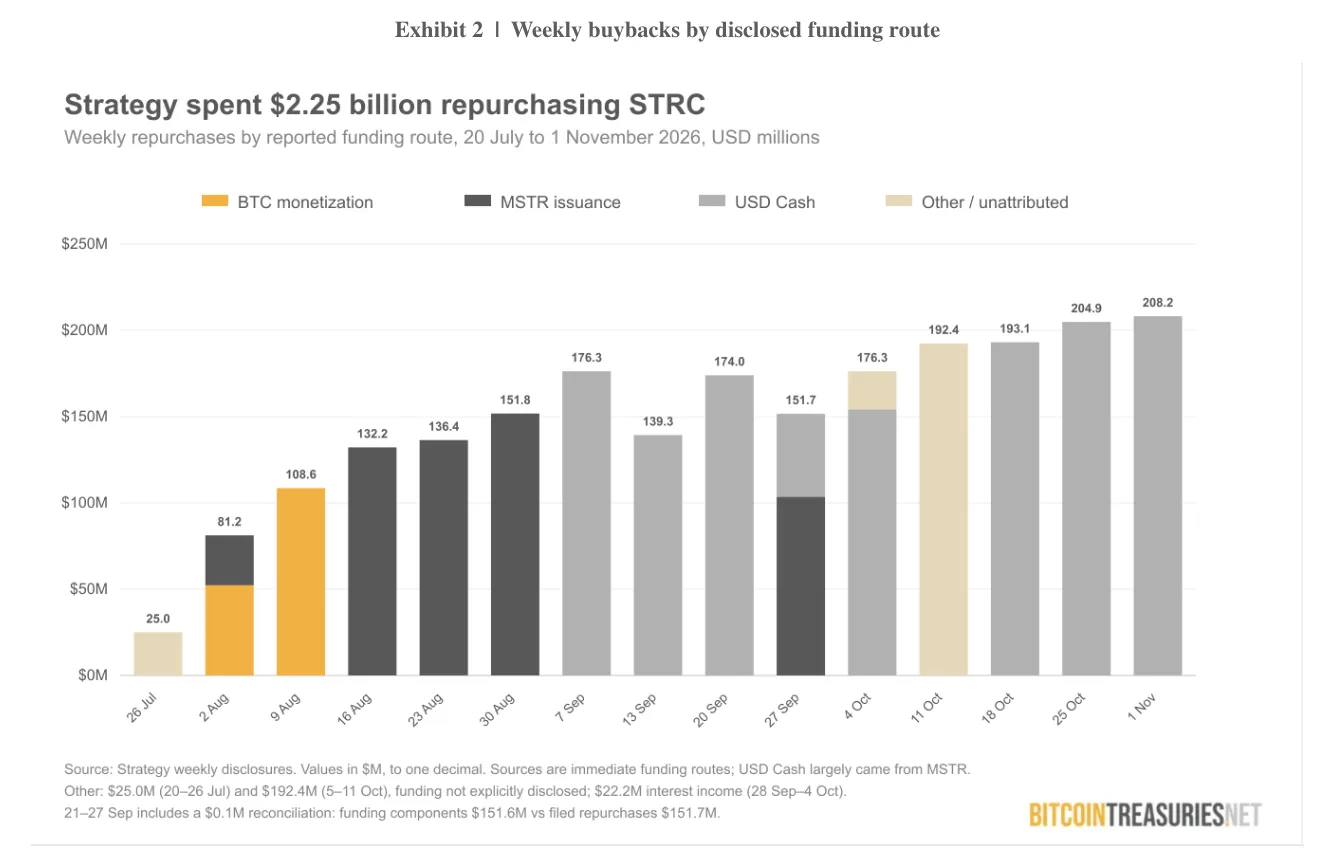
The next phase was more unusual. During July 27–August 2, Strategy sold 1,638 BTC for $104.7 million. It allocated $52.3 million of the proceeds to STRC repurchases and $52.4 million to preferred dividends. Another $28.9 million from MSTR common-stock issuance went toward buying back STRC. Repurchases for that week totaled $81.2 million.
During August 3–9, Strategy sold another 1,690 BTC for $108.6 million and used those proceeds to buy back 1,152,020 STRC shares. The combined Bitcoin monetization in those two weeks was approximately $213.3 million, though only $160.9 million of those proceeds was directly allocated to STRC repurchases; the balance funded preferred dividends.
Strategy then leaned more heavily on common equity. MSTR issuance funded $132.2 million of STRC repurchases in the week ending August 16 and $136.4 million the following week. In the week ending August 30, Strategy raised $602.8 million through MSTR ATM sales and directed $151.8 million toward STRC buybacks. Some of those MSTR proceeds also purchased Bitcoin, paid preferred dividends and added to unrestricted cash.
This is where the trade-off becomes visible. Selling Bitcoin reduces the treasury's future exposure if BTC appreciates. Issuing MSTR can dilute common shareholders. But retiring preferred shares reduces future cash distributions and, when done below $100, removes $100 of stated amount for less than $100 of expenditure. Strategy was accepting costs in one part of its capital structure to improve another.
The repurchase program quickly outgrew its original authorization. Strategy lifted the digital credit buyback ceiling to $2 billion in September, then to $3 billion on October 19. The $1 billion MSTR common repurchase authorization remained unused as of the latest disclosures reviewed.
By September 30, Strategy had reported 13,930,173 STRC shares repurchased for about $1.34 billion. From October 1 through October 25, its Form 10-Q reported another 7,050,335 shares for $700.9 million. In the week ending November 1, it bought 2,092,035 shares for $208.2 million. Taken together, the company's cumulative disclosures put spending at approximately $2.25 billion, with roughly 23.07 million shares bought back. Figures are rounded, and interim weekly filings can differ in settlement cutoffs from quarterly cumulative reporting.
At $100 of stated amount per share, 23.07 million repurchased shares represent approximately $2.31 billion of stated amount. At a continuing 12% annual rate, their cancellation implies a reduction in annual dividend requirements of about $277 million, assuming all repurchases are cancelled and the rate remains unchanged. The Form 10-Q confirms that repurchased shares through September 30 were cancelled; subsequent purchases may not yet have completed that process. The saving is recurring, not a one-time trading profit.
Strategy created a cash account it could actually use
Repurchases and dividend liquidity were deliberately kept separate. The distinction became clearer in August when Strategy established USD Cash, an unrestricted liquidity pool alongside its board-designated USD Reserve.
The USD Reserve could pay preferred dividends and debt interest under the company's policy. USD Cash could fund broader needs, including Bitcoin purchases and share repurchases. Strategy said USD Cash was funded primarily through MSTR issuance.
By August 30, the USD Reserve had reached $5.10 billion and unrestricted USD Cash stood at $1.61 billion. From September onward, many weekly STRC repurchases came from that second pool. For the week ending September 7, Strategy spent $176.3 million of USD Cash on STRC. It spent another $139.3 million during September 8–13 and $174 million during September 14–20. During September 21–27, $103.5 million of MSTR issuance proceeds and $48.1 million of USD Cash funded the $151.7 million repurchase total.
The pattern continued through October. Strategy was often funding STRC buybacks from unrestricted cash while keeping the dividend reserve subject to its separate coverage policy. As of November 1, the company reported a $4.79 billion USD Reserve and $132.7 million of unrestricted USD Cash. It also had $748.6 million of remaining preferred repurchase authorization.
The mix of funding matters more than the color of any single bar in a chart. Some buybacks were directly financed by BTC sales; some by new MSTR issuance; others used USD Cash that itself had largely been accumulated through earlier common-stock issuance. The source of cash at the point of purchase and the economic origin of that cash are different questions.
Dividends became more frequent, not more generous
Strategy also changed STRC's payment mechanics twice.
Shareholders approved semi-monthly dividend record dates on June 8, with the first semi-monthly payment taking place July 15. That replaced the original monthly schedule with record dates on the 15th and final day of each month.
The second change followed an October 28 shareholder approval. Beginning November 1, STRC moved to daily dividend record dates, including weekends and holidays. Declared dividends are generally paid on the following business day, so a weekend or holiday can result in grouped payments rather than separate bank deposits every calendar day.
Strategy declared an aggregate November distribution of $1 per STRC share, paid in daily portions of roughly three or four cents. The annualized dividend rate remained 12%.
More frequent distributions change the cash-flow experience for holders without increasing the stated annual yield. They also reduce the size of individual ex-dividend price adjustments associated with larger monthly or semi-monthly payments. Those are plausible reasons the change could support trading closer to $100, although the available evidence does not isolate its price impact from buybacks or broader market movements.
Bitcoin provided a tailwind of its own
STRC's recovery coincided with a substantial rebound in Bitcoin. BTC traded into the $58,000 range in late June and closed November 4 around $80,405. Its June 26 closing price was about $60,016, making the close-to-close increase approximately 34%; using the late-June intraday lows produces a larger gain approaching 38%.
That rise improved the market value of Strategy's treasury. The company held 849,327 BTC as of November 1. For investors weighing claims on the same corporate balance sheet, a larger Bitcoin asset cushion can make preferred distributions appear better supported and help narrow the yield demanded for credit risk.
But Bitcoin alone does not explain the full sequence. STRC rose 12.2% on June 29, the day the new capital framework was announced and before the first disclosed buyback. Management then spent billions repurchasing shares, increased liquidity coverage and redesigned payments while Bitcoin's price also recovered. A chart showing both prices cannot tell us how much of the outcome belongs to each intervention.
What the $100 touch proves and what it doesn't
Strategy's stated objective has been sustained trading around $99–$100, not one intraday print. The November 4 high reached $100, but the closing price was still $99.98. That was a major improvement from $74.57 in June: STRC's closing price had risen approximately 34.1% from its trough.
The company had spent roughly $2.25 billion getting to that point. It had also accepted a 12% annual dividend rate, built a substantial reserve, created unrestricted liquidity and repurchased enough STRC to imply roughly $277 million less in annual dividends at the current rate, subject to cancellation. Those measures should not be mistaken for costless price support. They consumed capital, depended in part on common issuance and reduced Strategy's Bitcoin holdings during part of the recovery.
The next phase will test whether this repaired market can stand on its own. A sustained STRC price at or near $100 could make issuance attractive again, reopening a channel for Strategy to finance Bitcoin purchases. But each additional $1 billion of STRC sold at $100 would also add approximately $120 million in annual preferred dividends at a 12% rate, assuming the rate is maintained and dividends are declared.
The important question is whether Strategy can move back from repurchasing digital credit to issuing it without having to spend comparable sums supporting the market. November 4 showed that the discount could be closed. It did not yet show that the mechanism is self-sustaining.
Want more bitcoin treasury coverage in your search results? Add Bitcoin Treasuries as a preferred source on Google.